
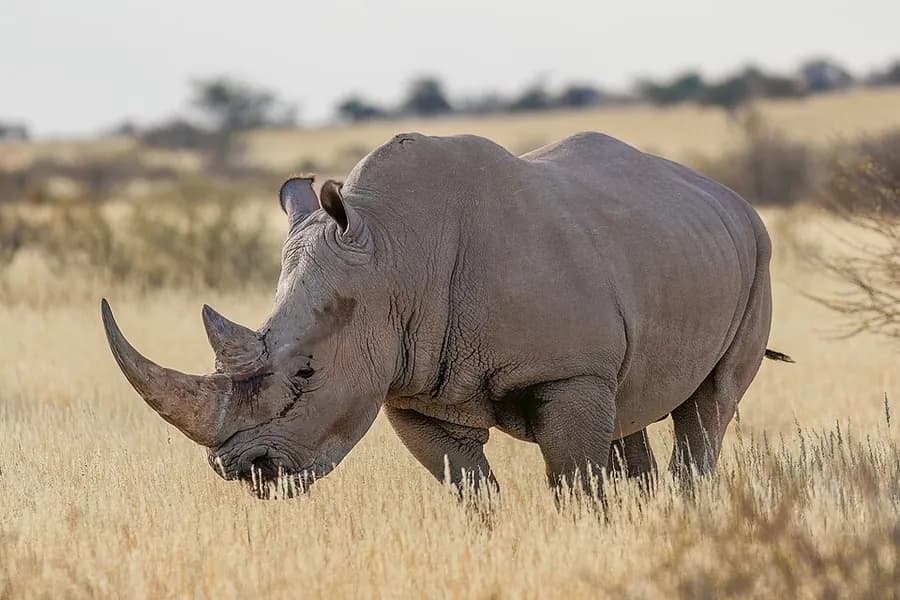
🦏White rhinoceros
The white rhinoceros, also known as the white rhino or square-lipped rhinoceros, is the largest extant species of rhinoceros and the most social of all rhino species, characterized by its wide mouth adapted for grazing. The species includes two subspecies with dramatically different conservation outlooks: the southern white rhinoceros, with an estimated 17,464 individuals in the wild as of the end of 2023, and the northern white rhinoceros. The northern subspecies is critically endangered and on the brink of extinction; its last known male, Sudan, died in March 2018, leaving behind only two females. Both subspecies have faced significant threats, primarily from poaching for their horns and habitat loss, which contribute to the species' overall conservation status of Near Threatened. White rhinoceros can run up to 40 mph (64 km/h) for very short bursts. They can maintain speeds of around 30–31 mph (48–50 km/h) for a good amount of time, and they have good stamina.
Text: Wikipedia, CC BY-SA 4.0.
IUCN Red List assessment, 2020.
- Body mass
- 2,230 kg
- Body length
- 3.39 m
- Shoulder height
- 1.78 m
- Top speed
- 24 km/h
- Bite force
- not recorded
- Maximum lifespan
- 50 years
Everything we know about the White rhinoceros
Typical adult figures. Where a value is an estimate rather than a measurement, it says so.
Body mass2,230 kgCOMBINEOther figures ↓Hide ↑
Source: COMBINE · v1 (Soria et al. 2021) · CC BY 4.0
Figures vary
- 2,175 kgAnAgeAnAge build 15, 2023-07-03 (HAGR)data quality: high
Body length3.39 mCOMBINEDetails ↓Hide ↑
Source: COMBINE · v1 (Soria et al. 2021) · CC BY 4.0
Shoulder height1.78 m1.71–1.85 m · typical rangeDetails ↓Hide ↑
n=4; sex not stated. Value is the midpoint.
Source: Groves 1972, Mammalian Species 8, p.1 · see citation
Top speed24 km/hDetails ↓Hide ↑
Sprint over a short distance, not a sustained pace. Published figures vary: 24.36 and 25.0 against Christiansen's 39.99 km/h. No white rhino has ever been properly timed.
Source: Bejan & Marden 2006, J Exp Biol 209:238, Garland 1983, J Zool 199:157 and Christiansen 2002, Zool J Linn Soc 136:685; compiled in Hirt et al. 2017, Nat Ecol Evol 1:1116, Supplementary Data · see citation
Maximum lifespan50 yearsCOMBINEOther figures ↓Hide ↑
Source: COMBINE · v1 (Soria et al. 2021) · CC BY 4.0
Figures vary
- 45 yearsAnAgeAnAge build 15, 2023-07-03 (HAGR)data quality: high
Generation length19 yearsCOMBINEDetails ↓Hide ↑
Source: COMBINE · v1 (Soria et al. 2021) · CC BY 4.0
Age at maturity7.5 yearsCOMBINEDetails ↓Hide ↑
Source: COMBINE · v1 (Soria et al. 2021) · CC BY 4.0
Gestation1.4 yearsCOMBINEOther figures ↓Hide ↑
Source: COMBINE · v1 (Soria et al. 2021) · CC BY 4.0
Figures vary
- 1.4 yearsAnAgeAnAge build 15, 2023-07-03 (HAGR)data quality: high
Litter size1COMBINEOther figures ↓Hide ↑
Source: COMBINE · v1 (Soria et al. 2021) · CC BY 4.0
Figures vary
- 1AnAgeAnAge build 15, 2023-07-03 (HAGR)data quality: high
Trophic levelHerbivoreCOMBINEDetails ↓Hide ↑
Source: COMBINE · v1 (Soria et al. 2021) · CC BY 4.0
Activity cycleCrepuscular / mixedCOMBINEDetails ↓Hide ↑
Source: COMBINE · v1 (Soria et al. 2021) · CC BY 4.0
Home range19 km²COMBINEDetails ↓Hide ↑
Source: COMBINE · v1 (Soria et al. 2021) · CC BY 4.0
Population density0.78 per km²COMBINEDetails ↓Hide ↑
Source: COMBINE · v1 (Soria et al. 2021) · CC BY 4.0
Volume l2,230 LaverageDetails ↓Hide ↑
Body mass at ~1.0 kg/L, the density of vertebrate tissue.
average = a mean across sexes or species in a group.
Not recorded for White rhinoceros yet: bite force.
Family tree
- kingdomAnimalia
- ›phylumChordata
- ›classMammalia
- ›orderPerissodactyla
- ›familyRhinocerotidae
- ›genusCeratotherium
- ›speciesCeratotherium simum
- classMammals · Mammalia
- orderOdd-toed hoofed animals · Perissodactyla
- familyRhinocerotidae
- genusCeratotherium
All 13 branches ↓Fewer branches ↑
- kingdomMetazoa
- phylumChordata
- subphylumCraniata
- subphylumVertebrata
- superclassGnathostomata
- superclassSarcopterygii
- superclassTetrapoda
- classMammals · Mammalia
- subclassTheria
- superorderLaurasiatheria
- orderOdd-toed hoofed animals · Perissodactyla
- familyRhinocerotidae
- genusCeratotherium
More about the White rhinoceros


Animals caught on camera
Real footage of the animals on this site — hunting, fighting, and getting on with it.
Compare the White rhinoceros
Pick a tool — the White rhinoceros is already selected.
Compare every stat with any other animal.
Stand them on the same floor and see who's bigger.
Does it punch above its weight? Its stats against what body size predicts.
See where it sits in the tree of life.