
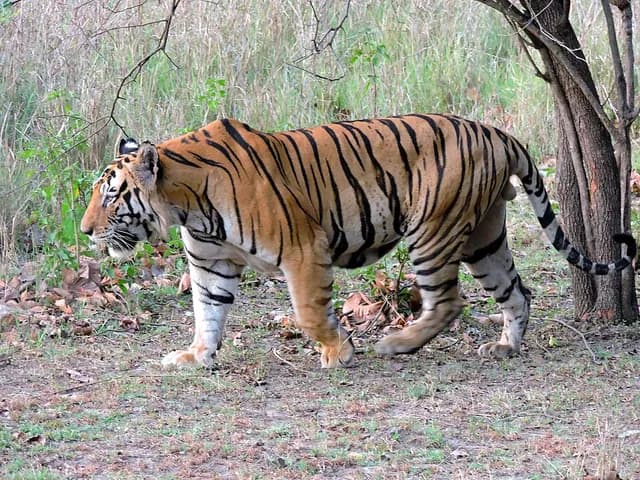
🐅Tiger
The tiger is a large cat and a member of the genus Panthera native to Asia. It has a powerful, muscular body with a large head and paws, a long tail and orange fur that fades to white in parts, with black, mostly vertical stripes. It is traditionally classified into nine subspecies, though some recognise only two subspecies, the mainland Asian tiger and the Sunda Islands tiger.
Text: Wikipedia, CC BY-SA 4.0.
IUCN Red List assessment, 2022.
- Body mass
- 129 kg
- Body length
- 2.31 m
- Shoulder height
- 0.91 m
- Top speed
- 54 km/h
- Bite force
- 1,525 N
- Maximum lifespan
- 26 years
Everything we know about the Tiger
Typical adult figures. Where a value is an estimate rather than a measurement, it says so.
Body mass129 kgCOMBINEOther figures ↓Hide ↑
Source: COMBINE · v1 (Soria et al. 2021) · CC BY 4.0
By sex
- Male180 kgWikidataQ19939
- Female120 kgWikidataQ19939
Figures vary
- 120 kgAnAgeAnAge build 15, 2023-07-03 (HAGR)data quality: high
Body length2.31 mCOMBINEDetails ↓Hide ↑
Source: COMBINE · v1 (Soria et al. 2021) · CC BY 4.0
Shoulder height0.91 m0.86–0.96 m · typical rangestanding, liveOther figures ↓Hide ↑
Standing withers height of living tigers measured against graduated scales at the Zoological Gardens; 'seldom exceeds 3 ft'. Largest individual measured 0.965 m (Amur male). Pocock explicitly warns that Rowland Ward's pegged 0.99-1.22 m 'is not the standing height of the living animal'.
Source: Pocock 1939, Fauna of British India, Mammalia I, p.206 · see citation
By sex
- Male0.99 mDunbar Brander 1923, Wild Animals in Central India, p.54Bengal / Central India. 'A good average male should measure 39 in.' Shikari field data; measuring protocol not stated.
Figures vary
- 0.95 mHunter 2011, Carnivores of the World, Plate 14Species-wide SH, not sex-split (the book splits HB and weight but not SH). Hunter measures carcasses laid on their side, so this runs high versus a standing animal -- see method.
Top speed54 km/hDetails ↓Hide ↑
Sprint over a short distance, not a sustained pace. Compilations give 54.43 and 55.98 km/h.
Source: Bejan & Marden 2006, J Exp Biol 209:238 and Christiansen 2002, Zool J Linn Soc 136:685; compiled in Hirt et al. 2017, Nat Ecol Evol 1:1116, Supplementary Data · see citation
Bite force1,525 NDetails ↓Hide ↑
Canine bite modelled by the dry-skull method (Thomason 1991) from a prepared skull; static bite at the canines, gape not stated. Not a live measurement. The skull's estimated body mass was 186.9 kg. Estimates span 2.2x with no measured value anywhere: 2105 N (Deutsch et al. 2025, Anat Rec 308:2944) and 3375 N (Rozycka et al. 2024, Animals 14:1367) for the same species.
Source: Wroe, McHenry & Thomason 2005, Proc R Soc B 272:619, Table 1 · see citation
Bite force for its size127Details ↓Hide ↑
Bite force normalised for body mass: the residual of canine bite force regressed on body mass, average across the sample set to 100. Above 100 means the animal bites harder than its size predicts. Do not cross-check against Wikipedia's BFQ table, which silently mixes this paper with Christiansen & Wroe 2007 and cites a popular-science book.
Source: Wroe, McHenry & Thomason 2005, Proc R Soc B 272:619, Table 1 · see citation
Brain mass287 gCOMBINEDetails ↓Hide ↑
Source: COMBINE · v1 (Soria et al. 2021) · CC BY 4.0
Maximum lifespan26 yearsCOMBINEOther figures ↓Hide ↑
Source: COMBINE · v1 (Soria et al. 2021) · CC BY 4.0
Figures vary
- 26 yearsAnAgeAnAge build 15, 2023-07-03 (HAGR)data quality: high
Generation length7.99 yearsCOMBINEDetails ↓Hide ↑
Source: COMBINE · v1 (Soria et al. 2021) · CC BY 4.0
Age at maturity4.2 yearsCOMBINEDetails ↓Hide ↑
Source: COMBINE · v1 (Soria et al. 2021) · CC BY 4.0
Gestation105 daysCOMBINEOther figures ↓Hide ↑
Source: COMBINE · v1 (Soria et al. 2021) · CC BY 4.0
Figures vary
- 105 daysAnAgeAnAge build 15, 2023-07-03 (HAGR)data quality: high
Litter sizeabout 3COMBINEOther figures ↓Hide ↑
Source: COMBINE · v1 (Soria et al. 2021) · CC BY 4.0
Figures vary
- 2.5AnAgeAnAge build 15, 2023-07-03 (HAGR)data quality: high
Trophic levelCarnivoreCOMBINEDetails ↓Hide ↑
Source: COMBINE · v1 (Soria et al. 2021) · CC BY 4.0
Activity cycleCrepuscular / mixedCOMBINEDetails ↓Hide ↑
Source: COMBINE · v1 (Soria et al. 2021) · CC BY 4.0
Home range65 km²COMBINEDetails ↓Hide ↑
Source: COMBINE · v1 (Soria et al. 2021) · CC BY 4.0
Population density0.06 per km²COMBINEDetails ↓Hide ↑
Source: COMBINE · v1 (Soria et al. 2021) · CC BY 4.0
Volume l129 LaverageDetails ↓Hide ↑
Body mass at ~1.0 kg/L, the density of vertebrate tissue.
average = a mean across sexes or species in a group.
Family tree
- kingdomAnimalia
- ›phylumChordata
- ›classMammalia
- ›orderCarnivora
- ›familyFelidae
- ›genusPanthera
- ›speciesPanthera tigris
- classMammals · Mammalia
- orderCarnivorans · Carnivora
- familyFelidae
- genusPanthera
All 14 branches ↓Fewer branches ↑
- kingdomMetazoa
- phylumChordata
- subphylumCraniata
- subphylumVertebrata
- superclassGnathostomata
- superclassSarcopterygii
- superclassTetrapoda
- classMammals · Mammalia
- subclassTheria
- superorderLaurasiatheria
- orderCarnivorans · Carnivora
- suborderFeliformia
- familyFelidae
- genusPanthera
More about the Tiger


Animals caught on camera
Real footage of the animals on this site — hunting, fighting, and getting on with it.
Compare the Tiger
Pick a tool — the Tiger is already selected.
Compare every stat with any other animal.
Stand them on the same floor and see who's bigger.
Does it punch above its weight? Its stats against what body size predicts.
See where it sits in the tree of life.