
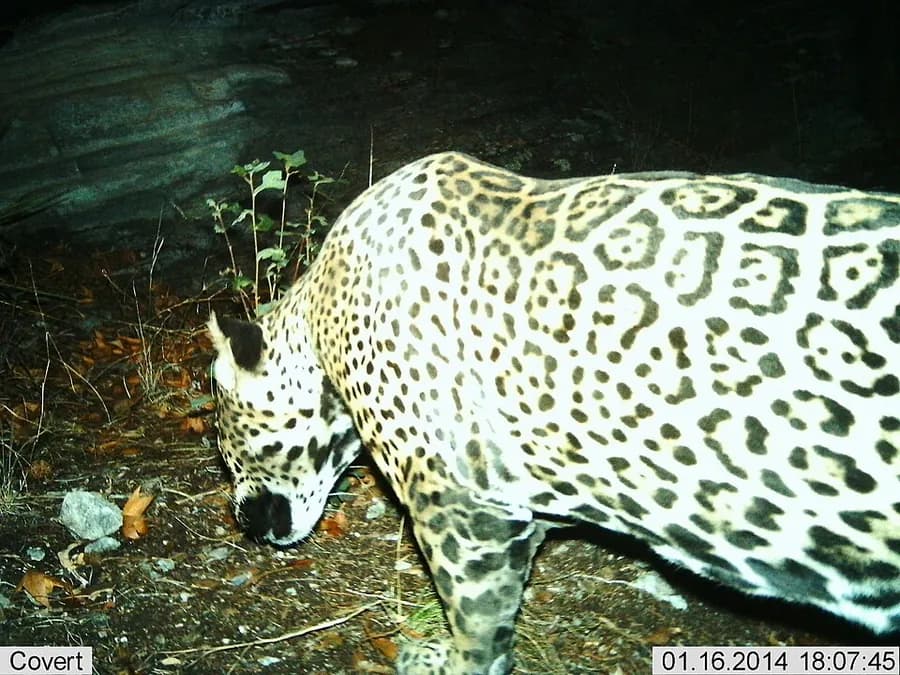
 🐆
Photo: U.S. Fish & Wildlife Service Southwest Reg… · Public domain
🐆Jaguar
The jaguar is a large cat species and the only living member of the genus Panthera that is native to the Americas. Its distinctively marked coat features pale yellow to tan colored fur covered by spots that transition to rosettes on the sides, although a melanistic black coat appears in some individuals. With a body length of up to 1.85 m and a weight of up to 158 kg (348 lb), it is the biggest cat species in the Americas and the third largest in the world. The jaguar's powerful bite allows it to pierce the carapaces of turtles and tortoises, and to employ an unusual killing method: it bites directly through the skull of mammalian prey between the ears to deliver a fatal blow to the brain.
Text: Wikipedia, CC BY-SA 4.0.
IUCN Red List assessment, 2017.
- Body mass
- 81 kg
- Body length
- 1.59 m
- Shoulder height
- 0.71 m
- Top speed
- not recorded
- Bite force
- 1,014 N
- Maximum lifespan
- 28 years
Everything we know about the Jaguar
Typical adult figures. Where a value is an estimate rather than a measurement, it says so.
Body mass81 kgCOMBINEOther figures ↓Hide ↑
Source: COMBINE · v1 (Soria et al. 2021) · CC BY 4.0
Figures vary
- 81 kgAnAgeAnAge build 15, 2023-07-03 (HAGR)data quality: high
Body length1.59 mCOMBINEDetails ↓Hide ↑
Source: COMBINE · v1 (Soria et al. 2021) · CC BY 4.0
Shoulder height0.71 m0.68–0.75 m · typical rangeDetails ↓Hide ↑
Sex not specified in source; value is the midpoint of the published range.
Source: Seymour 1989, Mammalian Species 340, p.1 · see citation
Bite force1,014 NDetails ↓Hide ↑
Canine bite modelled by the dry-skull method (Thomason 1991) from a prepared skull; static bite at the canines, gape not stated. Not a live measurement. The skull's estimated body mass was 83.2 kg. The reassuring case: an independent muscle-cross-section model gives 945 N at the canine (Deutsch et al. 2025, Anat Rec 308:2944), within 7% of this figure. Highest bite-force quotient of any big cat here, which fits an animal that kills by biting through skulls and turtle shells.
Source: Wroe, McHenry & Thomason 2005, Proc R Soc B 272:619, Table 1 · see citation
Bite force for its size137Details ↓Hide ↑
Bite force normalised for body mass: the residual of canine bite force regressed on body mass, average across the sample set to 100. Above 100 means the animal bites harder than its size predicts. Do not cross-check against Wikipedia's BFQ table, which silently mixes this paper with Christiansen & Wroe 2007 and cites a popular-science book.
Source: Wroe, McHenry & Thomason 2005, Proc R Soc B 272:619, Table 1 · see citation
Brain mass156 gCOMBINEDetails ↓Hide ↑
Source: COMBINE · v1 (Soria et al. 2021) · CC BY 4.0
Maximum lifespan28 yearsCOMBINEOther figures ↓Hide ↑
Source: COMBINE · v1 (Soria et al. 2021) · CC BY 4.0
Figures vary
- 28 yearsAnAgeAnAge build 15, 2023-07-03 (HAGR)data quality: high
Generation length9.81 yearsCOMBINEDetails ↓Hide ↑
Source: COMBINE · v1 (Soria et al. 2021) · CC BY 4.0
Age at maturity3.2 yearsCOMBINEDetails ↓Hide ↑
Source: COMBINE · v1 (Soria et al. 2021) · CC BY 4.0
Gestation101 daysCOMBINEOther figures ↓Hide ↑
Source: COMBINE · v1 (Soria et al. 2021) · CC BY 4.0
Figures vary
- 99 daysAnAgeAnAge build 15, 2023-07-03 (HAGR)data quality: high
Litter sizeabout 2COMBINEOther figures ↓Hide ↑
Source: COMBINE · v1 (Soria et al. 2021) · CC BY 4.0
Figures vary
- 2AnAgeAnAge build 15, 2023-07-03 (HAGR)data quality: high
Trophic levelCarnivoreCOMBINEDetails ↓Hide ↑
Source: COMBINE · v1 (Soria et al. 2021) · CC BY 4.0
Activity cycleCrepuscular / mixedCOMBINEDetails ↓Hide ↑
Source: COMBINE · v1 (Soria et al. 2021) · CC BY 4.0
Home range53 km²COMBINEDetails ↓Hide ↑
Source: COMBINE · v1 (Soria et al. 2021) · CC BY 4.0
Population density0.04 per km²COMBINEDetails ↓Hide ↑
Source: COMBINE · v1 (Soria et al. 2021) · CC BY 4.0
Volume l81 LaverageDetails ↓Hide ↑
Body mass at ~1.0 kg/L, the density of vertebrate tissue.
average = a mean across sexes or species in a group.
Not recorded for Jaguar yet: top speed.
Family tree
- kingdomAnimalia
- ›phylumChordata
- ›classMammalia
- ›orderCarnivora
- ›familyFelidae
- ›genusPanthera
- ›speciesPanthera onca
- classMammals · Mammalia
- orderCarnivorans · Carnivora
- familyFelidae
- genusPanthera
All 14 branches ↓Fewer branches ↑
- kingdomMetazoa
- phylumChordata
- subphylumCraniata
- subphylumVertebrata
- superclassGnathostomata
- superclassSarcopterygii
- superclassTetrapoda
- classMammals · Mammalia
- subclassTheria
- superorderLaurasiatheria
- orderCarnivorans · Carnivora
- suborderFeliformia
- familyFelidae
- genusPanthera
More about the Jaguar


Animals caught on camera
Real footage of the animals on this site — hunting, fighting, and getting on with it.
Compare the Jaguar
Pick a tool — the Jaguar is already selected.
Compare every stat with any other animal.
Stand them on the same floor and see who's bigger.
Does it punch above its weight? Its stats against what body size predicts.
See where it sits in the tree of life.