
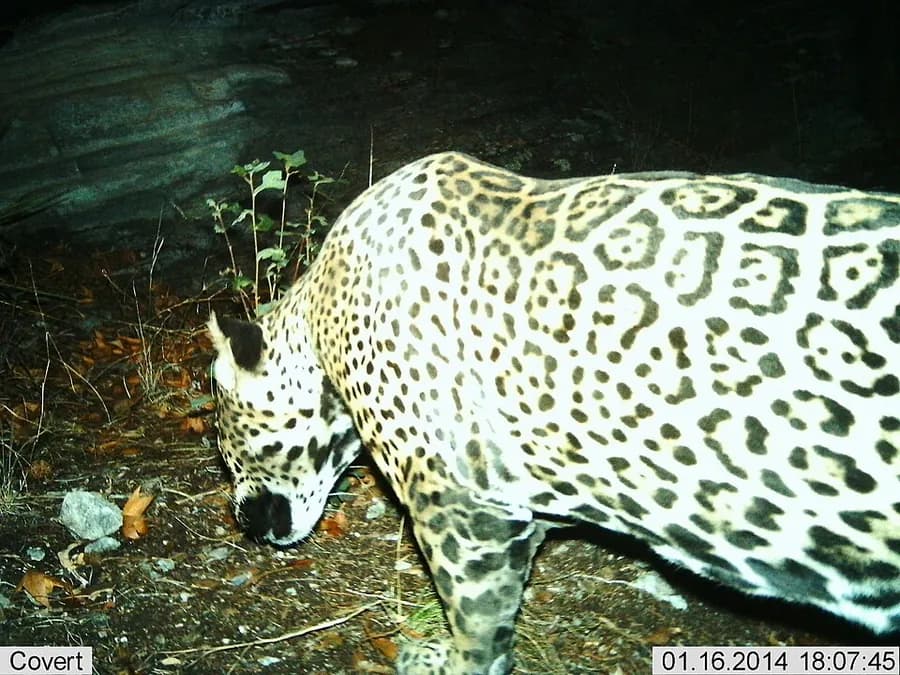
 🐆
Photo: U.S. Fish & Wildlife Service Southwest Reg… · Public domain
🐆Jaguar
재규어(영어: Jaguar, 학명: Panthera onca 판테라 온카[*])는 대형 고양이과 동물로, 아메리카에서 현존하는 유일한 표범속(Panthera) 종이다. 털은 옅은 노란색에서 황갈색을 띠며, 옆구리에는 장미꽃 모양의 반점이 촘촘히 박혀 있는 것이 특징이다. 일부 개체는 흑색증으로 인해 털이 검은색을 띠기도 한다. 몸길이가 최대 1.85 m, 몸무게가 최대 158 kg에 달하는 재규어는 아메리카 대륙에서 가장 큰 고양이과 동물이며, 세계에서 세 번째로 큰 고양이과 동물이다. 재규어는 몸무게 대비 가장 강력한 저작력을 가진 고양이과 동물로, 이 저작력을 통해 거북의 등껍데기나 포유류 먹이의 두개골을 뚫을 수 있다. 현생 재규어의 조상은 아마도 플라이스토세 초기에 베링 해협을 가로지르던 육교를 통해 유라시아에서 아메리카로 건너왔을 것으로 추정된다. 북아메리카에서 발견된 가장 오래된 재규어 화석은 85만 년에서 82만 년 전의 것으로 추정된다. 오늘날 재규어는 미국 남서부에서 멕시코와 중앙아메리카 대부분 지역, 아마존 우림을 거쳐 남쪽으로는 파라과이와 아르헨티나 북부까지 넓게 분포한다. 다양한 삼림 지대와 개방된 지형에 서식하지만, 열대·아열대 습윤활엽수림, 습지, 삼림 지대를 특히 선호한다. 재규어는 수영에 능숙하며 주로 단독 생활을 하는 기회주의적인 최상위 포식자로서 먹이에 몰래 접근하는 매복 사냥을 한다. 또한 핵심종으로서 생태계를 안정시키고 먹이의 개체 수를 조절하는 데 중요한 역할을 한다. 재규어는 서식지 파괴, 서식지 단편화, 신체 부위 거래를 위한 밀렵, 인간과 야생동물 간의 갈등(특히 중남미 목축업자의 사냥) 등으로 위협받고 있다. 재규어는 2002년부터 IUCN 적색 목록에서 준위협종으로 분류되어 있으머, 1990년대 후반부터 개체 수가 감소한 것으로 보인다. 최소 50마리 이상의 번식 개체가 서식하는 51개의 대규모 지역을 재규어 보존 구역(Jaguar Conservation Units)이라 부르는 데, 이 지역들은 멕시코에서 아르헨티나에 이르는 36개의 지리적 지역에 분포한다. 재규어는 아즈텍과 마야 문명을 비롯한 아메리카 원주민들의 신화에서 중요한 위치를 차지해 왔다.
Text: Wikipedia, CC BY-SA 4.0.
IUCN Red List assessment, 2017.
- Body mass
- 81 kg
- Body length
- 1.59 m
- Shoulder height
- 0.71 m
- Top speed
- not recorded
- Bite force
- 1,014 N
- Maximum lifespan
- 28 years
Everything we know about the Jaguar
Typical adult figures. Where a value is an estimate rather than a measurement, it says so.
Body mass81 kgCOMBINEOther figures ↓Hide ↑
Source: COMBINE · v1 (Soria et al. 2021) · CC BY 4.0
Figures vary
- 81 kgAnAgeAnAge build 15, 2023-07-03 (HAGR)data quality: high
Body length1.59 mCOMBINEDetails ↓Hide ↑
Source: COMBINE · v1 (Soria et al. 2021) · CC BY 4.0
Shoulder height0.71 m0.68–0.75 m · typical rangeDetails ↓Hide ↑
Sex not specified in source; value is the midpoint of the published range.
Source: Seymour 1989, Mammalian Species 340, p.1 · see citation
Bite force1,014 NDetails ↓Hide ↑
Canine bite modelled by the dry-skull method (Thomason 1991) from a prepared skull; static bite at the canines, gape not stated. Not a live measurement. The skull's estimated body mass was 83.2 kg. The reassuring case: an independent muscle-cross-section model gives 945 N at the canine (Deutsch et al. 2025, Anat Rec 308:2944), within 7% of this figure. Highest bite-force quotient of any big cat here, which fits an animal that kills by biting through skulls and turtle shells.
Source: Wroe, McHenry & Thomason 2005, Proc R Soc B 272:619, Table 1 · see citation
Bite force for its size137Details ↓Hide ↑
Bite force normalised for body mass: the residual of canine bite force regressed on body mass, average across the sample set to 100. Above 100 means the animal bites harder than its size predicts. Do not cross-check against Wikipedia's BFQ table, which silently mixes this paper with Christiansen & Wroe 2007 and cites a popular-science book.
Source: Wroe, McHenry & Thomason 2005, Proc R Soc B 272:619, Table 1 · see citation
Brain mass156 gCOMBINEDetails ↓Hide ↑
Source: COMBINE · v1 (Soria et al. 2021) · CC BY 4.0
Maximum lifespan28 yearsCOMBINEOther figures ↓Hide ↑
Source: COMBINE · v1 (Soria et al. 2021) · CC BY 4.0
Figures vary
- 28 yearsAnAgeAnAge build 15, 2023-07-03 (HAGR)data quality: high
Generation length9.81 yearsCOMBINEDetails ↓Hide ↑
Source: COMBINE · v1 (Soria et al. 2021) · CC BY 4.0
Age at maturity3.2 yearsCOMBINEDetails ↓Hide ↑
Source: COMBINE · v1 (Soria et al. 2021) · CC BY 4.0
Gestation101 daysCOMBINEOther figures ↓Hide ↑
Source: COMBINE · v1 (Soria et al. 2021) · CC BY 4.0
Figures vary
- 99 daysAnAgeAnAge build 15, 2023-07-03 (HAGR)data quality: high
Litter sizeabout 2COMBINEOther figures ↓Hide ↑
Source: COMBINE · v1 (Soria et al. 2021) · CC BY 4.0
Figures vary
- 2AnAgeAnAge build 15, 2023-07-03 (HAGR)data quality: high
Trophic levelCarnivoreCOMBINEDetails ↓Hide ↑
Source: COMBINE · v1 (Soria et al. 2021) · CC BY 4.0
Activity cycleCrepuscular / mixedCOMBINEDetails ↓Hide ↑
Source: COMBINE · v1 (Soria et al. 2021) · CC BY 4.0
Home range53 km²COMBINEDetails ↓Hide ↑
Source: COMBINE · v1 (Soria et al. 2021) · CC BY 4.0
Population density0.04 per km²COMBINEDetails ↓Hide ↑
Source: COMBINE · v1 (Soria et al. 2021) · CC BY 4.0
Volume l81 LaverageDetails ↓Hide ↑
Body mass at ~1.0 kg/L, the density of vertebrate tissue.
average = a mean across sexes or species in a group.
Not recorded for Jaguar yet: top speed.
Family tree
- kingdomAnimalia
- ›phylumChordata
- ›classMammalia
- ›orderCarnivora
- ›familyFelidae
- ›genusPanthera
- ›speciesPanthera onca
- classMammals · Mammalia
- orderCarnivorans · Carnivora
- familyFelidae
- genusPanthera
All 14 branches ↓Fewer branches ↑
- kingdomMetazoa
- phylumChordata
- subphylumCraniata
- subphylumVertebrata
- superclassGnathostomata
- superclassSarcopterygii
- superclassTetrapoda
- classMammals · Mammalia
- subclassTheria
- superorderLaurasiatheria
- orderCarnivorans · Carnivora
- suborderFeliformia
- familyFelidae
- genusPanthera
More about the Jaguar


카메라에 담긴 동물들
이 사이트에 실린 동물들의 실제 영상 — 사냥하고, 싸우고, 그냥 하루를 살아가는 모습까지 담았어요.
Compare the Jaguar
Pick a tool — the Jaguar is already selected.
Compare every stat with any other animal.
Stand them on the same floor and see who's bigger.
Does it punch above its weight? Its stats against what body size predicts.
See where it sits in the tree of life.