
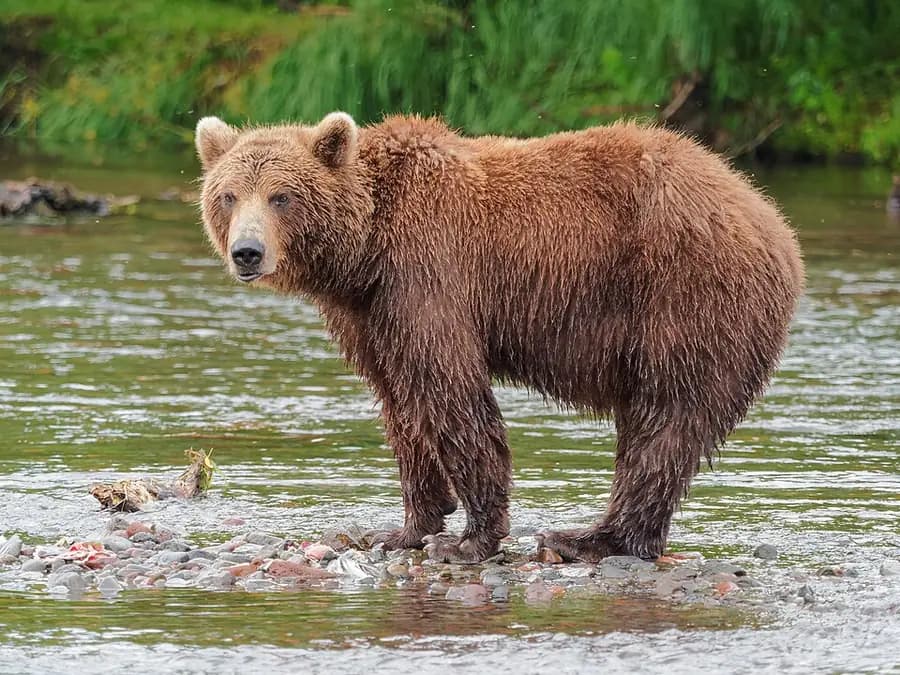
🐻Brown bear
불곰(학명: Ursus arctos), 또는 큰곰, 갈색곰은 유라시아와 북아메리카에 서식하는 대형 곰이다. 크기는 가장 가까운 친척인 북극곰과 비슷하지만, 불곰이 평균적으로 약간 더 작다. 성적 이형성을 보이는 종으로 보통 수컷이 암컷보다 더 크고 육중하다. 털 색깔은 크림색에서 붉은색, 짙은 갈색까지 다양하다. 어깨의 근육 덩어리가 특징으로, 이 근육 덩어리와 최대 너비 21cm, 길이 36cm의 앞 발을 이용해 흙을 효과적으로 파헤칠 수 있다. 치아 형태는 다른 곰들과 유사하며, 다양한 먹이를 섭취하는 적응력이 높다. 불곰은 서식지 전역에 걸쳐 주로 해발 5,000m까지의 삼림에 서식한다. 수많은 식물과 동물들을 섭취하는 잡식성 동물로, 지역에 따라 식성이 다르지만 보통 식단의 90%가 식물성 먹이다. 사냥할 때는 곤충이나 설치류처럼 작은 동물들부터 말코손바닥사슴이나 사향소 같은 대형 동물들까지 사냥한다. 알래스카주 해안 지역에서는 산란을 위해 찾아오는 연어과 어류들을 잡아 먹는다. 불곰은 대부분의 시간을 홀로 보내며 짝짓기나 새끼 양육 시기는 예외다. 암컷은 평균 1~3마리의 새끼를 낳으며, 새끼는 1.5~4.5년 동안 어미와 함께 생활한다. 수명이 긴 동물로 야생에서의 평균 수명은 25년이다. 몸집에 비해 뇌가 매우 큰 것이 특징이며, 이 덕에 도구 사용 능력과 높은 인지 능력을 가지고 있다. 인간에 대한 공격은 일반적으로 드물다. 불곰의 서식지가 줄어들며 서식지 곳곳에서 지역적인 멸종 위기에 직면했지만, 국제자연보전연맹에서는 불곰을 여전히 최소관심종으로 분류하고 있으며, 2017년 기준 총 개체 수는 약 11만 마리로 추정된다. 19세기와 20세기에 사냥으로 멸종된 불곰 개체군에는 북아프리카의 아틀라스불곰과 북미의 캘리포니아불곰, 웅가바불곰, 멕시코불곰이 있다. 유라시아 남부 지역에 서식하는 개체군들 또한 심각한 멸종 위기에 처해 있다. 몸집이 작은 아종 중 하나인 히말라야불곰은 심각한 절멸위급종으로, 과거 범위의 2%에서만 서식하며, 신체 부위를 노린 무분별한 밀렵으로 위협받고 있다. 이탈리아 중부에 서식하는 마르시카불곰도 약 50마리만 남아있는 상태다. 불곰은 예로부터 가장 매력적인 대형 동물 중 하나로 여겨져 왔다. 먼 고대부터 동물원에서 사육되어 왔으며, 서커스에 동원될 수 있도록 길들여지고 훈련되기도 했다. 수천 년 동안 불곰은 인간 문화 속에서 중요한 역할을 해왔으며, 문학, 미술, 민속, 신화 등 다양한 매체에 등장한다.
Text: Wikipedia, CC BY-SA 4.0.
IUCN Red List assessment, 2017.
- Body mass
- 241 kg
- Body length
- 2.29 m
- Shoulder height
- 1.2 m
- Top speed
- 47 km/h
- Bite force
- 751 N
- Maximum lifespan
- 50 years
Everything we know about the Brown bear
Typical adult figures. Where a value is an estimate rather than a measurement, it says so.
Body mass241 kgCOMBINEOther figures ↓Hide ↑
Source: COMBINE · v1 (Soria et al. 2021) · CC BY 4.0
Figures vary
- 278 kgAnAgeAnAge build 15, 2023-07-03 (HAGR)data quality: acceptable
Body length2.29 mCOMBINEDetails ↓Hide ↑
Source: COMBINE · v1 (Soria et al. 2021) · CC BY 4.0
Shoulder height1.2 m0.9–1.5 m · typical rangeat the shoulder (quadruped)Details ↓Hide ↑
"They are 90 to 150 cm tall at the shoulder and can tower at an intimidating height of 8 feet when standing upright on their hind legs." Recorded value is quadruped shoulder height (midpoint of 90-150 cm); the 8-ft figure is an upright hind-leg height stated separately and not recorded here.
Source: Animal Diversity Web (Univ. Michigan), Ursus arctos account, https://animaldiversity.org/accounts/Ursus_arctos/ · see citation
Top speed47 km/hDetails ↓Hide ↑
Sprint over a short distance, not a sustained pace. Compilations give 46.66 and 47.97 km/h.
Source: Bejan & Marden 2006, J Exp Biol 209:238 and Christiansen 2002, Zool J Linn Soc 136:685; compiled in Hirt et al. 2017, Nat Ecol Evol 1:1116, Supplementary Data · see citation
Bite force751 NDetails ↓Hide ↑
Canine bite modelled by the dry-skull method (Thomason 1991) from a prepared skull; static bite at the canines, gape not stated. Not a live measurement. The skull's estimated body mass was 128.8 kg. Estimates span 2.2x. A value of 1410 N is attributed to Christiansen & Wroe 2007, Ecology 88:347 -- that paper is paywalled and the figure could not be verified against its own table. Rozycka et al. 2024 give 1627 N. Do NOT use the 1681 N brown bear figure in Slater et al. 2010: that skull was rescaled to polar-bear size and driven by polar-bear muscle forces.
Source: Wroe, McHenry & Thomason 2005, Proc R Soc B 272:619, Table 1 · see citation
Bite force for its size78Details ↓Hide ↑
Bite force normalised for body mass: the residual of canine bite force regressed on body mass, average across the sample set to 100. Above 100 means the animal bites harder than its size predicts. Do not cross-check against Wikipedia's BFQ table, which silently mixes this paper with Christiansen & Wroe 2007 and cites a popular-science book.
Source: Wroe, McHenry & Thomason 2005, Proc R Soc B 272:619, Table 1 · see citation
Brain mass359 gCOMBINEDetails ↓Hide ↑
Source: COMBINE · v1 (Soria et al. 2021) · CC BY 4.0
Maximum lifespan50 yearsCOMBINEOther figures ↓Hide ↑
Source: COMBINE · v1 (Soria et al. 2021) · CC BY 4.0
Figures vary
- 40 yearsAnAgeAnAge build 15, 2023-07-03 (HAGR)data quality: acceptable
Generation length16 yearsCOMBINEDetails ↓Hide ↑
Source: COMBINE · v1 (Soria et al. 2021) · CC BY 4.0
Age at maturity3.6 yearsCOMBINEDetails ↓Hide ↑
Source: COMBINE · v1 (Soria et al. 2021) · CC BY 4.0
Gestation103 daysCOMBINEOther figures ↓Hide ↑
Source: COMBINE · v1 (Soria et al. 2021) · CC BY 4.0
Figures vary
- 103 daysAnAgeAnAge build 15, 2023-07-03 (HAGR)data quality: acceptable
Litter sizeabout 2COMBINEOther figures ↓Hide ↑
Source: COMBINE · v1 (Soria et al. 2021) · CC BY 4.0
Figures vary
- 2AnAgeAnAge build 15, 2023-07-03 (HAGR)data quality: acceptable
Trophic levelOmnivoreCOMBINEDetails ↓Hide ↑
Source: COMBINE · v1 (Soria et al. 2021) · CC BY 4.0
Activity cycleCrepuscular / mixedCOMBINEDetails ↓Hide ↑
Source: COMBINE · v1 (Soria et al. 2021) · CC BY 4.0
Home range311 km²COMBINEDetails ↓Hide ↑
Source: COMBINE · v1 (Soria et al. 2021) · CC BY 4.0
Population density0.27 per km²COMBINEDetails ↓Hide ↑
Source: COMBINE · v1 (Soria et al. 2021) · CC BY 4.0
Volume l241 LaverageDetails ↓Hide ↑
Body mass at ~1.0 kg/L, the density of vertebrate tissue.
average = a mean across sexes or species in a group.
Family tree
- kingdomAnimalia
- ›phylumChordata
- ›classMammalia
- ›orderCarnivora
- ›familyUrsidae
- ›genusUrsus
- ›speciesUrsus arctos
- classMammals · Mammalia
- orderCarnivorans · Carnivora
- suborderCaniformia
- familyUrsidae
All 13 branches ↓Fewer branches ↑
- kingdomMetazoa
- phylumChordata
- subphylumCraniata
- subphylumVertebrata
- superclassGnathostomata
- superclassSarcopterygii
- superclassTetrapoda
- classMammals · Mammalia
- subclassTheria
- superorderLaurasiatheria
- orderCarnivorans · Carnivora
- suborderCaniformia
- familyUrsidae
More about the Brown bear


카메라에 담긴 동물들
이 사이트에 실린 동물들의 실제 영상 — 사냥하고, 싸우고, 그냥 하루를 살아가는 모습까지 담았어요.
Compare the Brown bear
Pick a tool — the Brown bear is already selected.
Compare every stat with any other animal.
Stand them on the same floor and see who's bigger.
Does it punch above its weight? Its stats against what body size predicts.
See where it sits in the tree of life.