
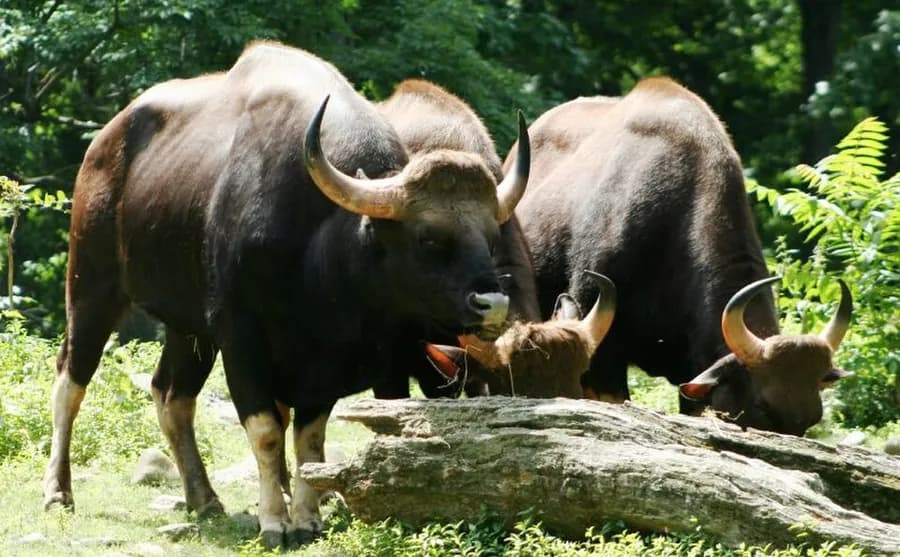
🐃Gaur
Gauren (Bos gaurus) er den største nulevende okseart og hører taksonomisk til under de skedehornede pattedyr. Den lever naturligt i Syd- og Sydøstasien, men er i tilbagegang som art, så den på IUCN's Rødliste siden 1986 har været betegnet som sårbar; faldet i populationen er på over 70 % inden for de seneste tre generationer. Populationen ser dog ud til at være stabil i velbeskyttede områder, og i visse områder stiger den endog. Gauren er den største af de vilde oksearter med en længde på 250-330 cm og en skulderhøjde på 165-220 cm; halen er 70-105 cm lang. Den gennemsnitlige vægt for en udvokset gaur er 650-1.000 kg, og en stor tyr kan veje op til 1.500 kg. Den malajiske gaur kaldes seladang og den burmesiske pyoung. Den domesticerede form af gauren er gayalen (Bos frontalis).
Text: Wikipedia, CC BY-SA 4.0.
IUCN Red List assessment, 2016.
- Body mass
- 813 kg
- Body length
- 3 m
- Shoulder height
- 1.93 m
- Top speed
- not recorded
- Bite force
- not recorded
- Maximum lifespan
- 26 years
Everything we know about the Gaur
Typical adult figures. Where a value is an estimate rather than a measurement, it says so.
Body mass813 kgCOMBINEDetails ↓Hide ↑
Source: COMBINE · v1 (Soria et al. 2021) · CC BY 4.0
Body length3 mCOMBINEDetails ↓Hide ↑
Source: COMBINE · v1 (Soria et al. 2021) · CC BY 4.0
Shoulder height1.93 m1.65–2.2 m · typical rangenot statedDetails ↓Hide ↑
"Shoulder height is 1.65 to 2.2 meters." Range-only; value is the midpoint. ADW files the gaur under the synonym Bos frontalis; no account exists under Bos gaurus.
Source: Lundrigan & Zachariah 2000, Animal Diversity Web account: Bos frontalis (gaur), https://animaldiversity.org/accounts/Bos_frontalis/ · see citation
Maximum lifespan26 yearsCOMBINEDetails ↓Hide ↑
Source: COMBINE · v1 (Soria et al. 2021) · CC BY 4.0
Generation length8.99 yearsCOMBINEDetails ↓Hide ↑
Source: COMBINE · v1 (Soria et al. 2021) · CC BY 4.0
Age at maturity1.7 yearsCOMBINEDetails ↓Hide ↑
Source: COMBINE · v1 (Soria et al. 2021) · CC BY 4.0
Gestation275 daysCOMBINEDetails ↓Hide ↑
Source: COMBINE · v1 (Soria et al. 2021) · CC BY 4.0
Litter size1COMBINEDetails ↓Hide ↑
Source: COMBINE · v1 (Soria et al. 2021) · CC BY 4.0
Trophic levelHerbivoreCOMBINEDetails ↓Hide ↑
Source: COMBINE · v1 (Soria et al. 2021) · CC BY 4.0
Activity cycleDiurnalCOMBINEDetails ↓Hide ↑
Source: COMBINE · v1 (Soria et al. 2021) · CC BY 4.0
Population density0.86 per km²COMBINEDetails ↓Hide ↑
Source: COMBINE · v1 (Soria et al. 2021) · CC BY 4.0
Volume l813 LaverageDetails ↓Hide ↑
Body mass at ~1.0 kg/L, the density of vertebrate tissue.
average = a mean across sexes or species in a group.
Not recorded for Gaur yet: top speed, bite force.
Family tree
- kingdomAnimalia
- ›phylumChordata
- ›classMammalia
- ›orderArtiodactyla
- ›familyBovidae
- ›genusBos
- ›speciesBos frontalis
- classMammals · Mammalia
- orderEven-toed hoofed animals · Artiodactyla
- familyBovidae
- subfamilyBovinae
All 15 branches ↓Fewer branches ↑
- kingdomMetazoa
- phylumChordata
- subphylumCraniata
- subphylumVertebrata
- superclassGnathostomata
- superclassSarcopterygii
- superclassTetrapoda
- classMammals · Mammalia
- subclassTheria
- superorderLaurasiatheria
- orderEven-toed hoofed animals · Artiodactyla
- suborderRuminantia
- infraorderPecora
- familyBovidae
- subfamilyBovinae
More about the Gaur


No videos of the Gaur yet.
We have 44,653 videos so far, and none of them features this animal yet.
All videos →Compare the Gaur
Pick a tool — the Gaur is already selected.
Compare every stat with any other animal.
Stand them on the same floor and see who's bigger.
How speed, brain and bite scale with body size. This animal isn't in the sample yet.
See where it sits in the tree of life.