
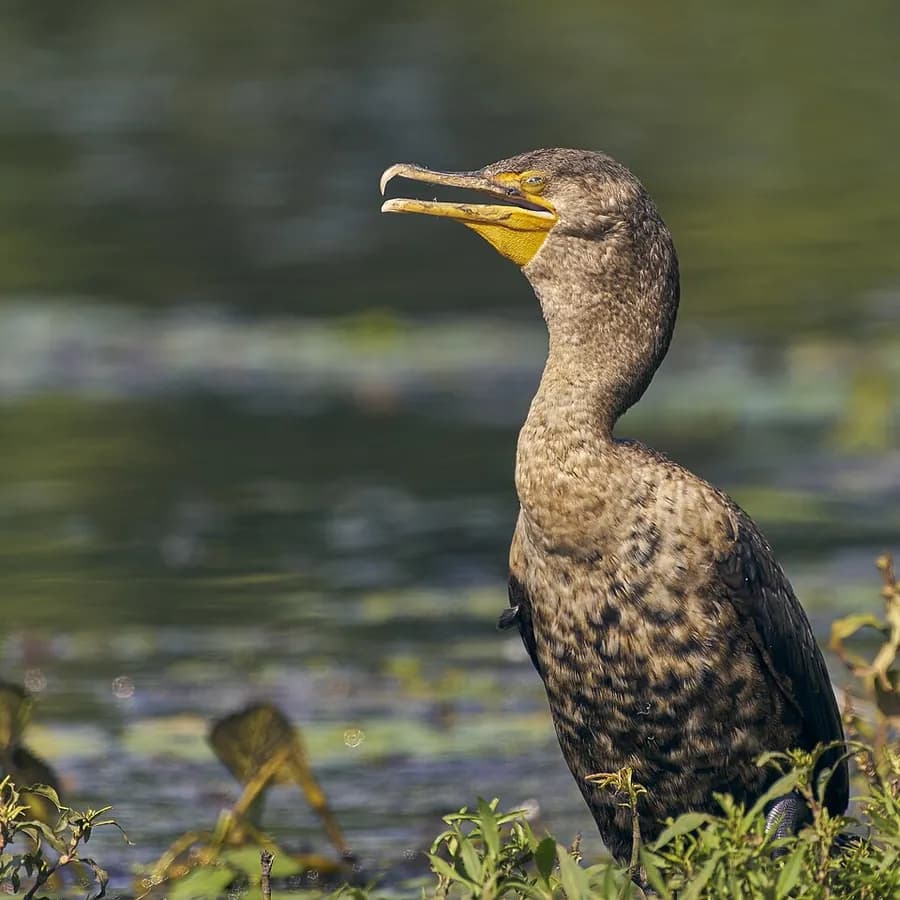
🐦Double-crested cormorant
The double-crested cormorant is a member of the cormorant family of water birds. It is found near rivers and lakes and in coastal areas and is widely distributed across North America, from the Aleutian Islands in Alaska down to Florida and Mexico. Measuring 70–90 cm (28–35 in) in length, it is entirely black except for a bare patch of orange-yellow facial skin and some extra plumage that it exhibits in the breeding season when it grows a double crest in which black feathers are mingled with white. Five subspecies are recognized. It mainly eats fish and hunts by swimming and diving. Its feathers, like all cormorants, are not waterproof, and it must dry them out after spending time in the water. Once threatened by the use of DDT, the numbers of this bird have increased markedly in recent years.
Text: Wikipedia, CC BY-SA 4.0.
IUCN Red List assessment, 2018.
- Body mass
- not recorded
- Body length
- not recorded
- Shoulder height
- not recorded
- Top speed
- not recorded
- Bite force
- not recorded
- Maximum lifespan
- not recorded
Everything we know about the Double-crested cormorant
Typical adult figures. Where a value is an estimate rather than a measurement, it says so.
No measurements for Double-crested cormorant yet.
Family tree
- kingdomAnimalia
- ›phylumChordata
- ›classAves
- ›orderSuliformes
- ›familyPhalacrocoracidae
- ›genusPhalacrocorax
- ›speciesPhalacrocorax auritus
Lineage not available yet.
More about the Double-crested cormorant


No videos of the Double-crested cormorant yet.
We have 44,653 videos so far, and none of them features this animal yet.
All videos →Compare the Double-crested cormorant
Pick a tool — the Double-crested cormorant is already selected.
Compare every stat with any other animal.
Stand them on the same floor and see who's bigger.
How speed, brain and bite scale with body size. This animal isn't in the sample yet.
See where it sits in the tree of life.