
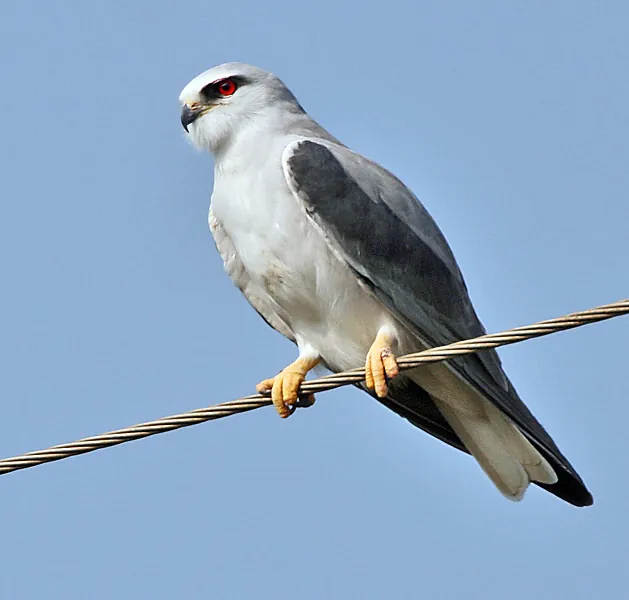
🦅Black-winged kite
The black-winged kite, also known as the black-shouldered kite, is a small diurnal bird of prey in the family Accipitridae best known for its habit of hovering over open grasslands in the manner of the much smaller kestrels. This Palearctic and Afrotropical species was sometimes combined with the Australian black-shouldered kite and the white-tailed kite of North and South America which together form a superspecies. This kite is distinctive, with long wings; white, grey and black plumage; and owl-like forward-facing eyes with red irises. The owl-like behaviour is even more pronounced in the letter-winged kite, a nocturnal relative in Australia. Although mainly seen on plains, they are sometimes seen on grassy slopes of hills in the higher elevation regions of Asia. They are not migratory, but show nomadism in response to weather and food availability. They are well adapted to utilize periodic upsurges in rodent populations and can raise multiple broods in a single year unlike most birds of prey. Populations in southern Europe have grown in response to human activities, particularly agriculture and livestock rearing. It is now present in Southwest France.
Text: Wikipedia, CC BY-SA 4.0.
IUCN Red List assessment, 2019.
- Body mass
- 0.26 kg
- Body length
- not recorded
- Shoulder height
- not recorded
- Top speed
- not recorded
- Bite force
- not recorded
- Maximum lifespan
- 6 years
Everything we know about the Black-winged kite
Typical adult figures. Where a value is an estimate rather than a measurement, it says so.
Body mass0.26 kgAVONETOther figures ↓Hide ↑
Source: AVONET · v1.1 (Tobias et al. 2022) · CC BY 4.0
Figures vary
- 0.26 kgAnAgeAnAge build 15, 2023-07-03 (HAGR)data quality: acceptable
Tail length0.13 mAVONETDetails ↓Hide ↑
Source: AVONET · v1.1 (Tobias et al. 2022) · CC BY 4.0
Wing length0.29 mAVONETDetails ↓Hide ↑
Source: AVONET · v1.1 (Tobias et al. 2022) · CC BY 4.0
Beak length0.03 mAVONETDetails ↓Hide ↑
Source: AVONET · v1.1 (Tobias et al. 2022) · CC BY 4.0
Tarsus length0.03 mAVONETDetails ↓Hide ↑
Source: AVONET · v1.1 (Tobias et al. 2022) · CC BY 4.0
Maximum lifespan6 yearsAnAgeDetails ↓Hide ↑
data quality: acceptable
Source: AnAge · AnAge build 15, 2023-07-03 (HAGR) · CC BY 3.0
Trophic levelCarnivoreAVONETDetails ↓Hide ↑
Source: AVONET · v1.1 (Tobias et al. 2022) · CC BY 4.0
HabitatGrasslandAVONETDetails ↓Hide ↑
Source: AVONET · v1.1 (Tobias et al. 2022) · CC BY 4.0
LifestyleAerialAVONETDetails ↓Hide ↑
Source: AVONET · v1.1 (Tobias et al. 2022) · CC BY 4.0
Volume l0.3 LaverageDetails ↓Hide ↑
Body mass at ~1.0 kg/L, the density of vertebrate tissue.
average = a mean across sexes or species in a group.
Not recorded for Black-winged kite yet: body length, shoulder height, top speed, bite force.
Family tree
- kingdomAnimalia
- ›phylumChordata
- ›classAves
- ›orderAccipitriformes
- ›familyAccipitridae
- ›genusElanus
- ›speciesElanus caeruleus
- classBirds · Aves
- orderHawks & eagles · Accipitriformes
- familyAccipitridae
- genusElanus
All 12 branches ↓Fewer branches ↑
- kingdomMetazoa
- phylumChordata
- subphylumCraniata
- subphylumVertebrata
- superclassGnathostomata
- superclassSarcopterygii
- superclassTetrapoda
- orderSauria
- classBirds · Aves
- orderHawks & eagles · Accipitriformes
- familyAccipitridae
- genusElanus
More about the Black-winged kite


No videos of the Black-winged kite yet.
We have 44,653 videos so far, and none of them features this animal yet.
All videos →Compare the Black-winged kite
Pick a tool — the Black-winged kite is already selected.
Compare every stat with any other animal.
Stand them on the same floor and see who's bigger.
How speed, brain and bite scale with body size. This animal isn't in the sample yet.
See where it sits in the tree of life.