
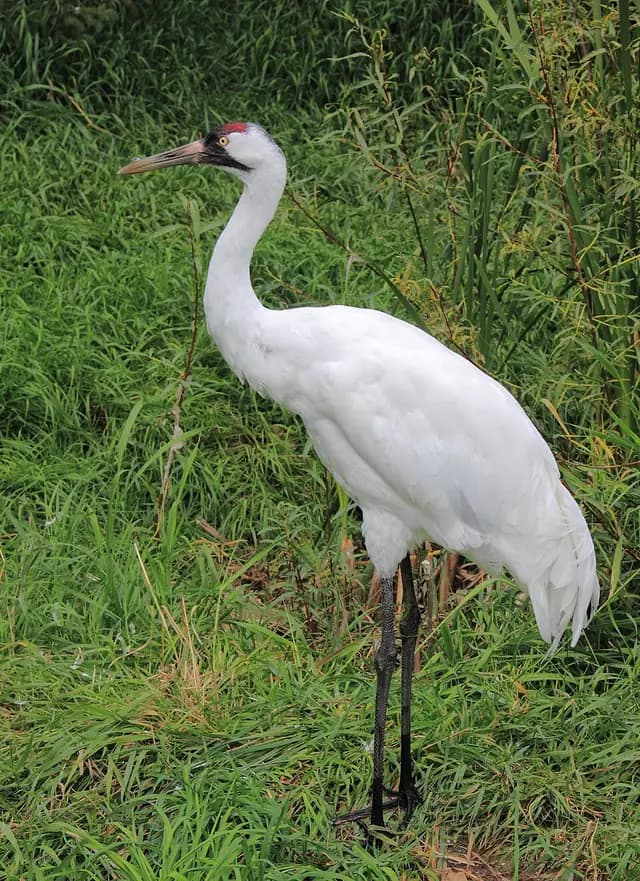
🐦Whooping crane
The whooping crane is an endangered crane species, native to North America, named for its "whooping" calls. Along with the sandhill crane, it is one of only two crane species native to North America, and it is also the tallest North American bird species, with an estimated 22–30+ year life expectancy in the wild. After being pushed to the brink of extinction by unregulated hunting and loss of habitat that left just 21 wild cranes by 1941, the whooping crane made a partial recovery through conservation efforts. The total number of cranes in the surviving migratory population, plus three reintroduced flocks and in-captivity, is just over 830 birds as of 2025. This includes about 560 individuals in the remnant population that migrates between coastal Texas, USA, and the Northwest Territories, Canada, which is termed the "Aransas-Wood Buffalo Population" after the protected areas that anchor the population's wintering and breeding ranges, respectively. Additionally, there are about 140 individuals in two reintroduced populations breeding in Wisconsin and Louisiana, USA, and an additional 130 individuals in captivity.
Text: Wikipedia, CC BY-SA 4.0.
IUCN Red List assessment, 2020.
- Body mass
- 5.83 kg
- Body length
- not recorded
- Shoulder height
- not recorded
- Top speed
- not recorded
- Bite force
- not recorded
- Maximum lifespan
- 40 years
Everything we know about the Whooping crane
Typical adult figures. Where a value is an estimate rather than a measurement, it says so.
Body mass5.83 kgAVONETOther figures ↓Hide ↑
Source: AVONET · v1.1 (Tobias et al. 2022) · CC BY 4.0
Figures vary
- 7.5 kgAnAgeAnAge build 15, 2023-07-03 (HAGR)data quality: acceptable
Tail length0.21 mAVONETDetails ↓Hide ↑
Source: AVONET · v1.1 (Tobias et al. 2022) · CC BY 4.0
Wing length0.61 mAVONETDetails ↓Hide ↑
Source: AVONET · v1.1 (Tobias et al. 2022) · CC BY 4.0
Beak length0.15 mAVONETDetails ↓Hide ↑
Source: AVONET · v1.1 (Tobias et al. 2022) · CC BY 4.0
Tarsus length0.29 mAVONETDetails ↓Hide ↑
Source: AVONET · v1.1 (Tobias et al. 2022) · CC BY 4.0
Maximum lifespan40 yearsAnAgeDetails ↓Hide ↑
data quality: acceptable
Source: AnAge · AnAge build 15, 2023-07-03 (HAGR) · CC BY 3.0
Gestation31 daysAnAgeDetails ↓Hide ↑
data quality: acceptable
Source: AnAge · AnAge build 15, 2023-07-03 (HAGR) · CC BY 3.0
Litter sizeabout 2AnAgeDetails ↓Hide ↑
data quality: acceptable
Source: AnAge · AnAge build 15, 2023-07-03 (HAGR) · CC BY 3.0
Trophic levelCarnivoreAVONETDetails ↓Hide ↑
Source: AVONET · v1.1 (Tobias et al. 2022) · CC BY 4.0
HabitatWetlandAVONETDetails ↓Hide ↑
Source: AVONET · v1.1 (Tobias et al. 2022) · CC BY 4.0
LifestyleTerrestrialAVONETDetails ↓Hide ↑
Source: AVONET · v1.1 (Tobias et al. 2022) · CC BY 4.0
Volume l5.8 LaverageDetails ↓Hide ↑
Body mass at ~1.0 kg/L, the density of vertebrate tissue.
average = a mean across sexes or species in a group.
Not recorded for Whooping crane yet: body length, shoulder height, top speed, bite force.
Family tree
- kingdomAnimalia
- ›phylumChordata
- ›classAves
- ›orderGruiformes
- ›familyGruidae
- ›genusGrus
- ›speciesGrus americana
- superclassTetrapoda
- orderSauria
- classBirds · Aves
- familyGruidae
All 10 branches ↓Fewer branches ↑
- kingdomMetazoa
- phylumChordata
- subphylumCraniata
- subphylumVertebrata
- superclassGnathostomata
- superclassSarcopterygii
- superclassTetrapoda
- orderSauria
- classBirds · Aves
- familyGruidae
More about the Whooping crane


Animals caught on camera
Real footage of the animals on this site — hunting, fighting, and getting on with it.
Compare the Whooping crane
Pick a tool — the Whooping crane is already selected.
Compare every stat with any other animal.
Stand them on the same floor and see who's bigger.
How speed, brain and bite scale with body size. This animal isn't in the sample yet.
See where it sits in the tree of life.