
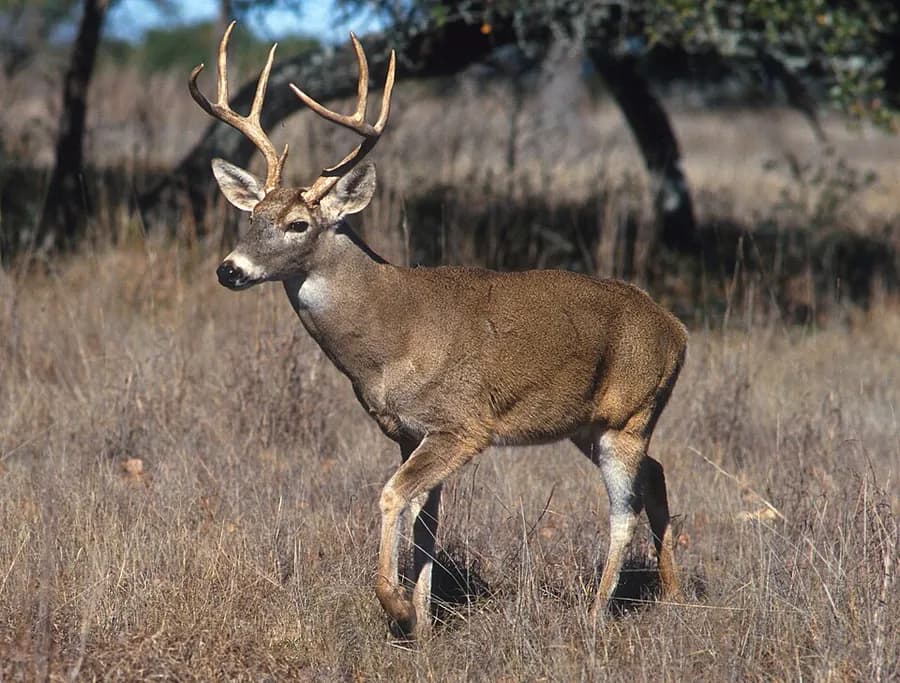
🦌White-tailed deer
The white-tailed deer, also known commonly as the whitetail and the Virginia deer, is a medium-sized species of deer native to North and South America. It is the most widely distributed mainland ungulate herbivore in the Americas; coupled with its natural predator, the mountain lion, it is one of the most widely distributed terrestrial mammal species in the Americas and the world. Highly adaptable, the various subspecies of white-tailed deer inhabit many different ecosystems, from arid grasslands to the Amazon and Orinoco basins; from the Llanos to the high-elevation terrain of the Andes.
Text: Wikipedia, CC BY-SA 4.0.
IUCN Red List assessment, 2016.
- Body mass
- 65 kg
- Body length
- 1.81 m
- Shoulder height
- 0.9 m
- Top speed
- not recorded
- Bite force
- not recorded
- Maximum lifespan
- 23 years
Everything we know about the White-tailed deer
Typical adult figures. Where a value is an estimate rather than a measurement, it says so.
Body mass65 kgCOMBINEOther figures ↓Hide ↑
Source: COMBINE · v1 (Soria et al. 2021) · CC BY 4.0
Figures vary
- 87 kgAnAgeAnAge build 15, 2023-07-03 (HAGR)data quality: high
Body length1.81 mCOMBINEDetails ↓Hide ↑
Source: COMBINE · v1 (Soria et al. 2021) · CC BY 4.0
Shoulder height0.9 m0.8–1 m · typical rangenot statedDetails ↓Hide ↑
"height at the shoulders is between 80 and 100 cm". Range-only; value is the midpoint. Size varies strongly with latitude (Bergmann's rule); northern animals larger.
Source: Dewey 2003, Animal Diversity Web account: Odocoileus virginianus, https://animaldiversity.org/accounts/Odocoileus_virginianus/ · see citation
Brain mass153 gCOMBINEDetails ↓Hide ↑
Source: COMBINE · v1 (Soria et al. 2021) · CC BY 4.0
Maximum lifespan23 yearsCOMBINEOther figures ↓Hide ↑
Source: COMBINE · v1 (Soria et al. 2021) · CC BY 4.0
Figures vary
- 23 yearsAnAgeAnAge build 15, 2023-07-03 (HAGR)data quality: high
Generation length7.43 yearsCOMBINEDetails ↓Hide ↑
Source: COMBINE · v1 (Soria et al. 2021) · CC BY 4.0
Age at maturity1.0 yearsCOMBINEDetails ↓Hide ↑
Source: COMBINE · v1 (Soria et al. 2021) · CC BY 4.0
Gestation201 daysCOMBINEOther figures ↓Hide ↑
Source: COMBINE · v1 (Soria et al. 2021) · CC BY 4.0
Figures vary
- 198 daysAnAgeAnAge build 15, 2023-07-03 (HAGR)data quality: high
Litter sizeabout 2COMBINEOther figures ↓Hide ↑
Source: COMBINE · v1 (Soria et al. 2021) · CC BY 4.0
Figures vary
- 2AnAgeAnAge build 15, 2023-07-03 (HAGR)data quality: high
Trophic levelHerbivoreCOMBINEDetails ↓Hide ↑
Source: COMBINE · v1 (Soria et al. 2021) · CC BY 4.0
Activity cycleCrepuscular / mixedCOMBINEDetails ↓Hide ↑
Source: COMBINE · v1 (Soria et al. 2021) · CC BY 4.0
Home range1.99 km²COMBINEDetails ↓Hide ↑
Source: COMBINE · v1 (Soria et al. 2021) · CC BY 4.0
Population density5.07 per km²COMBINEDetails ↓Hide ↑
Source: COMBINE · v1 (Soria et al. 2021) · CC BY 4.0
Volume l65 LaverageDetails ↓Hide ↑
Body mass at ~1.0 kg/L, the density of vertebrate tissue.
average = a mean across sexes or species in a group.
Not recorded for White-tailed deer yet: top speed, bite force.
Family tree
- kingdomAnimalia
- ›phylumChordata
- ›classMammalia
- ›orderArtiodactyla
- ›familyCervidae
- ›genusOdocoileus
- ›speciesOdocoileus virginianus
- classMammals · Mammalia
- orderEven-toed hoofed animals · Artiodactyla
- familyCervidae
- genusOdocoileus
All 15 branches ↓Fewer branches ↑
- kingdomMetazoa
- phylumChordata
- subphylumCraniata
- subphylumVertebrata
- superclassGnathostomata
- superclassSarcopterygii
- superclassTetrapoda
- classMammals · Mammalia
- subclassTheria
- superorderLaurasiatheria
- orderEven-toed hoofed animals · Artiodactyla
- suborderRuminantia
- infraorderPecora
- familyCervidae
- genusOdocoileus
More about the White-tailed deer


Animals caught on camera
Real footage of the animals on this site — hunting, fighting, and getting on with it.
Compare the White-tailed deer
Pick a tool — the White-tailed deer is already selected.
Compare every stat with any other animal.
Stand them on the same floor and see who's bigger.
How speed, brain and bite scale with body size. This animal isn't in the sample yet.
See where it sits in the tree of life.