
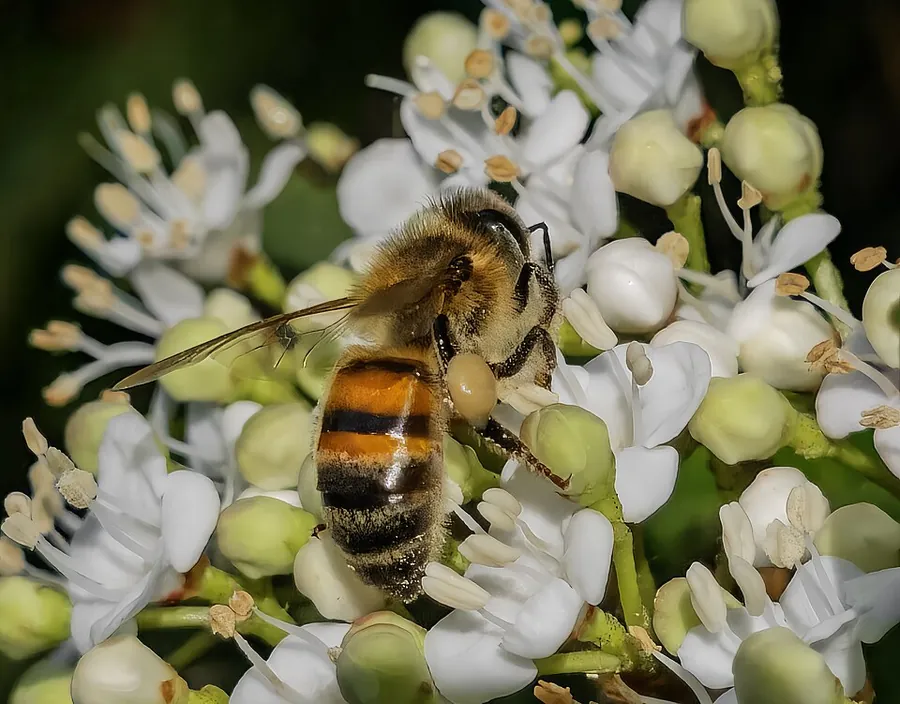
🐝Western honey bee
The western honey bee is the most common of the 7–12 species of honey bees worldwide. The genus name Apis is Latin for 'bee', and mellifera is the Latin for 'honey-bearing' or 'honey-carrying', referring to the species' production of honey.
Text: Wikipedia, CC BY-SA 4.0.
IUCN Red List assessment.
- Body mass
- not recorded
- Body length
- not recorded
- Shoulder height
- not recorded
- Top speed
- not recorded
- Bite force
- not recorded
- Maximum lifespan
- 8 years
Everything we know about the Western honey bee
Typical adult figures. Where a value is an estimate rather than a measurement, it says so.
Maximum lifespan8 yearsAnAgeDetails ↓Hide ↑
data quality: acceptable
Source: AnAge · AnAge build 15, 2023-07-03 (HAGR) · CC BY 3.0
Not recorded for Western honey bee yet: body mass, body length, shoulder height, top speed, bite force.
Family tree
- kingdomAnimalia
- ›phylumArthropoda
- ›classInsecta
- ›orderHymenoptera
- ›familyApidae
- ›genusApis
- ›speciesApis mellifera
- classInsects · Insecta
- subclassPterygota
- orderAnts, bees & wasps · Hymenoptera
- superfamilyApoidea
All 7 branches ↓Fewer branches ↑
- kingdomMetazoa
- phylumArthropoda
- subphylumHexapoda
- classInsects · Insecta
- subclassPterygota
- orderAnts, bees & wasps · Hymenoptera
- superfamilyApoidea
More about the Western honey bee


Animals caught on camera
Real footage of the animals on this site — hunting, fighting, and getting on with it.
Compare the Western honey bee
Pick a tool — the Western honey bee is already selected.
Compare every stat with any other animal.
Stand them on the same floor and see who's bigger.
How speed, brain and bite scale with body size. This animal isn't in the sample yet.
See where it sits in the tree of life.