
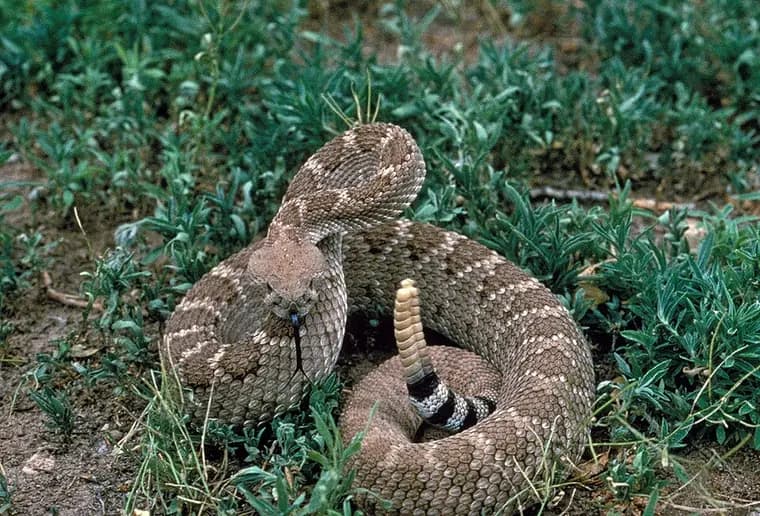
🐍Western diamondback rattlesnake
The western diamondback rattlesnake or western diamond-backed rattlesnake, is a rattlesnake species and member of the viper family, found in the southwestern United States and Mexico. Like all other rattlesnakes and all other vipers, it is venomous. It is likely responsible for the majority of snakebite fatalities in northern Mexico and the greatest number of snakebites in the U.S. No subspecies are currently recognized.
Text: Wikipedia, CC BY-SA 4.0.
IUCN Red List assessment, 2007.
- Body mass
- 6.7 kg
- Body length
- 2.34 m
- Shoulder height
- not recorded
- Top speed
- not recorded
- Bite force
- not recorded
- Maximum lifespan
- 27 years
Everything we know about the Western diamondback rattlesnake
Typical adult figures. Where a value is an estimate rather than a measurement, it says so.
Body mass6.7 kgrecord 6.16 kg · ReptTraitsAnAgeDetails ↓Hide ↑
data quality: acceptable
Record: largest individual on record
Source: AnAge · AnAge build 15, 2023-07-03 (HAGR) · CC BY 3.0
Body length2.34 mmaximum recordedReptTraitsDetails ↓Hide ↑
Source: ReptTraits · v1.2 (Oskyrko et al. 2024) · CC BY 4.0
Maximum lifespan27 yearsrecord 27 years · ReptTraitsAnAgeDetails ↓Hide ↑
data quality: acceptable
Record: largest individual on record
Source: AnAge · AnAge build 15, 2023-07-03 (HAGR) · CC BY 3.0
Gestation167 daysAnAgeDetails ↓Hide ↑
data quality: acceptable
Source: AnAge · AnAge build 15, 2023-07-03 (HAGR) · CC BY 3.0
Litter sizeabout 14AnAgeDetails ↓Hide ↑
data quality: acceptable
Source: AnAge · AnAge build 15, 2023-07-03 (HAGR) · CC BY 3.0
Activity cycleCathemeralReptTraitsDetails ↓Hide ↑
Source: ReptTraits · v1.2 (Oskyrko et al. 2024) · CC BY 4.0
Foraging modeMixedReptTraitsDetails ↓Hide ↑
Source: ReptTraits · v1.2 (Oskyrko et al. 2024) · CC BY 4.0
VenomousYesReptTraitsDetails ↓Hide ↑
Source: ReptTraits · v1.2 (Oskyrko et al. 2024) · CC BY 4.0
Volume l6.7 LaverageDetails ↓Hide ↑
Body mass at ~1.0 kg/L, the density of vertebrate tissue.
average = a mean across sexes or species in a group.
Not recorded for Western diamondback rattlesnake yet: shoulder height, top speed, bite force.
Family tree
- orderLizards & snakes · Squamata
- infraorderSnakes · Serpentes
- subfamilyCrotalinae
- genusCrotalus
All 14 branches ↓Fewer branches ↑
- kingdomMetazoa
- phylumChordata
- subphylumCraniata
- subphylumVertebrata
- superclassGnathostomata
- superclassSarcopterygii
- superclassTetrapoda
- orderSauria
- superorderLepidosauria
- orderLizards & snakes · Squamata
- infraorderSnakes · Serpentes
- familyViperidae
- subfamilyCrotalinae
- genusCrotalus
More about the Western diamondback rattlesnake
Animals caught on camera
Real footage of the animals on this site — hunting, fighting, and getting on with it.
Compare the Western diamondback rattlesnake
Pick a tool — the Western diamondback rattlesnake is already selected.
Compare every stat with any other animal.
Stand them on the same floor and see who's bigger.
How speed, brain and bite scale with body size. This animal isn't in the sample yet.
See where it sits in the tree of life.