
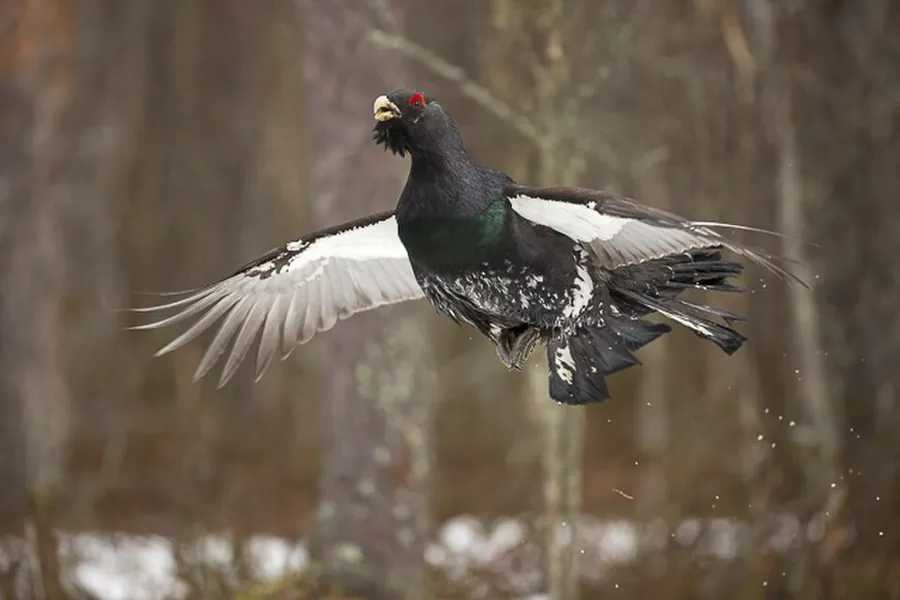
🐔Western Capercaillie
The western capercaillie, also known as the Eurasian capercaillie, wood grouse, heather cock, cock-of-the-woods, or simply capercaillie, is a heavy member of the grouse tribe and the largest of all extant grouse species. Found across Europe and the Palearctic, this primarily-ground-dwelling forest grouse is renowned for its courtship display. The bird shows extreme sexual dimorphism, with males nearly twice the size of females. The global population is listed as "least concern" under the IUCN, although the populations of central Europe are declining and fragmented, or possibly extirpated.
Text: Wikipedia, CC BY-SA 4.0.
IUCN Red List assessment, 2024.
- Body mass
- 2.72 kg
- Body length
- not recorded
- Shoulder height
- not recorded
- Top speed
- not recorded
- Bite force
- not recorded
- Maximum lifespan
- 18 years
Everything we know about the Western Capercaillie
Typical adult figures. Where a value is an estimate rather than a measurement, it says so.
Body mass2.72 kgAVONETOther figures ↓Hide ↑
Source: AVONET · v1.1 (Tobias et al. 2022) · CC BY 4.0
By sex
- Female1.97 kgWikidataQ129059
- Male3.8 kgWikidataQ129059
Figures vary
- 2.95 kgAnAgeAnAge build 15, 2023-07-03 (HAGR)data quality: acceptable
Tail length0.26 mAVONETDetails ↓Hide ↑
Source: AVONET · v1.1 (Tobias et al. 2022) · CC BY 4.0
Wing length0.35 mAVONETDetails ↓Hide ↑
Source: AVONET · v1.1 (Tobias et al. 2022) · CC BY 4.0
Beak length0.05 mAVONETDetails ↓Hide ↑
Source: AVONET · v1.1 (Tobias et al. 2022) · CC BY 4.0
Tarsus length0.06 mAVONETDetails ↓Hide ↑
Source: AVONET · v1.1 (Tobias et al. 2022) · CC BY 4.0
Maximum lifespan18 yearsAnAgeDetails ↓Hide ↑
data quality: acceptable
Source: AnAge · AnAge build 15, 2023-07-03 (HAGR) · CC BY 3.0
Trophic levelHerbivoreAVONETDetails ↓Hide ↑
Source: AVONET · v1.1 (Tobias et al. 2022) · CC BY 4.0
HabitatForestAVONETDetails ↓Hide ↑
Source: AVONET · v1.1 (Tobias et al. 2022) · CC BY 4.0
LifestyleGeneralistAVONETDetails ↓Hide ↑
Source: AVONET · v1.1 (Tobias et al. 2022) · CC BY 4.0
Volume l2.7 LaverageDetails ↓Hide ↑
Body mass at ~1.0 kg/L, the density of vertebrate tissue.
average = a mean across sexes or species in a group.
Not recorded for Western Capercaillie yet: body length, shoulder height, top speed, bite force.
Family tree
- kingdomAnimalia
- ›phylumChordata
- ›classAves
- ›orderGalliformes
- ›familyPhasianidae
- ›genusTetrao
- ›speciesTetrao urogallus
- classBirds · Aves
- orderGamebirds · Galliformes
- subfamilyTetraoninae
- genusTetrao
All 13 branches ↓Fewer branches ↑
- kingdomMetazoa
- phylumChordata
- subphylumCraniata
- subphylumVertebrata
- superclassGnathostomata
- superclassSarcopterygii
- superclassTetrapoda
- orderSauria
- classBirds · Aves
- superorderGalloanserae
- orderGamebirds · Galliformes
- subfamilyTetraoninae
- genusTetrao
More about the Western Capercaillie


Animals caught on camera
Real footage of the animals on this site — hunting, fighting, and getting on with it.
Compare the Western Capercaillie
Pick a tool — the Western Capercaillie is already selected.
Compare every stat with any other animal.
Stand them on the same floor and see who's bigger.
How speed, brain and bite scale with body size. This animal isn't in the sample yet.
See where it sits in the tree of life.