
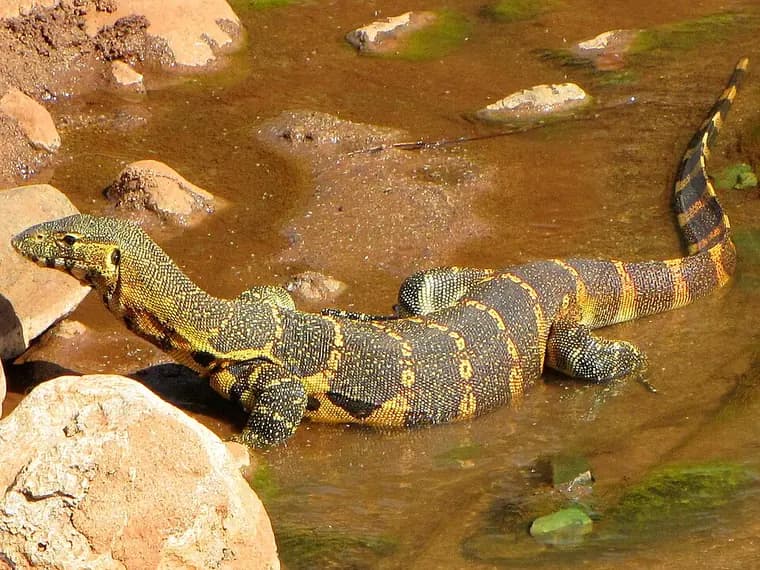
🦎Nile monitor
The Nile monitor is a large member of the monitor family (Varanidae) found throughout most of Sub-Saharan Africa, particularly in drier regions, and along the Nile River and its tributaries in East Africa. Additionally, there are modern, invasive populations in North America. The population found in West African forests and savannahs is sometimes recognized as a separate species, the West African Nile monitor and Ornate monitor. While it is dwarfed by its larger relatives, such as the Komodo dragon, the Asian water monitor or the crocodile monitor, it is still one of the largest lizards in the world, reaching Australia's perentie in size. Other common names include the African small-grain lizard, as well as iguana and various forms derived from it, such as guana, water leguaan or river leguaan.
Text: Wikipedia, CC BY-SA 4.0.
IUCN Red List assessment, 2021.
- Body mass
- 2.83 kg
- Body length
- not recorded
- Shoulder height
- not recorded
- Top speed
- not recorded
- Bite force
- not recorded
- Maximum lifespan
- 15 years
Everything we know about the Nile monitor
Typical adult figures. Where a value is an estimate rather than a measurement, it says so.
Body mass2.83 kgrecord 24 kg · ReptTraitsAnAgeDetails ↓Hide ↑
data quality: acceptable
Record: largest individual on record
Source: AnAge · AnAge build 15, 2023-07-03 (HAGR) · CC BY 3.0
Maximum lifespan15 yearsrecord 20 years · ReptTraitsAnAgeDetails ↓Hide ↑
data quality: acceptable
Record: largest individual on record
Source: AnAge · AnAge build 15, 2023-07-03 (HAGR) · CC BY 3.0
DietCarnivorousReptTraitsDetails ↓Hide ↑
Source: ReptTraits · v1.2 (Oskyrko et al. 2024) · CC BY 4.0
Activity cycleDiurnalReptTraitsDetails ↓Hide ↑
Source: ReptTraits · v1.2 (Oskyrko et al. 2024) · CC BY 4.0
Foraging modeACTReptTraitsDetails ↓Hide ↑
Source: ReptTraits · v1.2 (Oskyrko et al. 2024) · CC BY 4.0
Snout–vent length0.98 mmaximum recordedReptTraitsOther figures ↓Hide ↑
Source: ReptTraits · v1.2 (Oskyrko et al. 2024) · CC BY 4.0
By sex
- Female0.5 mReptTraitsv1.2 (Oskyrko et al. 2024)
Volume l2.8 LaverageDetails ↓Hide ↑
Body mass at ~1.0 kg/L, the density of vertebrate tissue.
average = a mean across sexes or species in a group.
Not recorded for Nile monitor yet: body length, shoulder height, top speed, bite force.
Family tree
- orderLizards & snakes · Squamata
- superfamilyVaranoidea
- familyVaranidae
- genusVaranus
All 14 branches ↓Fewer branches ↑
- kingdomMetazoa
- phylumChordata
- subphylumCraniata
- subphylumVertebrata
- superclassGnathostomata
- superclassSarcopterygii
- superclassTetrapoda
- orderSauria
- superorderLepidosauria
- orderLizards & snakes · Squamata
- infraorderAnguimorpha
- superfamilyVaranoidea
- familyVaranidae
- genusVaranus
More about the Nile monitor


No videos of the Nile monitor yet.
We have 44,653 videos so far, and none of them features this animal yet.
All videos →Compare the Nile monitor
Pick a tool — the Nile monitor is already selected.
Compare every stat with any other animal.
Stand them on the same floor and see who's bigger.
How speed, brain and bite scale with body size. This animal isn't in the sample yet.
See where it sits in the tree of life.