
🐃Nilgai
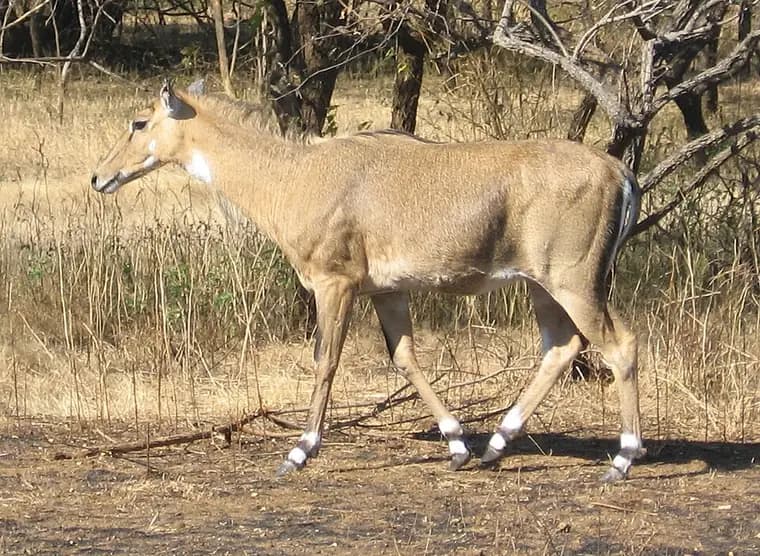
The nilgai is the largest antelope in Asia. It is ubiquitous across the northern Indian subcontinent. It is the sole living member of the genus Boselaphus, which was first scientifically described by Peter Simon Pallas in 1766. It is a sturdy, thin-legged antelope with a sloping back, a deep neck with a white patch on the throat, a short crest of hair along the neck terminating in a tuft, and white facial spots. A column of pendant, coarse hair hangs from the dewlap ridge below the white patch. It stands 100–150 cm (39–59 in) at the shoulder; males weigh 109–288 kg (240–635 lb), and the lighter females 100–213 kg (220–470 lb). Sexual dimorphism is prominent; while females and juveniles are orange to tawny, adult males have a bluish-grey coat. Only males have horns, which are 15–24 cm (5.9–9.4 in) long.
Text: Wikipedia, CC BY-SA 4.0.
IUCN Red List assessment, 2016.
- Body mass
- 180 kg
- Body length
- 2.05 m
- Shoulder height
- not recorded
- Top speed
- not recorded
- Bite force
- not recorded
- Maximum lifespan
- 22 years
Everything we know about the Nilgai
Typical adult figures. Where a value is an estimate rather than a measurement, it says so.
Body mass180 kgCOMBINEOther figures ↓Hide ↑
Source: COMBINE · v1 (Soria et al. 2021) · CC BY 4.0
Figures vary
- 180 kgAnAgeAnAge build 15, 2023-07-03 (HAGR)data quality: high
Body length2.05 mCOMBINEDetails ↓Hide ↑
Source: COMBINE · v1 (Soria et al. 2021) · CC BY 4.0
Brain mass272 gCOMBINEDetails ↓Hide ↑
Source: COMBINE · v1 (Soria et al. 2021) · CC BY 4.0
Maximum lifespan22 yearsCOMBINEOther figures ↓Hide ↑
Source: COMBINE · v1 (Soria et al. 2021) · CC BY 4.0
Figures vary
- 22 yearsAnAgeAnAge build 15, 2023-07-03 (HAGR)data quality: high
Generation length8.06 yearsCOMBINEDetails ↓Hide ↑
Source: COMBINE · v1 (Soria et al. 2021) · CC BY 4.0
Age at maturity2.2 yearsCOMBINEDetails ↓Hide ↑
Source: COMBINE · v1 (Soria et al. 2021) · CC BY 4.0
Gestation255 daysCOMBINEOther figures ↓Hide ↑
Source: COMBINE · v1 (Soria et al. 2021) · CC BY 4.0
Figures vary
- 255 daysAnAgeAnAge build 15, 2023-07-03 (HAGR)data quality: high
Litter sizeabout 2COMBINEOther figures ↓Hide ↑
Source: COMBINE · v1 (Soria et al. 2021) · CC BY 4.0
Figures vary
- 1.5AnAgeAnAge build 15, 2023-07-03 (HAGR)data quality: high
Trophic levelHerbivoreCOMBINEDetails ↓Hide ↑
Source: COMBINE · v1 (Soria et al. 2021) · CC BY 4.0
Activity cycleCrepuscular / mixedCOMBINEDetails ↓Hide ↑
Source: COMBINE · v1 (Soria et al. 2021) · CC BY 4.0
Population density1.63 per km²COMBINEDetails ↓Hide ↑
Source: COMBINE · v1 (Soria et al. 2021) · CC BY 4.0
Volume l180 LaverageDetails ↓Hide ↑
Body mass at ~1.0 kg/L, the density of vertebrate tissue.
average = a mean across sexes or species in a group.
Not recorded for Nilgai yet: shoulder height, top speed, bite force.
Family tree
- kingdomAnimalia
- ›phylumChordata
- ›classMammalia
- ›orderArtiodactyla
- ›familyBovidae
- ›genusBoselaphus
- ›speciesBoselaphus tragocamelus
- classMammals · Mammalia
- orderEven-toed hoofed animals · Artiodactyla
- subfamilyBovinae
- genusBoselaphus
All 16 branches ↓Fewer branches ↑
- kingdomMetazoa
- phylumChordata
- subphylumCraniata
- subphylumVertebrata
- superclassGnathostomata
- superclassSarcopterygii
- superclassTetrapoda
- classMammals · Mammalia
- subclassTheria
- superorderLaurasiatheria
- orderEven-toed hoofed animals · Artiodactyla
- suborderRuminantia
- infraorderPecora
- familyBovidae
- subfamilyBovinae
- genusBoselaphus
More about the Nilgai


Kameraya yakalanan hayvanlar
Bu sitedeki hayvanların gerçek görüntüleri — avlanırken, kavga ederken, kendi hâllerinde.
Compare the Nilgai
Pick a tool — the Nilgai is already selected.
Compare every stat with any other animal.
Stand them on the same floor and see who's bigger.
How speed, brain and bite scale with body size. This animal isn't in the sample yet.
See where it sits in the tree of life.