
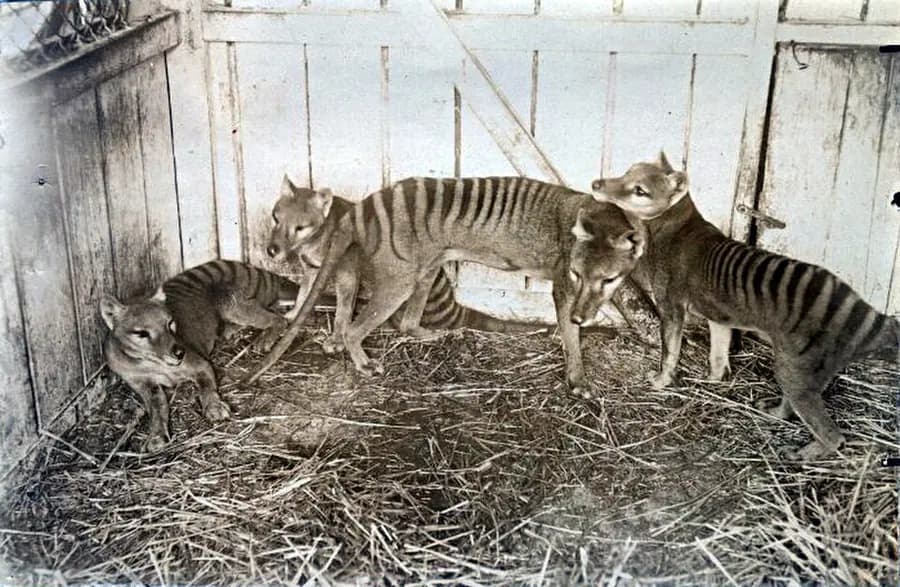
🐾Thylacine
The thylacine, also commonly known as the Tasmanian tiger, Tasmanian wolf or marsupial wolf is an extinct species of carnivorous marsupial which was native to the Australian mainland and the islands of Tasmania and New Guinea. The thylacine died out in New Guinea and mainland Australia around 3,600–3,200 years ago, possibly because of the introduction of the dingo, whose earliest record dates to around the same time, but which never reached Tasmania. Before European settlement, several thousand remained in the wild on the island of Tasmania. Beginning in the 19th century, they were perceived as a threat to the livestock of farmers and bounty hunting was introduced. The last known of its species died in 1936 at Hobart Zoo in Tasmania. The thylacine is widespread in popular culture and is a cultural icon in Australia.
Text: Wikipedia, CC BY-SA 4.0.
IUCN Red List assessment, 2025.
- Body mass
- 25 kg
- Body length
- 1.3 m
- Shoulder height
- 0.47 m
- Top speed
- not recorded
- Bite force
- not recorded
- Maximum lifespan
- 13 years
This animal is extinct
Assessed Extinct on the IUCN Red List, 2025. Everything on this page — the measurements, the photos, the videos — is a record of an animal that is gone.
Everything we know about the Thylacine
Typical adult figures. Where a value is an estimate rather than a measurement, it says so.
Body mass25 kgCOMBINEDetails ↓Hide ↑
Source: COMBINE · v1 (Soria et al. 2021) · CC BY 4.0
Body length1.3 mCOMBINEDetails ↓Hide ↑
Source: COMBINE · v1 (Soria et al. 2021) · CC BY 4.0
Shoulder height0.47 m0.35–0.6 m · typical rangetall at the shouldersDetails ↓Hide ↑
"They ranged from 350 to 600 mm tall at the shoulders and weighed from 15 to 30 kg." Value is the midpoint of the stated range; based on historical/museum records of an extinct species.
Source: Animal Diversity Web (Univ. Michigan), Thylacinus cynocephalus account, https://animaldiversity.org/accounts/Thylacinus_cynocephalus/ · see citation
Brain mass53 gCOMBINEDetails ↓Hide ↑
Source: COMBINE · v1 (Soria et al. 2021) · CC BY 4.0
Maximum lifespan13 yearsCOMBINEDetails ↓Hide ↑
Source: COMBINE · v1 (Soria et al. 2021) · CC BY 4.0
Generation length5.93 yearsestimatedCOMBINEDetails ↓Hide ↑
Source: COMBINE · v1 (Soria et al. 2021) · CC BY 4.0
Gestation60 daysestimatedCOMBINEDetails ↓Hide ↑
Source: COMBINE · v1 (Soria et al. 2021) · CC BY 4.0
Litter sizeabout 3COMBINEDetails ↓Hide ↑
Source: COMBINE · v1 (Soria et al. 2021) · CC BY 4.0
Trophic levelCarnivoreCOMBINEDetails ↓Hide ↑
Source: COMBINE · v1 (Soria et al. 2021) · CC BY 4.0
Activity cycleCrepuscular / mixedCOMBINEDetails ↓Hide ↑
Source: COMBINE · v1 (Soria et al. 2021) · CC BY 4.0
Volume l25 LaverageDetails ↓Hide ↑
Body mass at ~1.0 kg/L, the density of vertebrate tissue.
estimated = a model's estimate for a species nobody has measured; average = a mean across sexes or species in a group.
Not recorded for Thylacine yet: top speed, bite force.
Family tree
- kingdomAnimalia
- ›phylumChordata
- ›classMammalia
- ›orderDasyuromorphia
- ›familyThylacinidae
- ›genusThylacinus
- ›speciesThylacinus cynocephalus
- classMammals · Mammalia
- orderDasyuromorphia
- familyThylacinidae
- genusThylacinus
All 12 branches ↓Fewer branches ↑
- kingdomMetazoa
- phylumChordata
- subphylumCraniata
- subphylumVertebrata
- superclassGnathostomata
- superclassSarcopterygii
- superclassTetrapoda
- classMammals · Mammalia
- subclassTheria
- orderDasyuromorphia
- familyThylacinidae
- genusThylacinus
More about the Thylacine
Animals caught on camera
Real footage of the animals on this site — hunting, fighting, and getting on with it.
Compare the Thylacine
Pick a tool — the Thylacine is already selected.
Compare every stat with any other animal.
Stand them on the same floor and see who's bigger.
How speed, brain and bite scale with body size. This animal isn't in the sample yet.
See where it sits in the tree of life.