
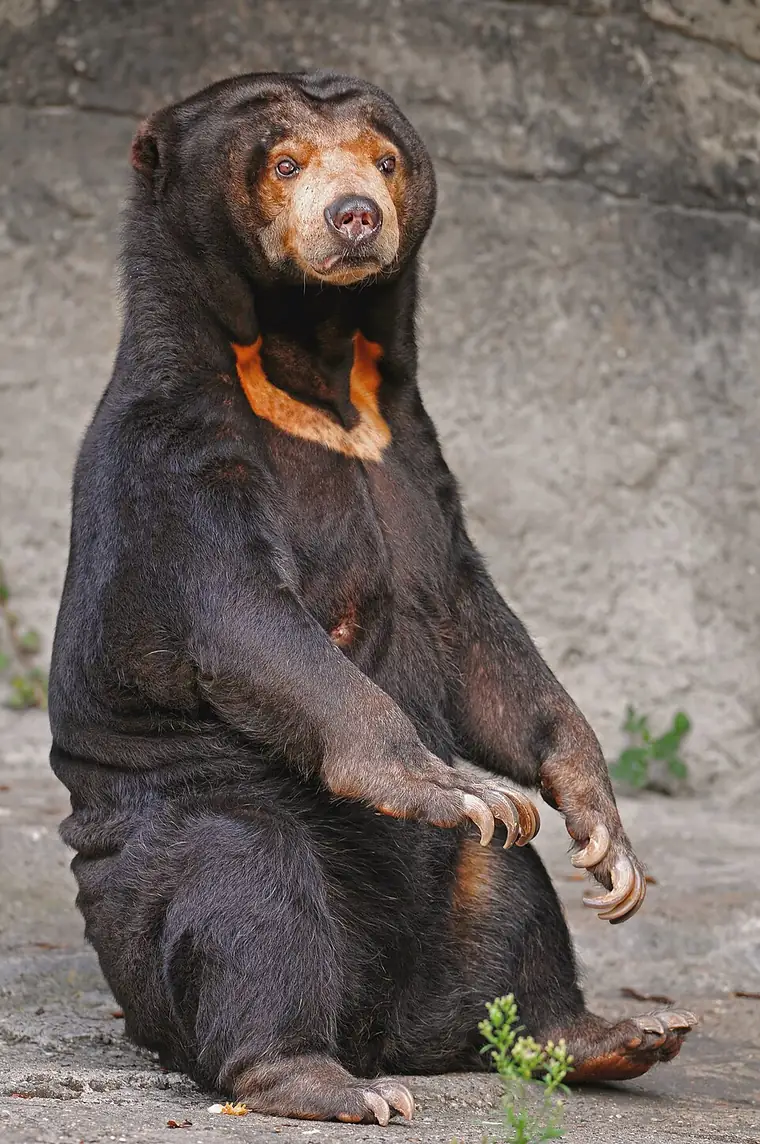
🐾Sun bear
The sun bear is a bear species in the family Ursidae found in the tropical forests of Southeast Asia. It is the only species in the genus Helarctos and the smallest bear species, standing nearly 70 cm (28 in) at the shoulder and weighing 25–65 kg (55–143 lb). It is stockily built, with large paws, strongly curved claws, small, rounded ears and a short snout. The fur is generally short and jet black, but can vary from grey to red. The sun bear gets its name from its characteristic orange to cream-coloured chest patch.
Text: Wikipedia, CC BY-SA 4.0.
IUCN Red List assessment, 2017.
- Body mass
- 46 kg
- Body length
- 1.31 m
- Shoulder height
- 0.7 m
- Top speed
- not recorded
- Bite force
- not recorded
- Maximum lifespan
- 36 years
Everything we know about the Sun bear
Typical adult figures. Where a value is an estimate rather than a measurement, it says so.
Body mass46 kgCOMBINEOther figures ↓Hide ↑
Source: COMBINE · v1 (Soria et al. 2021) · CC BY 4.0
Figures vary
- 46 kgAnAgeAnAge build 15, 2023-07-03 (HAGR)data quality: acceptable
Body length1.31 mCOMBINEDetails ↓Hide ↑
Source: COMBINE · v1 (Soria et al. 2021) · CC BY 4.0
Shoulder height0.7 mnot statedDetails ↓Hide ↑
"They stand 70 cm at the shoulder and are 1.2 to 1.5 m from head to tail."
Source: Bies 2007, Animal Diversity Web account: Helarctos malayanus, https://animaldiversity.org/accounts/Helarctos_malayanus/ · see citation
Brain mass363 gCOMBINEDetails ↓Hide ↑
Source: COMBINE · v1 (Soria et al. 2021) · CC BY 4.0
Maximum lifespan36 yearsCOMBINEOther figures ↓Hide ↑
Source: COMBINE · v1 (Soria et al. 2021) · CC BY 4.0
Figures vary
- 36 yearsAnAgeAnAge build 15, 2023-07-03 (HAGR)data quality: acceptable
Generation length9.99 yearsCOMBINEDetails ↓Hide ↑
Source: COMBINE · v1 (Soria et al. 2021) · CC BY 4.0
Age at maturity6.5 yearsCOMBINEDetails ↓Hide ↑
Source: COMBINE · v1 (Soria et al. 2021) · CC BY 4.0
Gestation98 daysCOMBINEOther figures ↓Hide ↑
Source: COMBINE · v1 (Soria et al. 2021) · CC BY 4.0
Figures vary
- 95 daysAnAgeAnAge build 15, 2023-07-03 (HAGR)data quality: acceptable
Litter size1COMBINEOther figures ↓Hide ↑
Source: COMBINE · v1 (Soria et al. 2021) · CC BY 4.0
Figures vary
- 1AnAgeAnAge build 15, 2023-07-03 (HAGR)data quality: acceptable
Trophic levelOmnivoreCOMBINEDetails ↓Hide ↑
Source: COMBINE · v1 (Soria et al. 2021) · CC BY 4.0
Activity cycleNocturnalCOMBINEDetails ↓Hide ↑
Source: COMBINE · v1 (Soria et al. 2021) · CC BY 4.0
Population density1.21 per km²COMBINEDetails ↓Hide ↑
Source: COMBINE · v1 (Soria et al. 2021) · CC BY 4.0
Volume l46 LaverageDetails ↓Hide ↑
Body mass at ~1.0 kg/L, the density of vertebrate tissue.
average = a mean across sexes or species in a group.
Not recorded for Sun bear yet: top speed, bite force.
Family tree
- kingdomAnimalia
- ›phylumChordata
- ›classMammalia
- ›orderCarnivora
- ›familyUrsidae
- ›genusHelarctos
- ›speciesHelarctos malayanus
- classMammals · Mammalia
- orderCarnivorans · Carnivora
- familyUrsidae
- genusHelarctos
All 14 branches ↓Fewer branches ↑
- kingdomMetazoa
- phylumChordata
- subphylumCraniata
- subphylumVertebrata
- superclassGnathostomata
- superclassSarcopterygii
- superclassTetrapoda
- classMammals · Mammalia
- subclassTheria
- superorderLaurasiatheria
- orderCarnivorans · Carnivora
- suborderCaniformia
- familyUrsidae
- genusHelarctos
More about the Sun bear


Animals caught on camera
Real footage of the animals on this site — hunting, fighting, and getting on with it.
Compare the Sun bear
Pick a tool — the Sun bear is already selected.
Compare every stat with any other animal.
Stand them on the same floor and see who's bigger.
How speed, brain and bite scale with body size. This animal isn't in the sample yet.
See where it sits in the tree of life.