
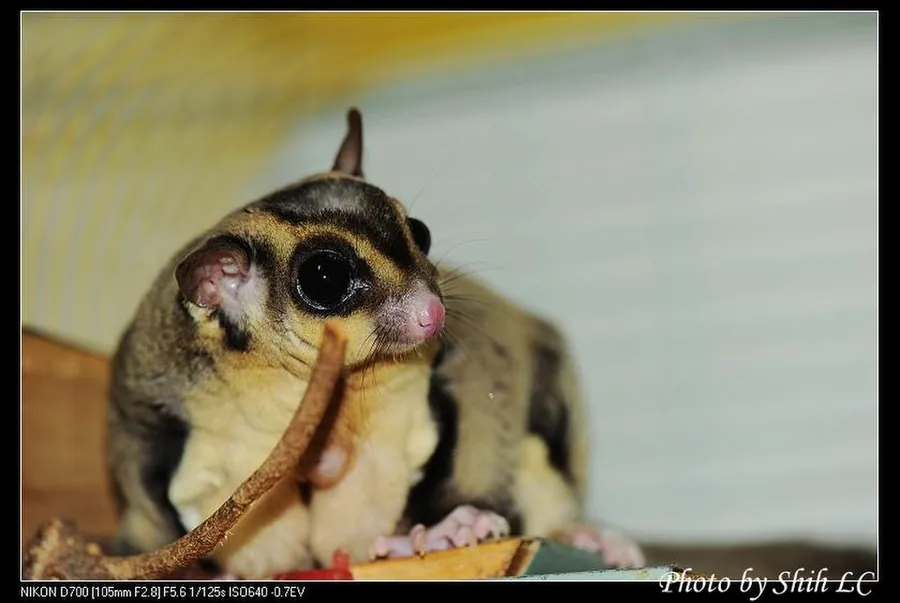
🐿️Sugar glider
The sugar glider is a small, omnivorous, arboreal, and nocturnal gliding possum. The common name refers to its predilection for sugary foods such as sap and nectar and its ability to glide through the air, much like a flying squirrel. They have very similar habits and appearance to the flying squirrel, despite not being closely related—an example of convergent evolution. The scientific name, Petaurus breviceps, translates from Latin as "short-headed rope-dancer", a reference to their canopy acrobatics.
Text: Wikipedia, CC BY-SA 4.0.
IUCN Red List assessment, 2016.
- Body mass
- 0.13 kg
- Body length
- 0.17 m
- Shoulder height
- not recorded
- Top speed
- not recorded
- Bite force
- not recorded
- Maximum lifespan
- 18 years
Everything we know about the Sugar glider
Typical adult figures. Where a value is an estimate rather than a measurement, it says so.
Body mass0.13 kgCOMBINEOther figures ↓Hide ↑
Source: COMBINE · v1 (Soria et al. 2021) · CC BY 4.0
Figures vary
- 0.11 kgAnAgeAnAge build 15, 2023-07-03 (HAGR)data quality: high
Body length0.17 mCOMBINEDetails ↓Hide ↑
Source: COMBINE · v1 (Soria et al. 2021) · CC BY 4.0
Brain mass2.09 gCOMBINEDetails ↓Hide ↑
Source: COMBINE · v1 (Soria et al. 2021) · CC BY 4.0
Maximum lifespan18 yearsCOMBINEOther figures ↓Hide ↑
Source: COMBINE · v1 (Soria et al. 2021) · CC BY 4.0
Figures vary
- 18 yearsAnAgeAnAge build 15, 2023-07-03 (HAGR)data quality: high
Generation length5.39 yearsCOMBINEDetails ↓Hide ↑
Source: COMBINE · v1 (Soria et al. 2021) · CC BY 4.0
Age at maturity320 daysCOMBINEDetails ↓Hide ↑
Source: COMBINE · v1 (Soria et al. 2021) · CC BY 4.0
Gestation16 daysCOMBINEOther figures ↓Hide ↑
Source: COMBINE · v1 (Soria et al. 2021) · CC BY 4.0
Figures vary
- 16 daysAnAgeAnAge build 15, 2023-07-03 (HAGR)data quality: high
Litter sizeabout 2COMBINEOther figures ↓Hide ↑
Source: COMBINE · v1 (Soria et al. 2021) · CC BY 4.0
Figures vary
- 2AnAgeAnAge build 15, 2023-07-03 (HAGR)data quality: high
Trophic levelOmnivoreCOMBINEDetails ↓Hide ↑
Source: COMBINE · v1 (Soria et al. 2021) · CC BY 4.0
Activity cycleNocturnalCOMBINEDetails ↓Hide ↑
Source: COMBINE · v1 (Soria et al. 2021) · CC BY 4.0
Home range0.01 km²COMBINEDetails ↓Hide ↑
Source: COMBINE · v1 (Soria et al. 2021) · CC BY 4.0
Population density450 per km²COMBINEDetails ↓Hide ↑
Source: COMBINE · v1 (Soria et al. 2021) · CC BY 4.0
Volume l0.1 LaverageDetails ↓Hide ↑
Body mass at ~1.0 kg/L, the density of vertebrate tissue.
average = a mean across sexes or species in a group.
Not recorded for Sugar glider yet: shoulder height, top speed, bite force.
Family tree
- kingdomAnimalia
- ›phylumChordata
- ›classMammalia
- ›orderDiprotodontia
- ›familyPetauridae
- ›genusPetaurus
- ›speciesPetaurus breviceps
- classMammals · Mammalia
- orderKangaroos, koalas & possums · Diprotodontia
- familyPetauridae
- genusPetaurus
All 12 branches ↓Fewer branches ↑
- kingdomMetazoa
- phylumChordata
- subphylumCraniata
- subphylumVertebrata
- superclassGnathostomata
- superclassSarcopterygii
- superclassTetrapoda
- classMammals · Mammalia
- subclassTheria
- orderKangaroos, koalas & possums · Diprotodontia
- familyPetauridae
- genusPetaurus
More about the Sugar glider
Animals caught on camera
Real footage of the animals on this site — hunting, fighting, and getting on with it.
Compare the Sugar glider
Pick a tool — the Sugar glider is already selected.
Compare every stat with any other animal.
Stand them on the same floor and see who's bigger.
How speed, brain and bite scale with body size. This animal isn't in the sample yet.
See where it sits in the tree of life.