
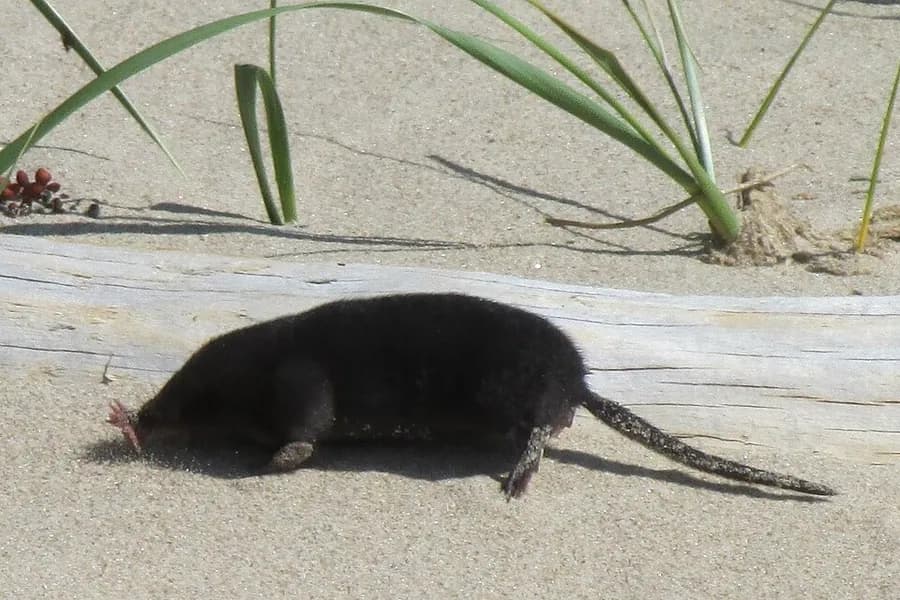
🐾Star-nosed mole
The star-nosed mole is a small semiaquatic mole found in moist, low elevation areas in the northeastern parts of North America. It is the only extant member of the tribe Condylurini and genus Condylura. It has more than 25,000 minute sensory receptors in touch organs, known as Eimer's organs, with which this hamster-sized mole feels its way around. With the help of its Eimer's organs, it may be perfectly poised to detect seismic wave vibrations.
Text: Wikipedia, CC BY-SA 4.0.
IUCN Red List assessment, 2016.
- Body mass
- 0.05 kg
- Body length
- 0.12 m
- Shoulder height
- not recorded
- Top speed
- not recorded
- Bite force
- not recorded
- Maximum lifespan
- 3 years
Everything we know about the Star-nosed mole
Typical adult figures. Where a value is an estimate rather than a measurement, it says so.
Body mass0.05 kgCOMBINEOther figures ↓Hide ↑
Source: COMBINE · v1 (Soria et al. 2021) · CC BY 4.0
Figures vary
- 0.06 kgAnAgeAnAge build 15, 2023-07-03 (HAGR)data quality: questionable
Body length0.12 mCOMBINEDetails ↓Hide ↑
Source: COMBINE · v1 (Soria et al. 2021) · CC BY 4.0
Brain mass1.37 gCOMBINEDetails ↓Hide ↑
Source: COMBINE · v1 (Soria et al. 2021) · CC BY 4.0
Maximum lifespan3 yearsCOMBINEOther figures ↓Hide ↑
Source: COMBINE · v1 (Soria et al. 2021) · CC BY 4.0
Figures vary
- 2.5 yearsAnAgeAnAge build 15, 2023-07-03 (HAGR)data quality: questionable
Generation length1.53 yearsCOMBINEDetails ↓Hide ↑
Source: COMBINE · v1 (Soria et al. 2021) · CC BY 4.0
Age at maturity304 daysCOMBINEDetails ↓Hide ↑
Source: COMBINE · v1 (Soria et al. 2021) · CC BY 4.0
Gestation40 daysCOMBINEOther figures ↓Hide ↑
Source: COMBINE · v1 (Soria et al. 2021) · CC BY 4.0
Figures vary
- 40 daysAnAgeAnAge build 15, 2023-07-03 (HAGR)data quality: questionable
Litter sizeabout 4COMBINEOther figures ↓Hide ↑
Source: COMBINE · v1 (Soria et al. 2021) · CC BY 4.0
Figures vary
- 4.4AnAgeAnAge build 15, 2023-07-03 (HAGR)data quality: questionable
Trophic levelCarnivoreCOMBINEDetails ↓Hide ↑
Source: COMBINE · v1 (Soria et al. 2021) · CC BY 4.0
Activity cycleCrepuscular / mixedCOMBINEDetails ↓Hide ↑
Source: COMBINE · v1 (Soria et al. 2021) · CC BY 4.0
Home range0 km²COMBINEDetails ↓Hide ↑
Source: COMBINE · v1 (Soria et al. 2021) · CC BY 4.0
Population density5,000 per km²COMBINEDetails ↓Hide ↑
Source: COMBINE · v1 (Soria et al. 2021) · CC BY 4.0
Volume l0.1 LaverageDetails ↓Hide ↑
Body mass at ~1.0 kg/L, the density of vertebrate tissue.
average = a mean across sexes or species in a group.
Not recorded for Star-nosed mole yet: shoulder height, top speed, bite force.
Family tree
- kingdomAnimalia
- ›phylumChordata
- ›classMammalia
- ›orderSoricomorpha
- ›familyTalpidae
- ›genusCondylura
- ›speciesCondylura cristata
- classMammals · Mammalia
- orderEulipotyphla
- familyTalpidae
- genusCondylura
All 13 branches ↓Fewer branches ↑
- kingdomMetazoa
- phylumChordata
- subphylumCraniata
- subphylumVertebrata
- superclassGnathostomata
- superclassSarcopterygii
- superclassTetrapoda
- classMammals · Mammalia
- subclassTheria
- superorderLaurasiatheria
- orderEulipotyphla
- familyTalpidae
- genusCondylura
More about the Star-nosed mole
No videos of the Star-nosed mole yet.
We have 44,653 videos so far, and none of them features this animal yet.
All videos →Compare the Star-nosed mole
Pick a tool — the Star-nosed mole is already selected.
Compare every stat with any other animal.
Stand them on the same floor and see who's bigger.
How speed, brain and bite scale with body size. This animal isn't in the sample yet.
See where it sits in the tree of life.