
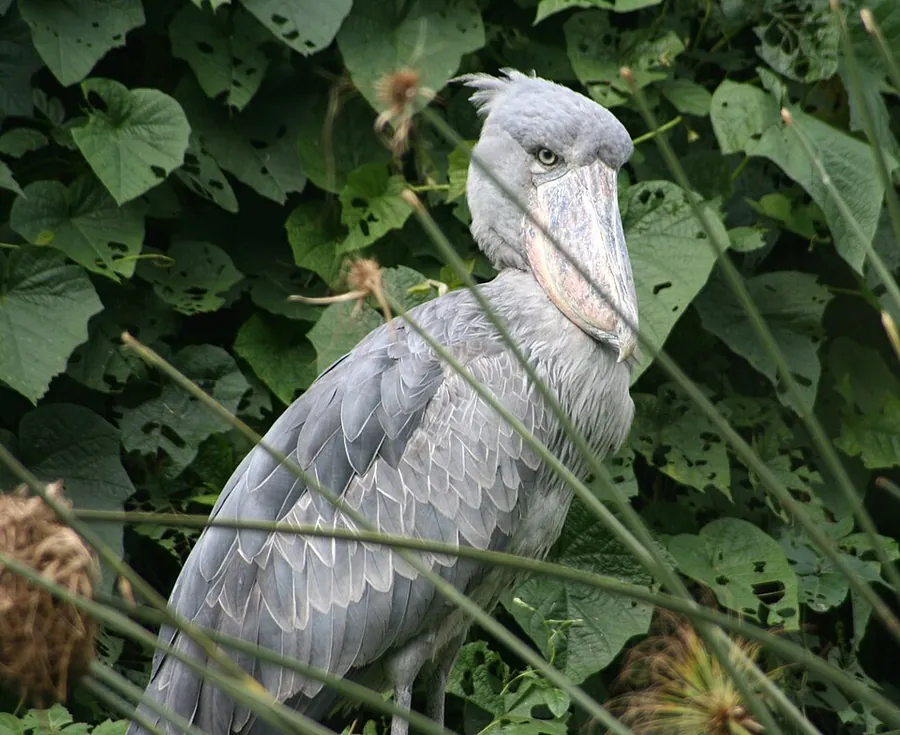
🐦Shoebill
The shoebill, also known as the whale-headed stork, whalebill, and shoe-billed stork, is a large long-legged wading bird. It is named for its enormous, shoe-shaped bill. It has a somewhat stork-like overall form and was previously classified as a stork in the order Ciconiiformes, but genetic evidence has now placed it along with pelicans, herons, and its closest relative, the hamerkop, all in the order Pelecaniformes. Adults are mainly grey, while juveniles are browner. It lives in tropical East Africa in large swamps from South Sudan down to Zambia.
Text: Wikipedia, CC BY-SA 4.0.
IUCN Red List assessment, 2018.
- Body mass
- 5.94 kg
- Body length
- not recorded
- Shoulder height
- not recorded
- Top speed
- not recorded
- Bite force
- not recorded
- Maximum lifespan
- 36 years
Everything we know about the Shoebill
Typical adult figures. Where a value is an estimate rather than a measurement, it says so.
Body mass5.94 kgAVONETOther figures ↓Hide ↑
Source: AVONET · v1.1 (Tobias et al. 2022) · CC BY 4.0
Figures vary
- 5.98 kgAnAgeAnAge build 15, 2023-07-03 (HAGR)data quality: acceptable
Standing height1.25 m1.1–1.4 m · typical rangestandingDetails ↓Hide ↑
"Large, somewhat frightful looking birds, shoebill storks stand 110 to 140 cm tall." Value is the midpoint of the stated range.
Source: Animal Diversity Web (Univ. Michigan), Balaeniceps rex account, https://animaldiversity.org/accounts/Balaeniceps_rex/ · see citation
Tail length0.28 mAVONETDetails ↓Hide ↑
Source: AVONET · v1.1 (Tobias et al. 2022) · CC BY 4.0
Wing length0.64 mAVONETDetails ↓Hide ↑
Source: AVONET · v1.1 (Tobias et al. 2022) · CC BY 4.0
Beak length0.2 mAVONETDetails ↓Hide ↑
Source: AVONET · v1.1 (Tobias et al. 2022) · CC BY 4.0
Tarsus length0.24 mAVONETDetails ↓Hide ↑
Source: AVONET · v1.1 (Tobias et al. 2022) · CC BY 4.0
Maximum lifespan36 yearsAnAgeDetails ↓Hide ↑
data quality: acceptable
Source: AnAge · AnAge build 15, 2023-07-03 (HAGR) · CC BY 3.0
Trophic levelCarnivoreAVONETDetails ↓Hide ↑
Source: AVONET · v1.1 (Tobias et al. 2022) · CC BY 4.0
HabitatWetlandAVONETDetails ↓Hide ↑
Source: AVONET · v1.1 (Tobias et al. 2022) · CC BY 4.0
LifestyleTerrestrialAVONETDetails ↓Hide ↑
Source: AVONET · v1.1 (Tobias et al. 2022) · CC BY 4.0
Volume l5.9 LaverageDetails ↓Hide ↑
Body mass at ~1.0 kg/L, the density of vertebrate tissue.
average = a mean across sexes or species in a group.
Not recorded for Shoebill yet: body length, shoulder height, top speed, bite force.
Family tree
- kingdomAnimalia
- ›phylumChordata
- ›classAves
- ›orderPelecaniformes
- ›familyBalaenicipitidae
- ›genusBalaeniceps
- ›speciesBalaeniceps rex
- orderSauria
- classBirds · Aves
- familyBalaenicipitidae
- genusBalaeniceps
All 11 branches ↓Fewer branches ↑
- kingdomMetazoa
- phylumChordata
- subphylumCraniata
- subphylumVertebrata
- superclassGnathostomata
- superclassSarcopterygii
- superclassTetrapoda
- orderSauria
- classBirds · Aves
- familyBalaenicipitidae
- genusBalaeniceps
More about the Shoebill


Animals caught on camera
Real footage of the animals on this site — hunting, fighting, and getting on with it.
Compare the Shoebill
Pick a tool — the Shoebill is already selected.
Compare every stat with any other animal.
Stand them on the same floor and see who's bigger.
How speed, brain and bite scale with body size. This animal isn't in the sample yet.
See where it sits in the tree of life.