
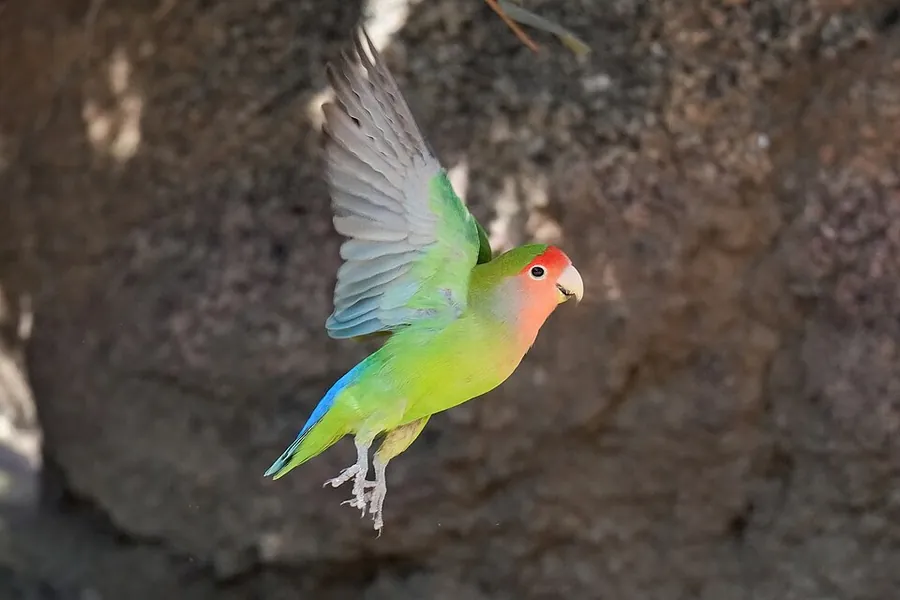
🦜Rosy-faced Lovebird
The rosy-faced lovebird, also known as the rosy-collared or peach-faced lovebird, is a species of lovebird native to the Namibian savanna woodlands. Loud and constant chirpers, these birds are very social animals and often congregate in small groups in the wild. They eat throughout the day and take frequent baths. Coloration can vary widely among populations. Plumage is identical in males and females. Lovebirds are renowned for their sleep position in which they sit side-by-side and turn their faces in towards each other. Also, females are well noted to tear raw materials into long strips, "twisty-tie" them onto their backs, and fly substantial distances back to make a nest. These birds are common in the pet industry.
Text: Wikipedia, CC BY-SA 4.0.
IUCN Red List assessment, 2018.
- Body mass
- 0.05 kg
- Body length
- not recorded
- Shoulder height
- not recorded
- Top speed
- not recorded
- Bite force
- not recorded
- Maximum lifespan
- not recorded
Everything we know about the Rosy-faced Lovebird
Typical adult figures. Where a value is an estimate rather than a measurement, it says so.
Body mass0.05 kgAVONETOther figures ↓Hide ↑
Source: AVONET · v1.1 (Tobias et al. 2022) · CC BY 4.0
Figures vary
- 0.05 kgAnAgeAnAge build 15, 2023-07-03 (HAGR)data quality: low
Tail length0.05 mAVONETDetails ↓Hide ↑
Source: AVONET · v1.1 (Tobias et al. 2022) · CC BY 4.0
Wing length0.1 mAVONETDetails ↓Hide ↑
Source: AVONET · v1.1 (Tobias et al. 2022) · CC BY 4.0
Beak length0.02 mAVONETDetails ↓Hide ↑
Source: AVONET · v1.1 (Tobias et al. 2022) · CC BY 4.0
Tarsus length0.01 mAVONETDetails ↓Hide ↑
Source: AVONET · v1.1 (Tobias et al. 2022) · CC BY 4.0
Gestation23 daysAnAgeDetails ↓Hide ↑
data quality: low
Source: AnAge · AnAge build 15, 2023-07-03 (HAGR) · CC BY 3.0
Litter sizeabout 5AnAgeDetails ↓Hide ↑
data quality: low
Source: AnAge · AnAge build 15, 2023-07-03 (HAGR) · CC BY 3.0
Trophic levelHerbivoreAVONETDetails ↓Hide ↑
Source: AVONET · v1.1 (Tobias et al. 2022) · CC BY 4.0
HabitatShrublandAVONETDetails ↓Hide ↑
Source: AVONET · v1.1 (Tobias et al. 2022) · CC BY 4.0
LifestyleTerrestrialAVONETDetails ↓Hide ↑
Source: AVONET · v1.1 (Tobias et al. 2022) · CC BY 4.0
Volume l0.1 LaverageDetails ↓Hide ↑
Body mass at ~1.0 kg/L, the density of vertebrate tissue.
average = a mean across sexes or species in a group.
Not recorded for Rosy-faced Lovebird yet: body length, shoulder height, top speed, bite force, maximum lifespan.
Family tree
- kingdomAnimalia
- ›phylumChordata
- ›classAves
- ›orderPsittaciformes
- ›familyPsittacidae
- ›genusAgapornis
- ›speciesAgapornis roseicollis
- orderSauria
- classBirds · Aves
- orderParrots · Psittaciformes
- genusAgapornis
All 11 branches ↓Fewer branches ↑
- kingdomMetazoa
- phylumChordata
- subphylumCraniata
- subphylumVertebrata
- superclassGnathostomata
- superclassSarcopterygii
- superclassTetrapoda
- orderSauria
- classBirds · Aves
- orderParrots · Psittaciformes
- genusAgapornis
More about the Rosy-faced Lovebird


No videos of the Rosy-faced Lovebird yet.
We have 44,653 videos so far, and none of them features this animal yet.
All videos →Compare the Rosy-faced Lovebird
Pick a tool — the Rosy-faced Lovebird is already selected.
Compare every stat with any other animal.
Stand them on the same floor and see who's bigger.
How speed, brain and bite scale with body size. This animal isn't in the sample yet.
See where it sits in the tree of life.