
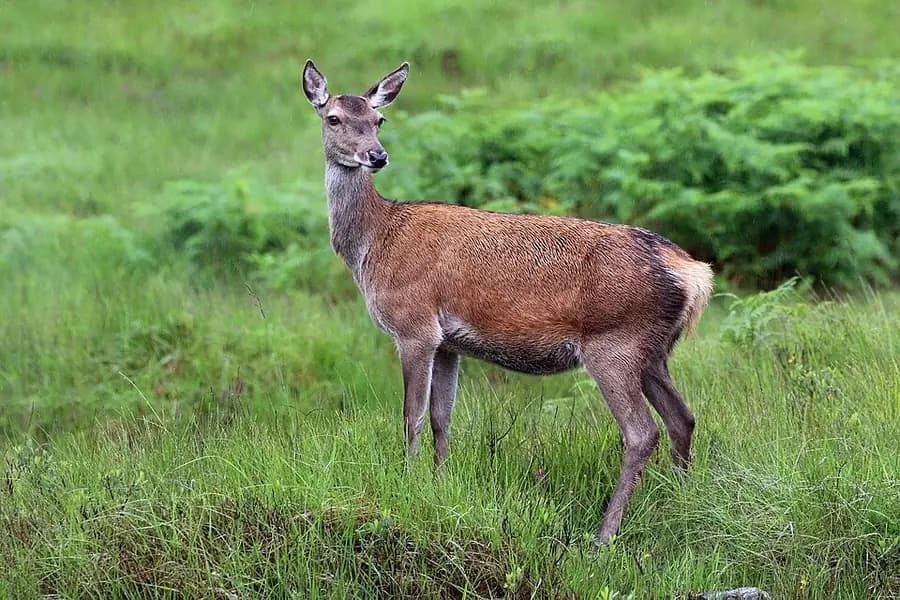
🦌Red deer
The red deer is a species of deer in the genus Cervus. It is one of the largest deer species. A male red deer is called a stag or hart, and a female is called a hind. The red deer inhabits most of Europe, the Caucasus Mountains region, Anatolia, Iran, and parts of Western Asia. It also inhabits the Atlas Mountains of Northern Africa, being the only living species of deer to inhabit Africa. Red deer have been introduced to other areas, including Australia, New Zealand, the United States, Canada, Peru, Uruguay, Chile and Argentina. In many parts of the world, the meat (venison) from red deer is used as a food source.
Text: Wikipedia, CC BY-SA 4.0.
IUCN Red List assessment, 2018.
- Body mass
- 160 kg
- Body length
- 2.14 m
- Shoulder height
- 1.13 m
- Top speed
- not recorded
- Bite force
- not recorded
- Maximum lifespan
- 31 years
Everything we know about the Red deer
Typical adult figures. Where a value is an estimate rather than a measurement, it says so.
Body mass160 kgCOMBINEOther figures ↓Hide ↑
Source: COMBINE · v1 (Soria et al. 2021) · CC BY 4.0
Figures vary
- 200 kgAnAgeAnAge build 15, 2023-07-03 (HAGR)data quality: high
Body length2.14 mCOMBINEDetails ↓Hide ↑
Source: COMBINE · v1 (Soria et al. 2021) · CC BY 4.0
Shoulder height1.13 maverageOther figures ↓Hide ↑
Species-level value synthesised as the mean of: both.
By sex
- Both1.13 mHandbook of the Mammals of the World Vol 2: Hoofed Mammals (Wilson & Mittermeier eds) 2011, Red Deer species account, pp. 422-423, Lynx Edicions, https://zenodo.org/records/6514513'Shoulder height 105-130 cm (stags) and 95-115 cm (hinds)'. Value is the midpoint of the combined published span (95-130 cm). European red deer; wapiti-type populations run larger (ADW for C. elaphus sensu lato: 'most elk stand approximately 0.75 to 1.5 m high at the shoulder').
Brain mass354 gCOMBINEDetails ↓Hide ↑
Source: COMBINE · v1 (Soria et al. 2021) · CC BY 4.0
Maximum lifespan31 yearsCOMBINEOther figures ↓Hide ↑
Source: COMBINE · v1 (Soria et al. 2021) · CC BY 4.0
Figures vary
- 32 yearsAnAgeAnAge build 15, 2023-07-03 (HAGR)data quality: high
Generation length14 yearsCOMBINEDetails ↓Hide ↑
Source: COMBINE · v1 (Soria et al. 2021) · CC BY 4.0
Age at maturity1.8 yearsCOMBINEDetails ↓Hide ↑
Source: COMBINE · v1 (Soria et al. 2021) · CC BY 4.0
Gestation244 daysCOMBINEOther figures ↓Hide ↑
Source: COMBINE · v1 (Soria et al. 2021) · CC BY 4.0
Figures vary
- 245 daysAnAgeAnAge build 15, 2023-07-03 (HAGR)data quality: high
Litter size1COMBINEOther figures ↓Hide ↑
Source: COMBINE · v1 (Soria et al. 2021) · CC BY 4.0
Figures vary
- 1AnAgeAnAge build 15, 2023-07-03 (HAGR)data quality: high
Trophic levelHerbivoreCOMBINEDetails ↓Hide ↑
Source: COMBINE · v1 (Soria et al. 2021) · CC BY 4.0
Activity cycleCrepuscular / mixedCOMBINEDetails ↓Hide ↑
Source: COMBINE · v1 (Soria et al. 2021) · CC BY 4.0
Home range58 km²COMBINEDetails ↓Hide ↑
Source: COMBINE · v1 (Soria et al. 2021) · CC BY 4.0
Population density3.62 per km²COMBINEDetails ↓Hide ↑
Source: COMBINE · v1 (Soria et al. 2021) · CC BY 4.0
Volume l160 LaverageDetails ↓Hide ↑
Body mass at ~1.0 kg/L, the density of vertebrate tissue.
average = a mean across sexes or species in a group.
Not recorded for Red deer yet: top speed, bite force.
Family tree
- kingdomAnimalia
- ›phylumChordata
- ›classMammalia
- ›orderArtiodactyla
- ›familyCervidae
- ›genusCervus
- ›speciesCervus elaphus
- classMammals · Mammalia
- orderEven-toed hoofed animals · Artiodactyla
- familyCervidae
- subfamilyCervinae
All 15 branches ↓Fewer branches ↑
- kingdomMetazoa
- phylumChordata
- subphylumCraniata
- subphylumVertebrata
- superclassGnathostomata
- superclassSarcopterygii
- superclassTetrapoda
- classMammals · Mammalia
- subclassTheria
- superorderLaurasiatheria
- orderEven-toed hoofed animals · Artiodactyla
- suborderRuminantia
- infraorderPecora
- familyCervidae
- subfamilyCervinae
More about the Red deer
Animals caught on camera
Real footage of the animals on this site — hunting, fighting, and getting on with it.
Compare the Red deer
Pick a tool — the Red deer is already selected.
Compare every stat with any other animal.
Stand them on the same floor and see who's bigger.
How speed, brain and bite scale with body size. This animal isn't in the sample yet.
See where it sits in the tree of life.