
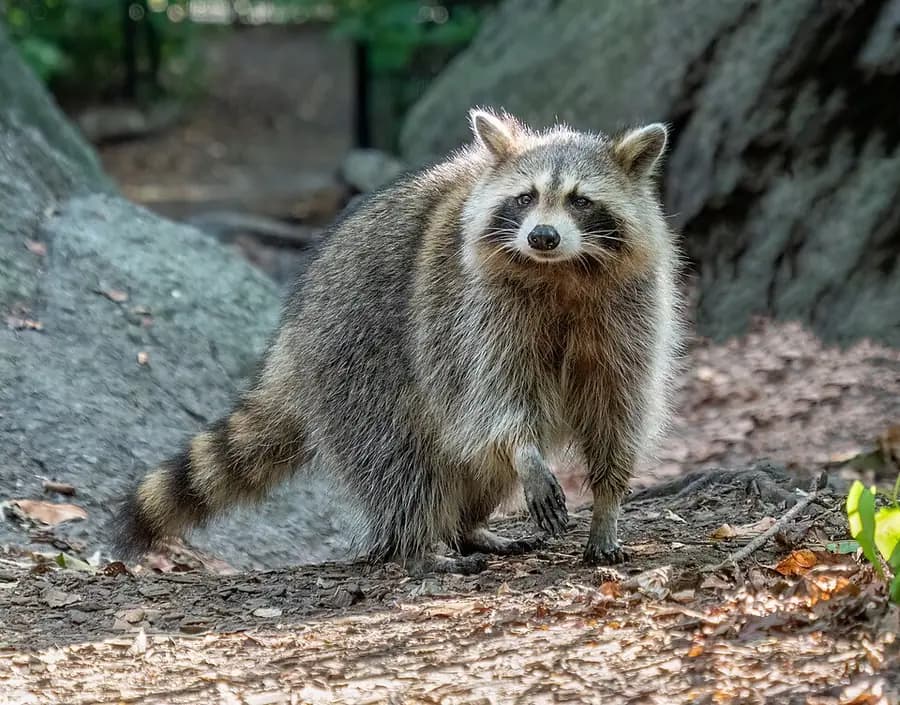
🦝Raccoon
The raccoon, sometimes called the North American, northern or common raccoon to distinguish it from other species of raccoon, is a mammal native to North America. It is the largest of the procyonid family, having a body length of 40 to 70 cm, and a body weight of 5 to 26 kg. Its grayish coat mostly consists of dense underfur, which insulates it against cold weather. The animal's most distinctive features include its extremely dexterous front paws, its facial mask, and its ringed tail, which are common themes in the mythologies of the Indigenous peoples of the Americas surrounding the species. The raccoon is noted for its intelligence, and studies show that it can remember the solution to tasks for at least three years. It is usually nocturnal and omnivorous, eating about 40% invertebrates, 33% plants, and 27% vertebrates.
Text: Wikipedia, CC BY-SA 4.0.
IUCN Red List assessment, 2016.
- Body mass
- 5.08 kg
- Body length
- 0.6 m
- Shoulder height
- 0.3 m
- Top speed
- not recorded
- Bite force
- not recorded
- Maximum lifespan
- 21 years
Everything we know about the Raccoon
Typical adult figures. Where a value is an estimate rather than a measurement, it says so.
Body mass5.08 kgCOMBINEOther figures ↓Hide ↑
Source: COMBINE · v1 (Soria et al. 2021) · CC BY 4.0
Figures vary
- 6 kgAnAgeAnAge build 15, 2023-07-03 (HAGR)data quality: acceptable
Body length0.6 mCOMBINEDetails ↓Hide ↑
Source: COMBINE · v1 (Soria et al. 2021) · CC BY 4.0
Shoulder height0.3 mat the shoulderDetails ↓Hide ↑
"Height: 12 in. at the shoulder" (profile also gives length 1 1/2-3 1/2 ft, weight 8-25 lbs). Point value, no range; published agency/extension figures vary (Univ. of Arizona Extension states about 16 in), so treat as approximate. ADW and Mammalian Species give no height.
Source: North Carolina Wildlife Resources Commission, Raccoon Wildlife Profile, https://www.ncwildlife.gov/media/2231/open · see citation
Brain mass42 gCOMBINEDetails ↓Hide ↑
Source: COMBINE · v1 (Soria et al. 2021) · CC BY 4.0
Maximum lifespan21 yearsCOMBINEOther figures ↓Hide ↑
Source: COMBINE · v1 (Soria et al. 2021) · CC BY 4.0
Figures vary
- 21 yearsAnAgeAnAge build 15, 2023-07-03 (HAGR)data quality: acceptable
Generation length7.4 yearsCOMBINEDetails ↓Hide ↑
Source: COMBINE · v1 (Soria et al. 2021) · CC BY 4.0
Age at maturity1.5 yearsCOMBINEDetails ↓Hide ↑
Source: COMBINE · v1 (Soria et al. 2021) · CC BY 4.0
Gestation64 daysCOMBINEOther figures ↓Hide ↑
Source: COMBINE · v1 (Soria et al. 2021) · CC BY 4.0
Figures vary
- 63 daysAnAgeAnAge build 15, 2023-07-03 (HAGR)data quality: acceptable
Litter sizeabout 3COMBINEOther figures ↓Hide ↑
Source: COMBINE · v1 (Soria et al. 2021) · CC BY 4.0
Figures vary
- 4AnAgeAnAge build 15, 2023-07-03 (HAGR)data quality: acceptable
Trophic levelOmnivoreCOMBINEDetails ↓Hide ↑
Source: COMBINE · v1 (Soria et al. 2021) · CC BY 4.0
Activity cycleNocturnalCOMBINEDetails ↓Hide ↑
Source: COMBINE · v1 (Soria et al. 2021) · CC BY 4.0
Home range4.62 km²COMBINEDetails ↓Hide ↑
Source: COMBINE · v1 (Soria et al. 2021) · CC BY 4.0
Population density147 per km²COMBINEDetails ↓Hide ↑
Source: COMBINE · v1 (Soria et al. 2021) · CC BY 4.0
Volume l5.1 LaverageDetails ↓Hide ↑
Body mass at ~1.0 kg/L, the density of vertebrate tissue.
average = a mean across sexes or species in a group.
Not recorded for Raccoon yet: top speed, bite force.
Family tree
- kingdomAnimalia
- ›phylumChordata
- ›classMammalia
- ›orderCarnivora
- ›familyProcyonidae
- ›genusProcyon
- ›speciesProcyon lotor
- classMammals · Mammalia
- orderCarnivorans · Carnivora
- familyProcyonidae
- genusProcyon
All 14 branches ↓Fewer branches ↑
- kingdomMetazoa
- phylumChordata
- subphylumCraniata
- subphylumVertebrata
- superclassGnathostomata
- superclassSarcopterygii
- superclassTetrapoda
- classMammals · Mammalia
- subclassTheria
- superorderLaurasiatheria
- orderCarnivorans · Carnivora
- suborderCaniformia
- familyProcyonidae
- genusProcyon
More about the Raccoon


Animals caught on camera
Real footage of the animals on this site — hunting, fighting, and getting on with it.
Compare the Raccoon
Pick a tool — the Raccoon is already selected.
Compare every stat with any other animal.
Stand them on the same floor and see who's bigger.
How speed, brain and bite scale with body size. This animal isn't in the sample yet.
See where it sits in the tree of life.