
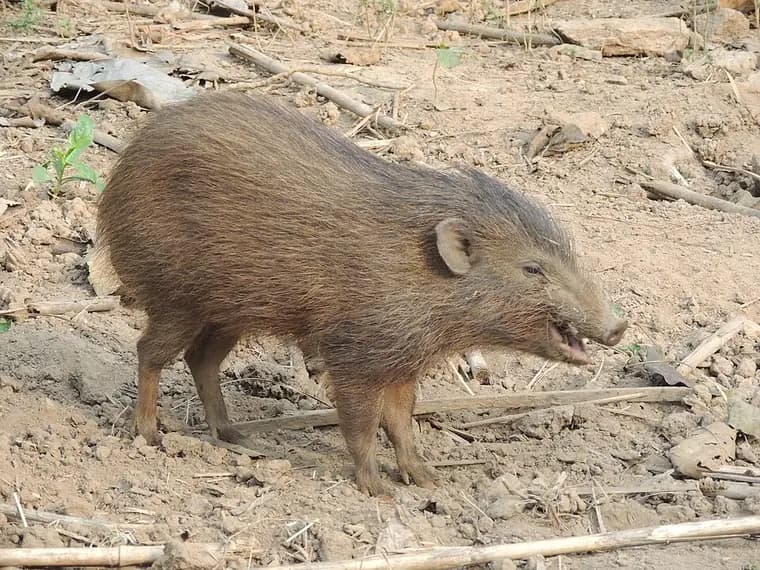
🐗Pygmy hog
The pygmy hog is a very small and endangered species of pig and the only species in the genus Porcula. Endemic to India, the pygmy hog is a suid native of the alluvial grasslands in the foothills of the Himalayas, at elevations of up to 300 m (980 ft). Populations of pygmy hogs were once widespread in the tall, dense, wet grasslands in a narrow belt of the southern Himalayan foothills from north-western Uttar Pradesh to Assam, through southern Nepal and North Bengal, and possibly extending into contiguous habitats in southern Bhutan. Due to human encroachment and destruction of the pygmy hogs' natural habitat, the species was thought to have gone extinct in the early 1960s. However, in 1971, a small pygmy hog population was rediscovered as they were fleeing a fire near the Barnadi Wildlife Sanctuary in Assam. Today, the only known population of pygmy hogs resides in Manas National Park. The population is threatened by livestock grazing, fires and poaching. With an estimated population of less than 250 mature individuals, the pygmy hog is listed as an Endangered species on the IUCN Red List, and conservation efforts such as captive breeding and re-release programs are currently being employed.
Text: Wikipedia, CC BY-SA 4.0.
IUCN Red List assessment, 2019.
- Body mass
- 8 kg
- Body length
- 0.62 m
- Shoulder height
- not recorded
- Top speed
- not recorded
- Bite force
- not recorded
- Maximum lifespan
- 14 years
Everything we know about the Pygmy hog
Typical adult figures. Where a value is an estimate rather than a measurement, it says so.
Body mass8 kgCOMBINEDetails ↓Hide ↑
Source: COMBINE · v1 (Soria et al. 2021) · CC BY 4.0
Body length0.62 mCOMBINEDetails ↓Hide ↑
Source: COMBINE · v1 (Soria et al. 2021) · CC BY 4.0
Maximum lifespan14 yearsCOMBINEDetails ↓Hide ↑
Source: COMBINE · v1 (Soria et al. 2021) · CC BY 4.0
Generation length4.35 yearsCOMBINEDetails ↓Hide ↑
Source: COMBINE · v1 (Soria et al. 2021) · CC BY 4.0
Age at maturity1.9 yearsCOMBINEDetails ↓Hide ↑
Source: COMBINE · v1 (Soria et al. 2021) · CC BY 4.0
Gestation111 daysCOMBINEDetails ↓Hide ↑
Source: COMBINE · v1 (Soria et al. 2021) · CC BY 4.0
Litter sizeabout 3COMBINEDetails ↓Hide ↑
Source: COMBINE · v1 (Soria et al. 2021) · CC BY 4.0
Trophic levelOmnivoreCOMBINEDetails ↓Hide ↑
Source: COMBINE · v1 (Soria et al. 2021) · CC BY 4.0
Activity cycleCrepuscular / mixedCOMBINEDetails ↓Hide ↑
Source: COMBINE · v1 (Soria et al. 2021) · CC BY 4.0
Home range0.15 km²COMBINEDetails ↓Hide ↑
Source: COMBINE · v1 (Soria et al. 2021) · CC BY 4.0
Volume l8 LaverageDetails ↓Hide ↑
Body mass at ~1.0 kg/L, the density of vertebrate tissue.
average = a mean across sexes or species in a group.
Not recorded for Pygmy hog yet: shoulder height, top speed, bite force.
Family tree
- kingdomAnimalia
- ›phylumChordata
- ›classMammalia
- ›orderArtiodactyla
- ›familySuidae
- ›genusSus
- ›speciesSus salvanius
- classMammals · Mammalia
- orderEven-toed hoofed animals · Artiodactyla
- familySuidae
- genusPorcula
All 14 branches ↓Fewer branches ↑
- kingdomMetazoa
- phylumChordata
- subphylumCraniata
- subphylumVertebrata
- superclassGnathostomata
- superclassSarcopterygii
- superclassTetrapoda
- classMammals · Mammalia
- subclassTheria
- superorderLaurasiatheria
- orderEven-toed hoofed animals · Artiodactyla
- suborderSuina
- familySuidae
- genusPorcula
More about the Pygmy hog
No videos of the Pygmy hog yet.
We have 44,653 videos so far, and none of them features this animal yet.
All videos →Compare the Pygmy hog
Pick a tool — the Pygmy hog is already selected.
Compare every stat with any other animal.
Stand them on the same floor and see who's bigger.
How speed, brain and bite scale with body size. This animal isn't in the sample yet.
See where it sits in the tree of life.