
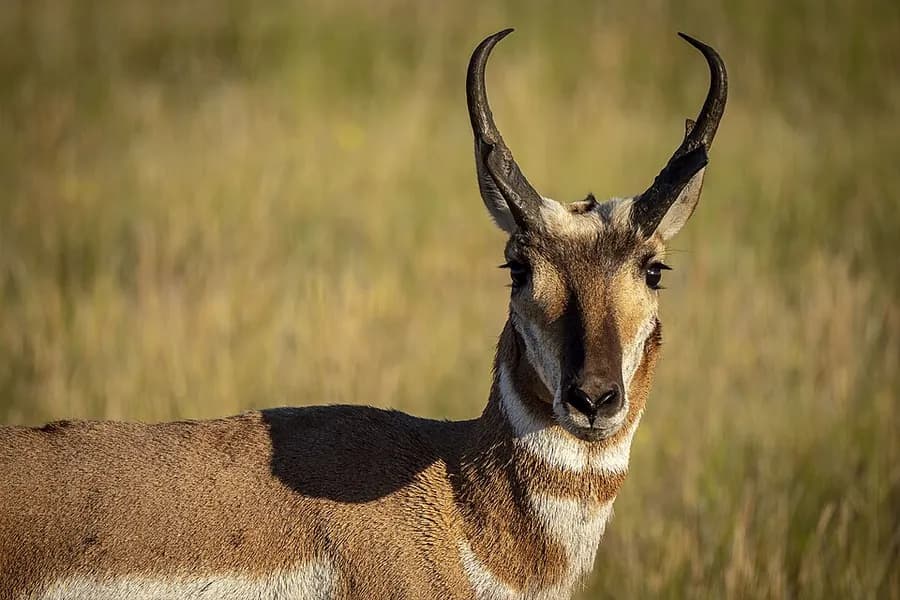
 🐃
Photo: U.S. Department of Agriculture Preston Keres/O… · Public domain
🐃Pronghorn
The pronghorn is a species of artiodactyl mammal indigenous to interior western and central North America. Though not an antelope, it is known colloquially in North America as the American antelope, prong buck, pronghorn antelope, and prairie antelope, because it closely resembles the antelopes of the Old World and fills a similar ecological niche due to parallel evolution. It is the only surviving member of the family Antilocapridae.
Text: Wikipedia, CC BY-SA 4.0.
IUCN Red List assessment, 2016.
- Body mass
- 45 kg
- Body length
- 1.41 m
- Shoulder height
- 0.87 m
- Top speed
- not recorded
- Bite force
- not recorded
- Maximum lifespan
- 15 years
Everything we know about the Pronghorn
Typical adult figures. Where a value is an estimate rather than a measurement, it says so.
Body mass45 kgCOMBINEOther figures ↓Hide ↑
Source: COMBINE · v1 (Soria et al. 2021) · CC BY 4.0
Figures vary
- 46 kgAnAgeAnAge build 15, 2023-07-03 (HAGR)data quality: acceptable
Body length1.41 mCOMBINEDetails ↓Hide ↑
Source: COMBINE · v1 (Soria et al. 2021) · CC BY 4.0
Shoulder height0.87 maverageOther figures ↓Hide ↑
Species-level value synthesised as the mean of: both.
By sex
- Both0.87 mO'Gara 1978, Antilocapra americana, Mammalian Species 90:1-7, p. 1 (data of Mitchell 1971), https://www.science.smith.edu/departments/Biology/VHAYSSEN/msi/pdf/i0076-3519-090-01-0001.pdf'Average body measurements (mm) of adult females and adult males collected in Alberta (Mitchell, 1971) are: total length 1406, 1415; height at shoulder 860, 875'. Low/high are the female and male means (0.860/0.875 m), not a population range; value is their midpoint. Verified against the account PDF (OCR of p. 1).
Brain mass126 gCOMBINEDetails ↓Hide ↑
Source: COMBINE · v1 (Soria et al. 2021) · CC BY 4.0
Maximum lifespan15 yearsCOMBINEOther figures ↓Hide ↑
Source: COMBINE · v1 (Soria et al. 2021) · CC BY 4.0
Figures vary
- 17 yearsAnAgeAnAge build 15, 2023-07-03 (HAGR)data quality: acceptable
Generation length4.53 yearsCOMBINEDetails ↓Hide ↑
Source: COMBINE · v1 (Soria et al. 2021) · CC BY 4.0
Age at maturity1.5 yearsCOMBINEDetails ↓Hide ↑
Source: COMBINE · v1 (Soria et al. 2021) · CC BY 4.0
Gestation247 daysCOMBINEOther figures ↓Hide ↑
Source: COMBINE · v1 (Soria et al. 2021) · CC BY 4.0
Figures vary
- 235 daysAnAgeAnAge build 15, 2023-07-03 (HAGR)data quality: acceptable
Litter sizeabout 2COMBINEOther figures ↓Hide ↑
Source: COMBINE · v1 (Soria et al. 2021) · CC BY 4.0
Figures vary
- 2AnAgeAnAge build 15, 2023-07-03 (HAGR)data quality: acceptable
Trophic levelHerbivoreCOMBINEDetails ↓Hide ↑
Source: COMBINE · v1 (Soria et al. 2021) · CC BY 4.0
Activity cycleCrepuscular / mixedCOMBINEDetails ↓Hide ↑
Source: COMBINE · v1 (Soria et al. 2021) · CC BY 4.0
Home range8.05 km²COMBINEDetails ↓Hide ↑
Source: COMBINE · v1 (Soria et al. 2021) · CC BY 4.0
Population density0.82 per km²COMBINEDetails ↓Hide ↑
Source: COMBINE · v1 (Soria et al. 2021) · CC BY 4.0
Volume l45 LaverageDetails ↓Hide ↑
Body mass at ~1.0 kg/L, the density of vertebrate tissue.
average = a mean across sexes or species in a group.
Not recorded for Pronghorn yet: top speed, bite force.
Family tree
- kingdomAnimalia
- ›phylumChordata
- ›classMammalia
- ›orderArtiodactyla
- ›familyAntilocapridae
- ›genusAntilocapra
- ›speciesAntilocapra americana
- classMammals · Mammalia
- orderEven-toed hoofed animals · Artiodactyla
- familyAntilocapridae
- genusAntilocapra
All 15 branches ↓Fewer branches ↑
- kingdomMetazoa
- phylumChordata
- subphylumCraniata
- subphylumVertebrata
- superclassGnathostomata
- superclassSarcopterygii
- superclassTetrapoda
- classMammals · Mammalia
- subclassTheria
- superorderLaurasiatheria
- orderEven-toed hoofed animals · Artiodactyla
- suborderRuminantia
- infraorderPecora
- familyAntilocapridae
- genusAntilocapra
More about the Pronghorn


Animals caught on camera
Real footage of the animals on this site — hunting, fighting, and getting on with it.
Compare the Pronghorn
Pick a tool — the Pronghorn is already selected.
Compare every stat with any other animal.
Stand them on the same floor and see who's bigger.
How speed, brain and bite scale with body size. This animal isn't in the sample yet.
See where it sits in the tree of life.