
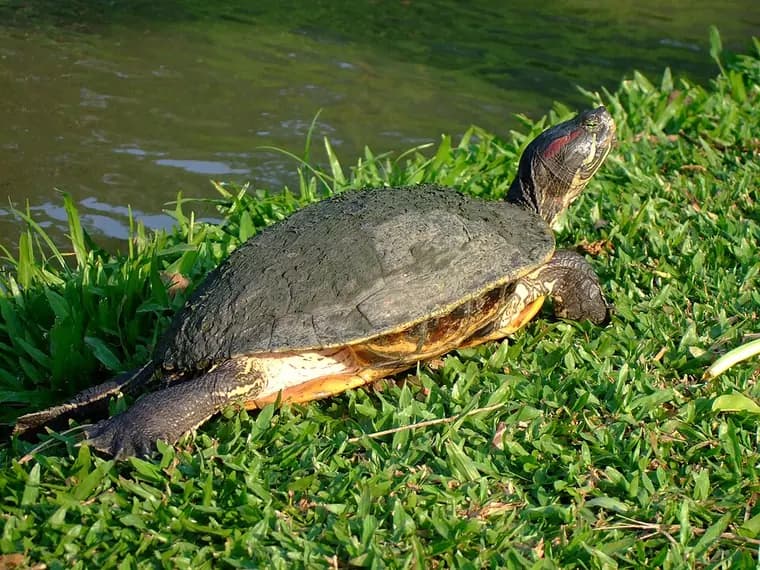
🦎Pond slider
The pond slider is a species of common, medium-sized, semiaquatic turtle. Three subspecies are described, the most recognizable of which is the red-eared slider, which is popular in the pet trade and has been introduced to other parts of the world by people releasing it to the wild. Hatchling and juvenile pond sliders have a green upper shell (carapace), yellow bottom shell (plastron), and green and yellow stripes and markings on their skin. These patterns and colors in the skin and shell fade with age until the carapace is a muted olive green to brown and the plastron is a dull yellow or darker. Some sliders become almost black with few visible markings. The carapace is oval with a bit of rounding and a central crest with knobs, but these features soften and fade with age, adults being smoother and flatter. For determining an adult slider's sex, males typically have much longer front claws than adult females, while females usually have shorter, more slender tails than males. Their lifespans range from 20 to 50 years.
Text: Wikipedia, CC BY-SA 4.0.
IUCN Red List assessment, 2011.
- Body mass
- 0.24 kg
- Body length
- not recorded
- Shoulder height
- not recorded
- Top speed
- not recorded
- Bite force
- not recorded
- Maximum lifespan
- 41 years
Everything we know about the Pond slider
Typical adult figures. Where a value is an estimate rather than a measurement, it says so.
Body mass0.24 kgrecord 2.73 kg · ReptTraitsAnAgeDetails ↓Hide ↑
data quality: acceptable
Record: largest individual on record
Source: AnAge · AnAge build 15, 2023-07-03 (HAGR) · CC BY 3.0
Maximum lifespan41 yearsrecord 41 years · ReptTraitsAnAgeDetails ↓Hide ↑
data quality: acceptable
Record: largest individual on record
Source: AnAge · AnAge build 15, 2023-07-03 (HAGR) · CC BY 3.0
Gestation75 daysAnAgeDetails ↓Hide ↑
data quality: acceptable
Source: AnAge · AnAge build 15, 2023-07-03 (HAGR) · CC BY 3.0
Litter sizeabout 13AnAgeDetails ↓Hide ↑
data quality: acceptable
Source: AnAge · AnAge build 15, 2023-07-03 (HAGR) · CC BY 3.0
DietCarnivorousReptTraitsDetails ↓Hide ↑
Source: ReptTraits · v1.2 (Oskyrko et al. 2024) · CC BY 4.0
Activity cycleDiurnalReptTraitsDetails ↓Hide ↑
Source: ReptTraits · v1.2 (Oskyrko et al. 2024) · CC BY 4.0
Foraging modeACTReptTraitsDetails ↓Hide ↑
Source: ReptTraits · v1.2 (Oskyrko et al. 2024) · CC BY 4.0
VenomousNoReptTraitsDetails ↓Hide ↑
Source: ReptTraits · v1.2 (Oskyrko et al. 2024) · CC BY 4.0
Snout–vent length0.26 mmaximum recordedReptTraitsOther figures ↓Hide ↑
Source: ReptTraits · v1.2 (Oskyrko et al. 2024) · CC BY 4.0
By sex
- Female0.26 mReptTraitsv1.2 (Oskyrko et al. 2024)
- Male0.17 mReptTraitsv1.2 (Oskyrko et al. 2024)
Volume l0.2 LaverageDetails ↓Hide ↑
Body mass at ~1.0 kg/L, the density of vertebrate tissue.
average = a mean across sexes or species in a group.
Not recorded for Pond slider yet: body length, shoulder height, top speed, bite force.
Family tree
- kingdomAnimalia
- ›phylumChordata
- ›classTestudines
- ›familyEmydidae
- ›genusTrachemys
- ›speciesTrachemys scripta
- orderTurtles & tortoises · Testudines
- suborderCryptodira
- superfamilyTestudinoidea
- familyEmydidae
All 12 branches ↓Fewer branches ↑
- kingdomMetazoa
- phylumChordata
- subphylumCraniata
- subphylumVertebrata
- superclassGnathostomata
- superclassSarcopterygii
- superclassTetrapoda
- orderSauria
- orderTurtles & tortoises · Testudines
- suborderCryptodira
- superfamilyTestudinoidea
- familyEmydidae
More about the Pond slider
No videos of the Pond slider yet.
We have 44,653 videos so far, and none of them features this animal yet.
All videos →Compare the Pond slider
Pick a tool — the Pond slider is already selected.
Compare every stat with any other animal.
Stand them on the same floor and see who's bigger.
How speed, brain and bite scale with body size. This animal isn't in the sample yet.
See where it sits in the tree of life.