
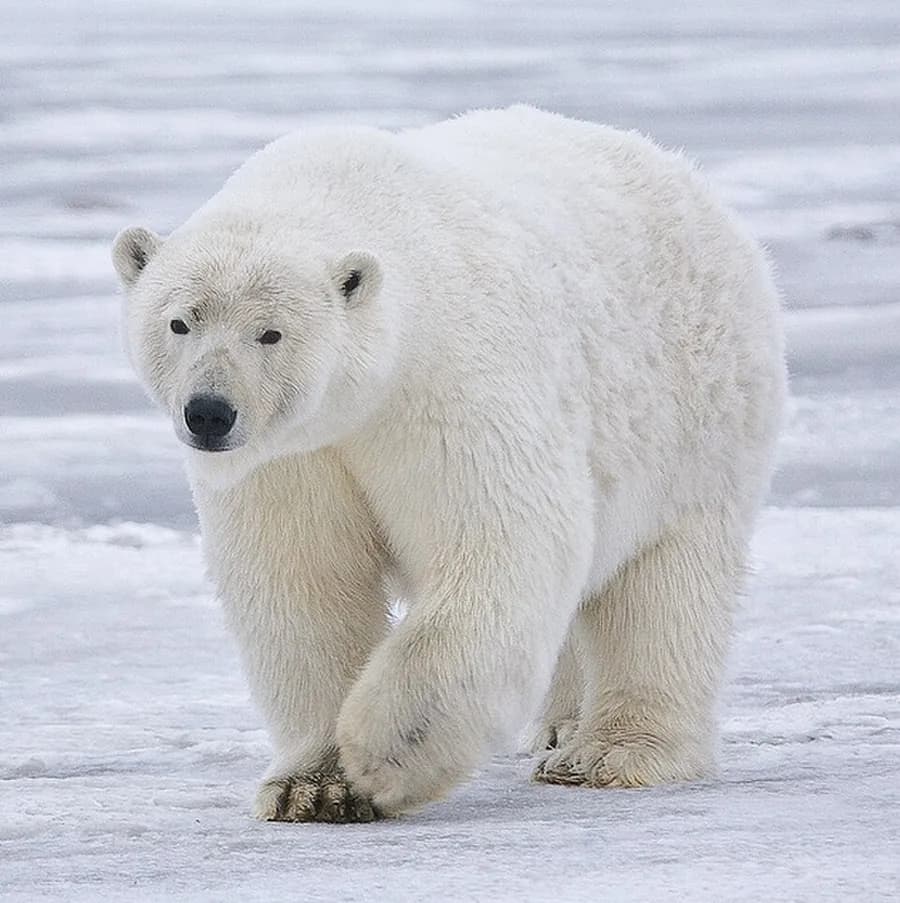
🐻❄️Polar bear
The polar bear is a large bear native to the Arctic and nearby areas. It is closely related to the brown bear, and the two species can interbreed. The polar bear is the largest extant species of bear and land carnivore by body mass, with adult males weighing 300–800 kg (660–1,760 lb). The species is sexually dimorphic, as adult females are much smaller. The polar bear is white or yellowish-furred with black skin and a thick layer of fat. It is more slender than the brown bear, with a narrower skull, longer neck and lower shoulder hump. Its teeth are sharper and more adapted to cutting meat. The paws are large and allow the bear to walk on ice and paddle in the water.
Text: Wikipedia, CC BY-SA 4.0.
IUCN Red List assessment, 2015.
- Body mass
- 372 kg
- Body length
- 2.25 m
- Shoulder height
- 1.45 m
- Top speed
- 39 km/h
- Bite force
- 2,121 N
- Maximum lifespan
- 45 years
Everything we know about the Polar bear
Typical adult figures. Where a value is an estimate rather than a measurement, it says so.
Body mass372 kgrecord 800 kg · SeaLifeBaseCOMBINEOther figures ↓Hide ↑
Record: largest individual on record
Source: COMBINE · v1 (Soria et al. 2021) · CC BY 4.0
By sex
- Female300 kgSeaLifeBasev25.04SeaLifeBase populates Weight independently of Length; the two are not guaranteed to describe the same individual. Verify before publishing.
Figures vary
- 475 kgAnAgeAnAge build 15, 2023-07-03 (HAGR)data quality: acceptable
Body length2.25 mCOMBINEOther figures ↓Hide ↑
Source: COMBINE · v1 (Soria et al. 2021) · CC BY 4.0
By sex
- Female2 mSeaLifeBasev25.04
Figures vary
- 2.5 mSeaLifeBasev25.04
Shoulder height1.45 m1.3–1.6 m · typical rangeDetails ↓Hide ↑
Sex not specified; value is the midpoint of the published range.
Source: DeMaster & Stirling 1981, Mammalian Species 145, p.1 · see citation
Top speed39 km/hDetails ↓Hide ↑
Sprint over a short distance, not a sustained pace. Published figures vary: 38.92 against 50.0 km/h.
Source: Bejan & Marden 2006, J Exp Biol 209:238 and Christiansen 2002, Zool J Linn Soc 136:685; compiled in Hirt et al. 2017, Nat Ecol Evol 1:1116, Supplementary Data · see citation
Bite force2,121 NDetails ↓Hide ↑
MODELLED by 3D finite-element analysis, canine bite, mean of left and right sides. Same paper gives 3840 N at PM4, 4454 N at M1 and 5085 N at M2 -- rear teeth bite far harder than canines. The authors note the model is unvalidated and absolute values need caution. Not comparable like-for-like with the dry-skull figures elsewhere in this file.
Source: Slater, Figueirido, Louis, Yang & Van Valkenburgh 2010, PLoS ONE 5(11):e13870 · see citation
Brain mass476 gCOMBINEDetails ↓Hide ↑
Source: COMBINE · v1 (Soria et al. 2021) · CC BY 4.0
Maximum lifespan45 yearsCOMBINEOther figures ↓Hide ↑
Source: COMBINE · v1 (Soria et al. 2021) · CC BY 4.0
Figures vary
- 44 yearsAnAgeAnAge build 15, 2023-07-03 (HAGR)data quality: acceptable
Generation length15 yearsCOMBINEDetails ↓Hide ↑
Source: COMBINE · v1 (Soria et al. 2021) · CC BY 4.0
Age at maturity5.1 yearsCOMBINEDetails ↓Hide ↑
Source: COMBINE · v1 (Soria et al. 2021) · CC BY 4.0
Gestation147 daysCOMBINEOther figures ↓Hide ↑
Source: COMBINE · v1 (Soria et al. 2021) · CC BY 4.0
Figures vary
- 65 daysAnAgeAnAge build 15, 2023-07-03 (HAGR)data quality: acceptable
Litter sizeabout 2COMBINEOther figures ↓Hide ↑
Source: COMBINE · v1 (Soria et al. 2021) · CC BY 4.0
Figures vary
- 2AnAgeAnAge build 15, 2023-07-03 (HAGR)data quality: acceptable
Trophic levelOmnivoreCOMBINEDetails ↓Hide ↑
Source: COMBINE · v1 (Soria et al. 2021) · CC BY 4.0
Activity cycleCrepuscular / mixedCOMBINEDetails ↓Hide ↑
Source: COMBINE · v1 (Soria et al. 2021) · CC BY 4.0
Home range77,270 km²COMBINEDetails ↓Hide ↑
Source: COMBINE · v1 (Soria et al. 2021) · CC BY 4.0
Population density0.01 per km²COMBINEDetails ↓Hide ↑
Source: COMBINE · v1 (Soria et al. 2021) · CC BY 4.0
Volume l372 LaverageDetails ↓Hide ↑
Body mass at ~1.0 kg/L, the density of vertebrate tissue.
average = a mean across sexes or species in a group.
Family tree
- kingdomAnimalia
- ›phylumChordata
- ›classMammalia
- ›orderCarnivora
- ›familyUrsidae
- ›genusUrsus
- ›speciesUrsus maritimus
- classMammals · Mammalia
- orderCarnivorans · Carnivora
- suborderCaniformia
- familyUrsidae
All 13 branches ↓Fewer branches ↑
- kingdomMetazoa
- phylumChordata
- subphylumCraniata
- subphylumVertebrata
- superclassGnathostomata
- superclassSarcopterygii
- superclassTetrapoda
- classMammals · Mammalia
- subclassTheria
- superorderLaurasiatheria
- orderCarnivorans · Carnivora
- suborderCaniformia
- familyUrsidae
More about the Polar bear


Animals caught on camera
Real footage of the animals on this site — hunting, fighting, and getting on with it.
Compare the Polar bear
Pick a tool — the Polar bear is already selected.
Compare every stat with any other animal.
Stand them on the same floor and see who's bigger.
Does it punch above its weight? Its stats against what body size predicts.
See where it sits in the tree of life.