
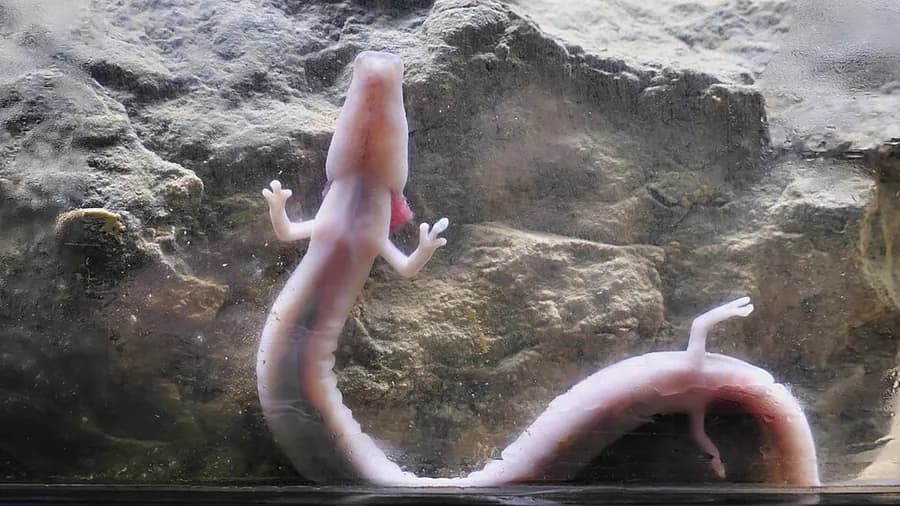
🦎Olm
The olm or proteus is an aquatic salamander which is the only species in the genus Proteus of the family Proteidae and the only exclusively cave-dwelling chordate species found in Europe; the family's other extant genus is Necturus. In contrast to most amphibians, it is entirely aquatic; eating, sleeping, and breeding underwater. Living in caves found in the Dinaric Alps, it is endemic to the waters that flow underground through the extensive limestone bedrock of the karst of Central and Southeastern Europe in the basin of the Soča River near Trieste, Italy, southern Slovenia, southwestern Croatia, and Bosnia and Herzegovina. Introduced populations are found near Vicenza, Italy, and Kranj, Slovenia. It was first mentioned in 1689 by the local naturalist Valvasor in his Glory of the Duchy of Carniola, who reported that, after heavy rains, the olms were washed up from the underground waters and were believed by local people to be a cave dragon's offspring.
Text: Wikipedia, CC BY-SA 4.0.
IUCN Red List assessment, 2024.
- Body mass
- 0.02 kg
- Body length
- 0.25 m
- Shoulder height
- not recorded
- Top speed
- not recorded
- Bite force
- not recorded
- Maximum lifespan
- 102 years
Everything we know about the Olm
Typical adult figures. Where a value is an estimate rather than a measurement, it says so.
Body mass0.02 kgAnAgeOther figures ↓Hide ↑
data quality: acceptable
Source: AnAge · AnAge build 15, 2023-07-03 (HAGR) · CC BY 3.0
Figures vary
- 0.02 kgAmphiBIOv1 (Oliveira et al. 2017)
Body length0.25 mAmphiBIODetails ↓Hide ↑
Source: AmphiBIO · v1 (Oliveira et al. 2017) · CC BY 4.0
Maximum lifespan102 yearsrecord 12 years · AmphiBIOAnAgeDetails ↓Hide ↑
data quality: acceptable
Record: largest individual on record
Source: AnAge · AnAge build 15, 2023-07-03 (HAGR) · CC BY 3.0
Gestation133 daysAnAgeDetails ↓Hide ↑
data quality: acceptable
Source: AnAge · AnAge build 15, 2023-07-03 (HAGR) · CC BY 3.0
Litter sizeabout 35AnAgeDetails ↓Hide ↑
data quality: acceptable
Source: AnAge · AnAge build 15, 2023-07-03 (HAGR) · CC BY 3.0
DietarthropodsAmphiBIODetails ↓Hide ↑
Source: AmphiBIO · v1 (Oliveira et al. 2017) · CC BY 4.0
Volume l0 LaverageDetails ↓Hide ↑
Body mass at ~1.0 kg/L, the density of vertebrate tissue.
average = a mean across sexes or species in a group.
Not recorded for Olm yet: shoulder height, top speed, bite force.
Family tree
- kingdomAnimalia
- ›phylumChordata
- ›classAmphibia
- ›orderCaudata
- ›familyProteidae
- ›genusProteus
- ›speciesProteus anguinus
- classAmphibians · Amphibia
- orderSalamanders & newts · Caudata
- familyProteidae
- genusProteus
All 13 branches ↓Fewer branches ↑
- kingdomMetazoa
- phylumChordata
- subphylumCraniata
- subphylumVertebrata
- superclassGnathostomata
- superclassSarcopterygii
- superclassTetrapoda
- classAmphibians · Amphibia
- superorderBatrachia
- orderSalamanders & newts · Caudata
- superfamilySalamandroidea
- familyProteidae
- genusProteus
More about the Olm


No videos of the Olm yet.
We have 44,653 videos so far, and none of them features this animal yet.
All videos →Compare the Olm
Pick a tool — the Olm is already selected.
Compare every stat with any other animal.
Stand them on the same floor and see who's bigger.
Does it punch above its weight? Its stats against what body size predicts.
See where it sits in the tree of life.