
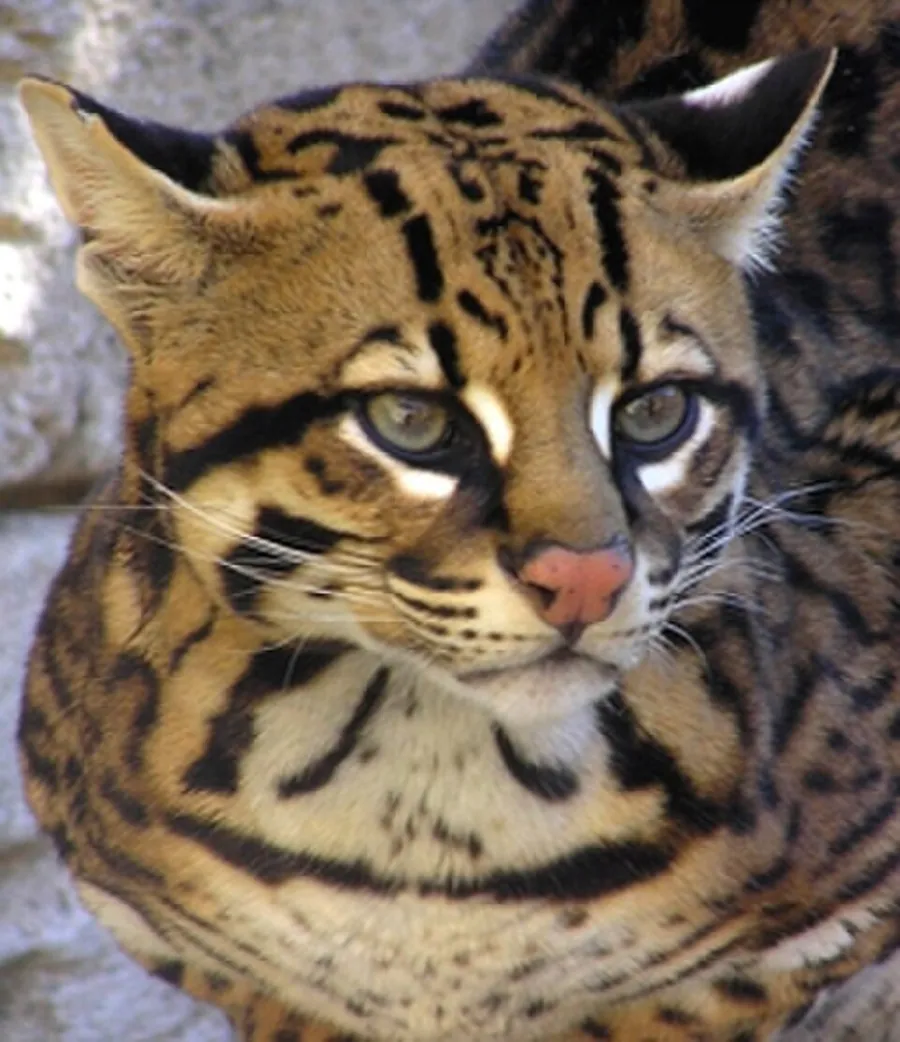
🐈Ocelot
The ocelot is a medium-sized spotted wild cat that reaches 40–50 cm (16–20 in) at the shoulders and weighs between 7 and 15.5 kg on average. It is native to the southwestern United States, Mexico, Central and South America, and the Caribbean islands of Trinidad and Margarita. Carl Linnaeus scientifically described it in 1758. Two subspecies are recognized.
Text: Wikipedia, CC BY-SA 4.0.
IUCN Red List assessment, 2015.
- Body mass
- 11 kg
- Body length
- 0.87 m
- Shoulder height
- 0.45 m
- Top speed
- not recorded
- Bite force
- not recorded
- Maximum lifespan
- 28 years
Everything we know about the Ocelot
Typical adult figures. Where a value is an estimate rather than a measurement, it says so.
Body mass11 kgCOMBINEOther figures ↓Hide ↑
Source: COMBINE · v1 (Soria et al. 2021) · CC BY 4.0
Figures vary
- 8.8 kgAnAgeAnAge build 15, 2023-07-03 (HAGR)data quality: acceptable
Body length0.87 mCOMBINEDetails ↓Hide ↑
Source: COMBINE · v1 (Soria et al. 2021) · CC BY 4.0
Shoulder height0.45 m0.4–0.5 m · typical rangenot statedDetails ↓Hide ↑
"Shoulder Height: 40-50 cm (~20 in)". Range-only; value is the midpoint. SDZWA fact-sheet table without inline attribution; the Mammalian Species account 548 (Murray & Gardner 1997) is paywalled and could not be verified directly. ADW (Kittel 2011) gives mass and length only.
Source: San Diego Zoo Wildlife Alliance, Ocelot (Leopardus pardalis) Fact Sheet: Physical Characteristics, https://ielc.libguides.com/sdzg/factsheets/ocelot/characteristics · see citation
Brain mass66 gCOMBINEDetails ↓Hide ↑
Source: COMBINE · v1 (Soria et al. 2021) · CC BY 4.0
Maximum lifespan28 yearsCOMBINEOther figures ↓Hide ↑
Source: COMBINE · v1 (Soria et al. 2021) · CC BY 4.0
Figures vary
- 28 yearsAnAgeAnAge build 15, 2023-07-03 (HAGR)data quality: acceptable
Generation length8.25 yearsCOMBINEDetails ↓Hide ↑
Source: COMBINE · v1 (Soria et al. 2021) · CC BY 4.0
Age at maturity1.9 yearsCOMBINEDetails ↓Hide ↑
Source: COMBINE · v1 (Soria et al. 2021) · CC BY 4.0
Gestation80 daysCOMBINEOther figures ↓Hide ↑
Source: COMBINE · v1 (Soria et al. 2021) · CC BY 4.0
Figures vary
- 77 daysAnAgeAnAge build 15, 2023-07-03 (HAGR)data quality: acceptable
Litter sizeabout 2COMBINEOther figures ↓Hide ↑
Source: COMBINE · v1 (Soria et al. 2021) · CC BY 4.0
Figures vary
- 2AnAgeAnAge build 15, 2023-07-03 (HAGR)data quality: acceptable
Trophic levelCarnivoreCOMBINEDetails ↓Hide ↑
Source: COMBINE · v1 (Soria et al. 2021) · CC BY 4.0
Activity cycleNocturnalCOMBINEDetails ↓Hide ↑
Source: COMBINE · v1 (Soria et al. 2021) · CC BY 4.0
Home range5.08 km²COMBINEDetails ↓Hide ↑
Source: COMBINE · v1 (Soria et al. 2021) · CC BY 4.0
Population density0.17 per km²COMBINEDetails ↓Hide ↑
Source: COMBINE · v1 (Soria et al. 2021) · CC BY 4.0
Volume l11 LaverageDetails ↓Hide ↑
Body mass at ~1.0 kg/L, the density of vertebrate tissue.
average = a mean across sexes or species in a group.
Not recorded for Ocelot yet: top speed, bite force.
Family tree
- kingdomAnimalia
- ›phylumChordata
- ›classMammalia
- ›orderCarnivora
- ›familyFelidae
- ›genusLeopardus
- ›speciesLeopardus pardalis
- classMammals · Mammalia
- orderCarnivorans · Carnivora
- familyFelidae
- genusLeopardus
All 14 branches ↓Fewer branches ↑
- kingdomMetazoa
- phylumChordata
- subphylumCraniata
- subphylumVertebrata
- superclassGnathostomata
- superclassSarcopterygii
- superclassTetrapoda
- classMammals · Mammalia
- subclassTheria
- superorderLaurasiatheria
- orderCarnivorans · Carnivora
- suborderFeliformia
- familyFelidae
- genusLeopardus
More about the Ocelot


Animals caught on camera
Real footage of the animals on this site — hunting, fighting, and getting on with it.
Compare the Ocelot
Pick a tool — the Ocelot is already selected.
Compare every stat with any other animal.
Stand them on the same floor and see who's bigger.
How speed, brain and bite scale with body size. This animal isn't in the sample yet.
See where it sits in the tree of life.