
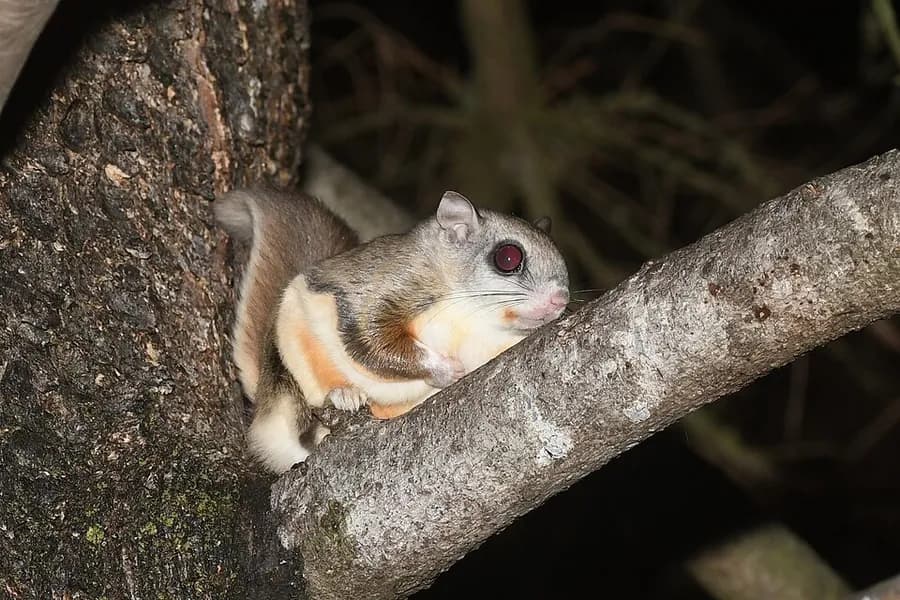
🐿️Northern flying squirrel
The northern flying squirrel is one of three species of the genus Glaucomys, the only flying squirrels found in North America. They are found in coniferous and mixed coniferous forests across much of Canada, from Alaska to Nova Scotia, and south to the mountains of North Carolina and west to Utah in the United States. They are light brown with pale underparts and grow to a length of 25 to 37 cm. They are proficient gliders but uncoordinated walkers on the ground. They feed on a variety of plant material as well as tree sap, fungi, insects, carrion, bird eggs and nestlings. They mostly breed once a year in a cavity lined with lichen or other soft material. Except when they have young, they change nests frequently, and in winter a number of individuals may huddle together in a shared nest. Unlike most members of their family, flying squirrels are strictly nocturnal.
Text: Wikipedia, CC BY-SA 4.0.
IUCN Red List assessment, 2016.
- Body mass
- 0.15 kg
- Body length
- 0.27 m
- Shoulder height
- not recorded
- Top speed
- not recorded
- Bite force
- not recorded
- Maximum lifespan
- 14 years
Everything we know about the Northern flying squirrel
Typical adult figures. Where a value is an estimate rather than a measurement, it says so.
Body mass0.15 kgCOMBINEOther figures ↓Hide ↑
Source: COMBINE · v1 (Soria et al. 2021) · CC BY 4.0
Figures vary
- 0.15 kgAnAgeAnAge build 15, 2023-07-03 (HAGR)data quality: acceptable
Body length0.27 mCOMBINEDetails ↓Hide ↑
Source: COMBINE · v1 (Soria et al. 2021) · CC BY 4.0
Brain mass3.01 gCOMBINEDetails ↓Hide ↑
Source: COMBINE · v1 (Soria et al. 2021) · CC BY 4.0
Maximum lifespan14 yearsCOMBINEOther figures ↓Hide ↑
Source: COMBINE · v1 (Soria et al. 2021) · CC BY 4.0
Figures vary
- 14 yearsAnAgeAnAge build 15, 2023-07-03 (HAGR)data quality: acceptable
Generation length4.74 yearsCOMBINEDetails ↓Hide ↑
Source: COMBINE · v1 (Soria et al. 2021) · CC BY 4.0
Age at maturity336 daysCOMBINEDetails ↓Hide ↑
Source: COMBINE · v1 (Soria et al. 2021) · CC BY 4.0
Gestation40 daysCOMBINEOther figures ↓Hide ↑
Source: COMBINE · v1 (Soria et al. 2021) · CC BY 4.0
Figures vary
- 40 daysAnAgeAnAge build 15, 2023-07-03 (HAGR)data quality: acceptable
Litter sizeabout 3COMBINEOther figures ↓Hide ↑
Source: COMBINE · v1 (Soria et al. 2021) · CC BY 4.0
Figures vary
- 3AnAgeAnAge build 15, 2023-07-03 (HAGR)data quality: acceptable
Trophic levelOmnivoreCOMBINEDetails ↓Hide ↑
Source: COMBINE · v1 (Soria et al. 2021) · CC BY 4.0
Activity cycleNocturnalCOMBINEDetails ↓Hide ↑
Source: COMBINE · v1 (Soria et al. 2021) · CC BY 4.0
Home range0.05 km²COMBINEDetails ↓Hide ↑
Source: COMBINE · v1 (Soria et al. 2021) · CC BY 4.0
Population density49 per km²COMBINEDetails ↓Hide ↑
Source: COMBINE · v1 (Soria et al. 2021) · CC BY 4.0
Volume l0.1 LaverageDetails ↓Hide ↑
Body mass at ~1.0 kg/L, the density of vertebrate tissue.
average = a mean across sexes or species in a group.
Not recorded for Northern flying squirrel yet: shoulder height, top speed, bite force.
Family tree
- kingdomAnimalia
- ›phylumChordata
- ›classMammalia
- ›orderRodentia
- ›familySciuridae
- ›genusGlaucomys
- ›speciesGlaucomys sabrinus
- classMammals · Mammalia
- orderRodents · Rodentia
- tribePteromyini
- genusGlaucomys
All 15 branches ↓Fewer branches ↑
- kingdomMetazoa
- phylumChordata
- subphylumCraniata
- subphylumVertebrata
- superclassGnathostomata
- superclassSarcopterygii
- superclassTetrapoda
- classMammals · Mammalia
- subclassTheria
- superorderEuarchontoglires
- orderRodents · Rodentia
- suborderSciuromorpha
- familySciuridae
- tribePteromyini
- genusGlaucomys
More about the Northern flying squirrel
No videos of the Northern flying squirrel yet.
We have 44,653 videos so far, and none of them features this animal yet.
All videos →Compare the Northern flying squirrel
Pick a tool — the Northern flying squirrel is already selected.
Compare every stat with any other animal.
Stand them on the same floor and see who's bigger.
How speed, brain and bite scale with body size. This animal isn't in the sample yet.
See where it sits in the tree of life.