
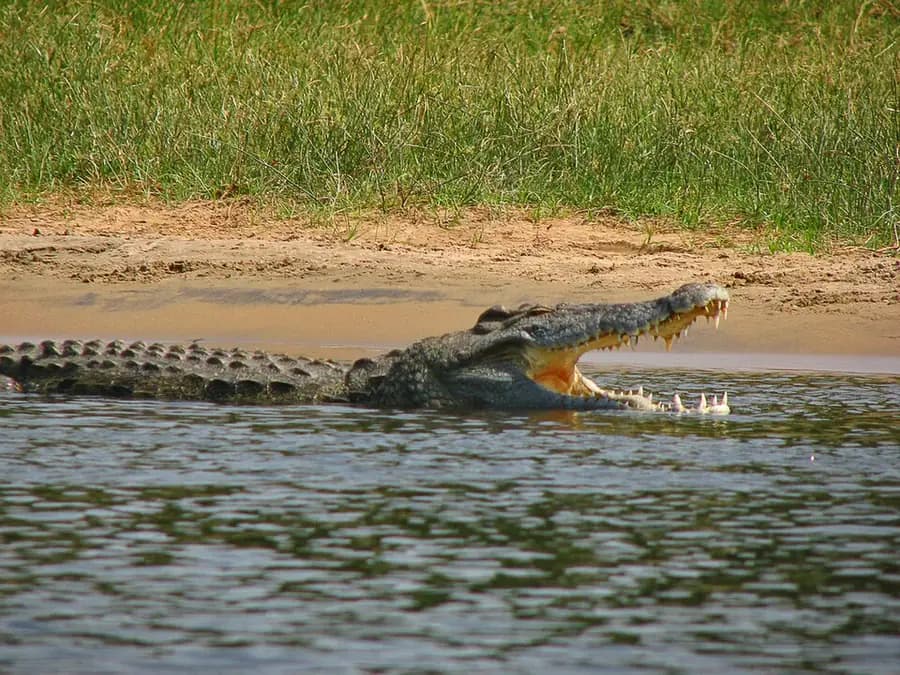
🐊Nile crocodile
The Nile crocodile is a large crocodilian native to freshwater habitats in Africa, where it is present in 26 countries. It is widely distributed in sub-Saharan Africa, occurring mostly in the eastern, southern, and central regions of the continent, and lives in different types of aquatic environments such as lakes, rivers, swamps and marshlands. It occasionally inhabits deltas, brackish lakes and rarely also saltwater. Its range once stretched from the Nile Delta throughout the Nile River. Lake Turkana in Kenya has one of the largest undisturbed Nile crocodile populations.
Text: Wikipedia, CC BY-SA 4.0.
IUCN Red List assessment, 2019.
- Body mass
- 94 kg
- Body length
- 5 m
- Shoulder height
- not recorded
- Top speed
- 9.86 km/h
- Bite force
- 3,043 N
- Maximum lifespan
- 56 years
Everything we know about the Nile crocodile
Typical adult figures. Where a value is an estimate rather than a measurement, it says so.
Body mass94 kgrecord 750 kg · ReptTraitsAnAgeDetails ↓Hide ↑
data quality: acceptable
Record: largest individual on record
Source: AnAge · AnAge build 15, 2023-07-03 (HAGR) · CC BY 3.0
Body length5 mmaximum recordedReptTraitsDetails ↓Hide ↑
Source: ReptTraits · v1.2 (Oskyrko et al. 2024) · CC BY 4.0
Top speed9.86 km/hDetails ↓Hide ↑
MEASURED on a track by high-speed video at 2.74 m/s -- but the animals were JUVENILES of 3-6.9 kg and no adult Nile crocodile has ever been timed. Useful ceiling from the same paper: no crocodilian of any species has been recorded above 5 m/s (18 km/h). A widely propagated 18 m/s claim for C. porosus was a tenfold transcription error for 1.8 m/s.
Source: Stevens, Hutchinson et al. 2019, Sci Rep 9:19302, Supplementary Dataset · see citation
Bite force3,043 NDetails ↓Hide ↑
MEASURED in vivo with a sandwich transducer under the maxillary molariform (rear) tooth; unilateral, 3-5 bites per animal, highest retained. This is the mean of only TWO specimens averaging 2.50 m and 86 kg -- well short of adult size, and bite force scales with mass^0.708, so it is not a big-adult figure. Individual values were 2914 and 3172 N. Estimated caniniform (front) bite for the same animals is 2007 N. The famous 16414 N record belongs to a saltwater crocodile, C. porosus, not to this species.
Source: Erickson et al. 2012, PLoS ONE 7(3):e31781, Table 1 · see citation
Maximum lifespan56 yearsrecord 80 years · ReptTraitsAnAgeDetails ↓Hide ↑
data quality: acceptable
Record: largest individual on record
Source: AnAge · AnAge build 15, 2023-07-03 (HAGR) · CC BY 3.0
DietCarnivorousReptTraitsDetails ↓Hide ↑
Source: ReptTraits · v1.2 (Oskyrko et al. 2024) · CC BY 4.0
Activity cycleNocturnalReptTraitsDetails ↓Hide ↑
Source: ReptTraits · v1.2 (Oskyrko et al. 2024) · CC BY 4.0
Foraging modeAMBReptTraitsDetails ↓Hide ↑
Source: ReptTraits · v1.2 (Oskyrko et al. 2024) · CC BY 4.0
VenomousNoReptTraitsDetails ↓Hide ↑
Source: ReptTraits · v1.2 (Oskyrko et al. 2024) · CC BY 4.0
Danger to humansharmlessSeaLifeBaseDetails ↓Hide ↑
Source: SeaLifeBase · v25.04 · CC BY-NC 4.0
Volume l94 LaverageDetails ↓Hide ↑
Body mass at ~1.0 kg/L, the density of vertebrate tissue.
average = a mean across sexes or species in a group.
Not recorded for Nile crocodile yet: shoulder height.
Family tree
- kingdomAnimalia
- ›phylumChordata
- ›classCrocodylia
- ›familyCrocodylidae
- ›genusCrocodylus
- ›speciesCrocodylus niloticus
- superclassTetrapoda
- orderSauria
- familyCrocodylidae
- genusCrocodylus
All 10 branches ↓Fewer branches ↑
- kingdomMetazoa
- phylumChordata
- subphylumCraniata
- subphylumVertebrata
- superclassGnathostomata
- superclassSarcopterygii
- superclassTetrapoda
- orderSauria
- familyCrocodylidae
- genusCrocodylus
More about the Nile crocodile


Animals caught on camera
Real footage of the animals on this site — hunting, fighting, and getting on with it.
Compare the Nile crocodile
Pick a tool — the Nile crocodile is already selected.
Compare every stat with any other animal.
Stand them on the same floor and see who's bigger.
Does it punch above its weight? Its stats against what body size predicts.
See where it sits in the tree of life.