
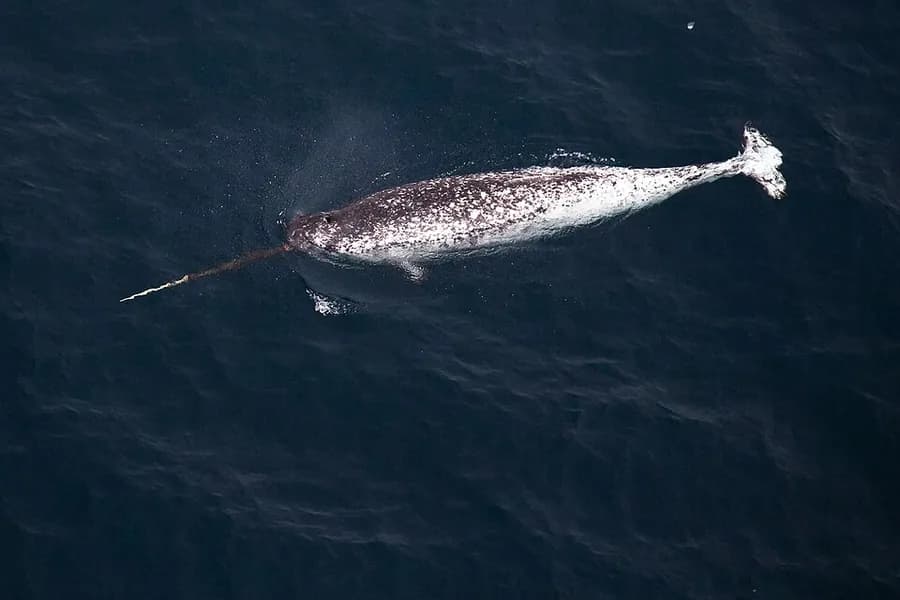
🐋Narwhal
The narwhal is a species of toothed whale native to the Arctic. It is the only member of the genus Monodon and one of two living representatives of the family Monodontidae. The narwhal is a stocky cetacean with a relatively blunt snout, a large melon, and a shallow ridge in place of a dorsal fin. Males of this species have a spiralled tusk that is 1.5–3.0 m (4.9–9.8 ft) long, which is a protruding left canine thought to function as a weapon, a tool for feeding, in attracting mates or sensing water salinity. Specially adapted slow-twitch muscles, along with the jointed neck vertebrae and shallow dorsal ridge allow for easy movement through the Arctic environment, where the narwhal spends extended periods at great depths. The narwhal's geographic range overlaps with that of the similarly built and closely related beluga whale, and the animals are known to interbreed.
Text: Wikipedia, CC BY-SA 4.0.
IUCN Red List assessment, 2017.
- Body mass
- 938 kg
- Body length
- 5.65 m
- Shoulder height
- not recorded
- Top speed
- not recorded
- Bite force
- not recorded
- Maximum lifespan
- 50 years
Everything we know about the Narwhal
Typical adult figures. Where a value is an estimate rather than a measurement, it says so.
Body mass938 kgrecord 1,600 kg · SeaLifeBaseCOMBINEOther figures ↓Hide ↑
Record: largest individual on record
Source: COMBINE · v1 (Soria et al. 2021) · CC BY 4.0
Figures vary
- 1,250 kgAnAgeAnAge build 15, 2023-07-03 (HAGR)data quality: acceptable
Body length5.65 mCOMBINEOther figures ↓Hide ↑
Source: COMBINE · v1 (Soria et al. 2021) · CC BY 4.0
By sex
- Female4.2 mSeaLifeBasev25.04
Figures vary
- 4.7 mSeaLifeBasev25.04
Brain mass2,997 gCOMBINEDetails ↓Hide ↑
Source: COMBINE · v1 (Soria et al. 2021) · CC BY 4.0
Maximum lifespan50 yearsrecord 115 years · SeaLifeBaseCOMBINEOther figures ↓Hide ↑
Record: largest individual on record
Source: COMBINE · v1 (Soria et al. 2021) · CC BY 4.0
Figures vary
- 50 yearsAnAgeAnAge build 15, 2023-07-03 (HAGR)data quality: acceptable
Generation length24 yearsCOMBINEDetails ↓Hide ↑
Source: COMBINE · v1 (Soria et al. 2021) · CC BY 4.0
Age at maturity7.1 yearsCOMBINEDetails ↓Hide ↑
Source: COMBINE · v1 (Soria et al. 2021) · CC BY 4.0
Gestation1.2 yearsCOMBINEOther figures ↓Hide ↑
Source: COMBINE · v1 (Soria et al. 2021) · CC BY 4.0
Figures vary
- 1.2 yearsAnAgeAnAge build 15, 2023-07-03 (HAGR)data quality: acceptable
Litter size1COMBINEOther figures ↓Hide ↑
Source: COMBINE · v1 (Soria et al. 2021) · CC BY 4.0
Figures vary
- 1AnAgeAnAge build 15, 2023-07-03 (HAGR)data quality: acceptable
Trophic levelCarnivoreCOMBINEDetails ↓Hide ↑
Source: COMBINE · v1 (Soria et al. 2021) · CC BY 4.0
Activity cycleCrepuscular / mixedestimatedCOMBINEDetails ↓Hide ↑
Source: COMBINE · v1 (Soria et al. 2021) · CC BY 4.0
Volume l938 LaverageDetails ↓Hide ↑
Body mass at ~1.0 kg/L, the density of vertebrate tissue.
estimated = a model's estimate for a species nobody has measured; average = a mean across sexes or species in a group.
Not recorded for Narwhal yet: shoulder height, top speed, bite force.
Family tree
- kingdomAnimalia
- ›phylumChordata
- ›classMammalia
- ›orderCetacea
- ›familyMonodontidae
- ›genusMonodon
- ›speciesMonodon monoceros
- classMammals · Mammalia
- orderEven-toed hoofed animals · Artiodactyla
- infraorderWhales & dolphins · Cetacea
- genusMonodon
All 15 branches ↓Fewer branches ↑
- kingdomMetazoa
- phylumChordata
- subphylumCraniata
- subphylumVertebrata
- superclassGnathostomata
- superclassSarcopterygii
- superclassTetrapoda
- classMammals · Mammalia
- subclassTheria
- superorderLaurasiatheria
- orderEven-toed hoofed animals · Artiodactyla
- suborderWhippomorpha
- infraorderWhales & dolphins · Cetacea
- familyMonodontidae
- genusMonodon
More about the Narwhal


Animals caught on camera
Real footage of the animals on this site — hunting, fighting, and getting on with it.
Compare the Narwhal
Pick a tool — the Narwhal is already selected.
Compare every stat with any other animal.
Stand them on the same floor and see who's bigger.
Does it punch above its weight? Its stats against what body size predicts.
See where it sits in the tree of life.