
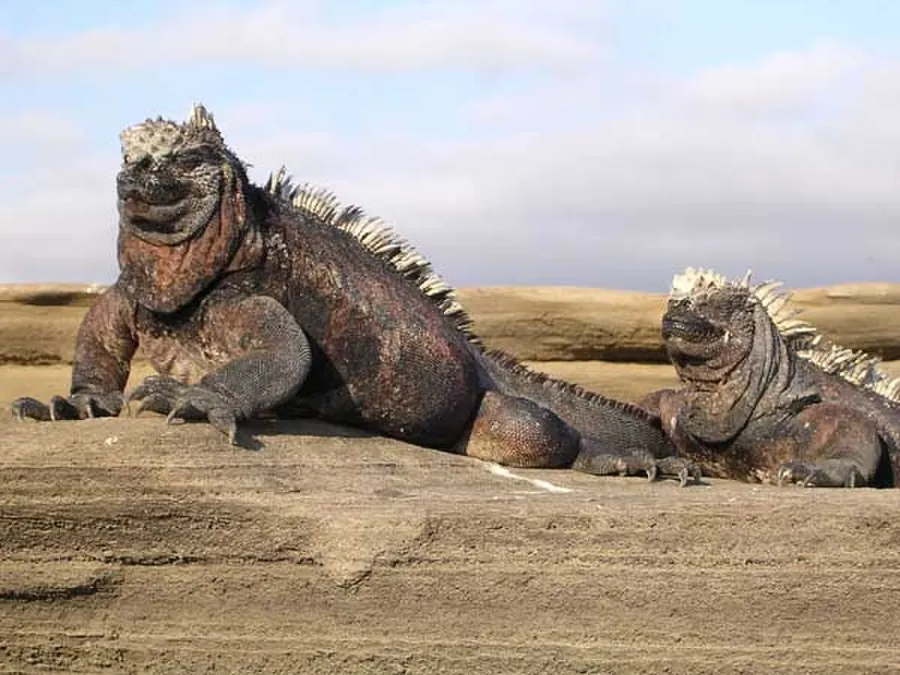
🦎Marine iguana
The marine iguana, also known as the sea iguana, saltwater iguana, or Galápagos marine iguana, is a species of iguana found only on the Galápagos Islands (Ecuador). Unique among modern lizards, it is a marine reptile that has the ability to forage in the sea for algae, which make up almost all of its diet. Marine iguanas are the only extant lizard that spends time in a marine environment. Large males are able to dive to find this food source, while females and smaller males feed during low tide in the intertidal zone. They mainly live in colonies on rocky shores where they bask after visiting the relatively cold water or intertidal zone, but can also be seen in marshes, mangrove swamps and beaches. Large males defend territories for a short period, but smaller males have other breeding strategies. After mating, the female digs a nest hole in the soil where she lays her eggs, leaving them to hatch on their own a few months later.
Text: Wikipedia, CC BY-SA 4.0.
IUCN Red List assessment, 2020.
- Body mass
- 2.23 kg
- Body length
- 1.3 m
- Shoulder height
- not recorded
- Top speed
- not recorded
- Bite force
- not recorded
- Maximum lifespan
- 6.4 years
Everything we know about the Marine iguana
Typical adult figures. Where a value is an estimate rather than a measurement, it says so.
Body mass2.23 kgrecord 7.41 kg · ReptTraitsAnAgeDetails ↓Hide ↑
data quality: acceptable
Record: largest individual on record
Source: AnAge · AnAge build 15, 2023-07-03 (HAGR) · CC BY 3.0
Body length1.3 mmaximum recorded, total lengthSeaLifeBaseOther figures ↓Hide ↑
Source: SeaLifeBase · v25.04 · CC BY-NC 4.0
By sex
- Female0.6 mSeaLifeBasev25.04
Maximum lifespan6.4 yearsrecord 28 years · ReptTraitsAnAgeDetails ↓Hide ↑
data quality: acceptable
Record: largest individual on record
Source: AnAge · AnAge build 15, 2023-07-03 (HAGR) · CC BY 3.0
DietHerbivorousReptTraitsDetails ↓Hide ↑
Source: ReptTraits · v1.2 (Oskyrko et al. 2024) · CC BY 4.0
Activity cycleDiurnalReptTraitsDetails ↓Hide ↑
Source: ReptTraits · v1.2 (Oskyrko et al. 2024) · CC BY 4.0
VenomousNoReptTraitsDetails ↓Hide ↑
Source: ReptTraits · v1.2 (Oskyrko et al. 2024) · CC BY 4.0
Snout–vent length0.56 mmaximum recordedReptTraitsOther figures ↓Hide ↑
Source: ReptTraits · v1.2 (Oskyrko et al. 2024) · CC BY 4.0
By sex
- Female0.32 mReptTraitsv1.2 (Oskyrko et al. 2024)
Volume l2.2 LaverageDetails ↓Hide ↑
Body mass at ~1.0 kg/L, the density of vertebrate tissue.
average = a mean across sexes or species in a group.
Not recorded for Marine iguana yet: shoulder height, top speed, bite force.
Family tree
- kingdomAnimalia
- ›phylumChordata
- ›classSquamata
- ›familyIguanidae
- ›genusAmblyrhynchus
- ›speciesAmblyrhynchus cristatus
- orderLizards & snakes · Squamata
- suborderIguania
- subfamilyIguaninae
- genusAmblyrhynchus
All 13 branches ↓Fewer branches ↑
- kingdomMetazoa
- phylumChordata
- subphylumCraniata
- subphylumVertebrata
- superclassGnathostomata
- superclassSarcopterygii
- superclassTetrapoda
- orderSauria
- superorderLepidosauria
- orderLizards & snakes · Squamata
- suborderIguania
- subfamilyIguaninae
- genusAmblyrhynchus
More about the Marine iguana


Animals caught on camera
Real footage of the animals on this site — hunting, fighting, and getting on with it.
Compare the Marine iguana
Pick a tool — the Marine iguana is already selected.
Compare every stat with any other animal.
Stand them on the same floor and see who's bigger.
How speed, brain and bite scale with body size. This animal isn't in the sample yet.
See where it sits in the tree of life.