
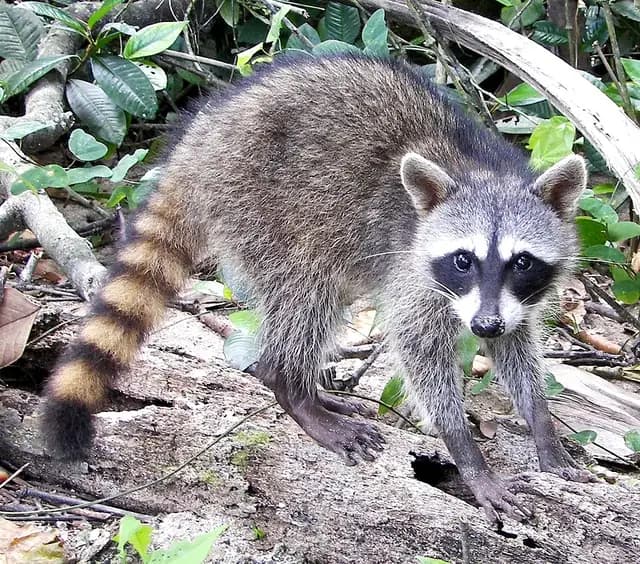
🐾Crab-eating raccoon
게잡이라쿤(Procyon cancrivorus)은 중앙아메리카와 남아메리카(트리니다드 토바고 포함)의 습지와 정글 지역에 사는 라쿤의 일종이다. 코스타리카부터 남쪽으로 안데스산맥 동부의 아르헨티나 북부와 우루과이에 이르는 대부분의 남아메리카 지역에서 발견된다. 게잡이라쿤으로 불리지만, 이 종만이 게를 먹는 것은 아니고 라쿤(아메리카너구리) 또한 게를 먹는다. 게잡이라쿤은 게와 바닷가재 그리고 기타 갑각류 등을 먹이로 먹지만, 잡식성 동물로 예를 들어 작은 양서류와 거북의 알, 식물 열매 등도 먹는다. 북부 지역에 서식하는 사촌 종이며, 털이 더부룩한 반지 모양 꼬리와 눈 둘레에 "산적 가면" 모양의 털을 가진 라쿤을 닮았다. 아메리카너구리와는 달리, 목덜미의 털이 뒷쪽으로 향하지 않고 머리 쪽 방향으로 나 있다.
Text: Wikipedia, CC BY-SA 4.0.
IUCN Red List assessment, 2016.
- Body mass
- 6.27 kg
- Body length
- 0.6 m
- Shoulder height
- not recorded
- Top speed
- not recorded
- Bite force
- not recorded
- Maximum lifespan
- 19 years
Everything we know about the Crab-eating raccoon
Typical adult figures. Where a value is an estimate rather than a measurement, it says so.
Body mass6.27 kgCOMBINEOther figures ↓Hide ↑
Source: COMBINE · v1 (Soria et al. 2021) · CC BY 4.0
Figures vary
- 6.27 kgAnAgeAnAge build 15, 2023-07-03 (HAGR)data quality: acceptable
Body length0.6 mCOMBINEDetails ↓Hide ↑
Source: COMBINE · v1 (Soria et al. 2021) · CC BY 4.0
Brain mass74 gCOMBINEDetails ↓Hide ↑
Source: COMBINE · v1 (Soria et al. 2021) · CC BY 4.0
Maximum lifespan19 yearsCOMBINEOther figures ↓Hide ↑
Source: COMBINE · v1 (Soria et al. 2021) · CC BY 4.0
Figures vary
- 19 yearsAnAgeAnAge build 15, 2023-07-03 (HAGR)data quality: acceptable
Generation length6 yearsCOMBINEDetails ↓Hide ↑
Source: COMBINE · v1 (Soria et al. 2021) · CC BY 4.0
Age at maturity1.7 yearsCOMBINEDetails ↓Hide ↑
Source: COMBINE · v1 (Soria et al. 2021) · CC BY 4.0
Gestation66 daysCOMBINEOther figures ↓Hide ↑
Source: COMBINE · v1 (Soria et al. 2021) · CC BY 4.0
Figures vary
- 63 daysAnAgeAnAge build 15, 2023-07-03 (HAGR)data quality: acceptable
Litter sizeabout 3COMBINEOther figures ↓Hide ↑
Source: COMBINE · v1 (Soria et al. 2021) · CC BY 4.0
Figures vary
- 3AnAgeAnAge build 15, 2023-07-03 (HAGR)data quality: acceptable
Trophic levelCarnivoreCOMBINEDetails ↓Hide ↑
Source: COMBINE · v1 (Soria et al. 2021) · CC BY 4.0
Activity cycleNocturnalCOMBINEDetails ↓Hide ↑
Source: COMBINE · v1 (Soria et al. 2021) · CC BY 4.0
Population density5.74 per km²COMBINEDetails ↓Hide ↑
Source: COMBINE · v1 (Soria et al. 2021) · CC BY 4.0
Volume l6.3 LaverageDetails ↓Hide ↑
Body mass at ~1.0 kg/L, the density of vertebrate tissue.
average = a mean across sexes or species in a group.
Not recorded for Crab-eating raccoon yet: shoulder height, top speed, bite force.
Family tree
- kingdomAnimalia
- ›phylumChordata
- ›classMammalia
- ›orderCarnivora
- ›familyProcyonidae
- ›genusProcyon
- ›speciesProcyon cancrivorus
- classMammals · Mammalia
- orderCarnivorans · Carnivora
- familyProcyonidae
- genusProcyon
All 14 branches ↓Fewer branches ↑
- kingdomMetazoa
- phylumChordata
- subphylumCraniata
- subphylumVertebrata
- superclassGnathostomata
- superclassSarcopterygii
- superclassTetrapoda
- classMammals · Mammalia
- subclassTheria
- superorderLaurasiatheria
- orderCarnivorans · Carnivora
- suborderCaniformia
- familyProcyonidae
- genusProcyon
More about the Crab-eating raccoon
No videos of the Crab-eating raccoon yet.
We have 44,653 videos so far, and none of them features this animal yet.
All videos →Compare the Crab-eating raccoon
Pick a tool — the Crab-eating raccoon is already selected.
Compare every stat with any other animal.
Stand them on the same floor and see who's bigger.
How speed, brain and bite scale with body size. This animal isn't in the sample yet.
See where it sits in the tree of life.