
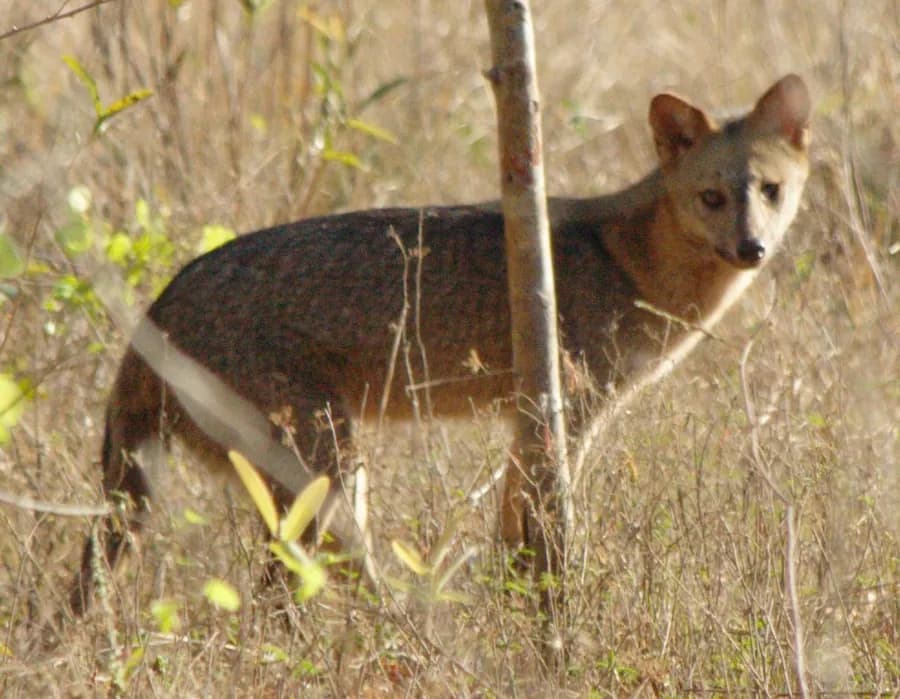
🐺Crab-eating fox
게잡이여우(Cerdocyon thous)는 남아메리카 중부 지역에서 사는 중간 크기의 현존하는 개과 동물이다. "숲여우" 또는 "나무여우", "커먼여우" 등으로도 불린다. 플리오세 동안에 처음 나타났다. 학명 "케르도키온"(Cerdocyon)은 "여우"(fox)를 의미하는 그리스어 단어 "케르도"(kerdo)와 "개"(dog)를 의미하는 "키온"(cyon)의 합성어에서 유래했으며, 이는 개와 여우를 닮은 이 동물의 특징을 나타낸다.
Text: Wikipedia, CC BY-SA 4.0.
IUCN Red List assessment, 2015.
- Body mass
- 5.74 kg
- Body length
- 0.67 m
- Shoulder height
- not recorded
- Top speed
- not recorded
- Bite force
- not recorded
- Maximum lifespan
- 13 years
Everything we know about the Crab-eating fox
Typical adult figures. Where a value is an estimate rather than a measurement, it says so.
Body mass5.74 kgCOMBINEOther figures ↓Hide ↑
Source: COMBINE · v1 (Soria et al. 2021) · CC BY 4.0
Figures vary
- 6.5 kgAnAgeAnAge build 15, 2023-07-03 (HAGR)data quality: acceptable
Body length0.67 mCOMBINEDetails ↓Hide ↑
Source: COMBINE · v1 (Soria et al. 2021) · CC BY 4.0
Brain mass40 gCOMBINEDetails ↓Hide ↑
Source: COMBINE · v1 (Soria et al. 2021) · CC BY 4.0
Maximum lifespan13 yearsCOMBINEOther figures ↓Hide ↑
Source: COMBINE · v1 (Soria et al. 2021) · CC BY 4.0
Figures vary
- 13 yearsAnAgeAnAge build 15, 2023-07-03 (HAGR)data quality: acceptable
Generation length4.19 yearsCOMBINEDetails ↓Hide ↑
Source: COMBINE · v1 (Soria et al. 2021) · CC BY 4.0
Age at maturity279 daysCOMBINEDetails ↓Hide ↑
Source: COMBINE · v1 (Soria et al. 2021) · CC BY 4.0
Gestation56 daysCOMBINEOther figures ↓Hide ↑
Source: COMBINE · v1 (Soria et al. 2021) · CC BY 4.0
Figures vary
- 55 daysAnAgeAnAge build 15, 2023-07-03 (HAGR)data quality: acceptable
Litter sizeabout 4COMBINEOther figures ↓Hide ↑
Source: COMBINE · v1 (Soria et al. 2021) · CC BY 4.0
Figures vary
- 4AnAgeAnAge build 15, 2023-07-03 (HAGR)data quality: acceptable
Trophic levelOmnivoreCOMBINEDetails ↓Hide ↑
Source: COMBINE · v1 (Soria et al. 2021) · CC BY 4.0
Activity cycleNocturnalCOMBINEDetails ↓Hide ↑
Source: COMBINE · v1 (Soria et al. 2021) · CC BY 4.0
Home range1.41 km²COMBINEDetails ↓Hide ↑
Source: COMBINE · v1 (Soria et al. 2021) · CC BY 4.0
Population density0.4 per km²COMBINEDetails ↓Hide ↑
Source: COMBINE · v1 (Soria et al. 2021) · CC BY 4.0
Volume l5.7 LaverageDetails ↓Hide ↑
Body mass at ~1.0 kg/L, the density of vertebrate tissue.
average = a mean across sexes or species in a group.
Not recorded for Crab-eating fox yet: shoulder height, top speed, bite force.
Family tree
- kingdomAnimalia
- ›phylumChordata
- ›classMammalia
- ›orderCarnivora
- ›familyCanidae
- ›genusCerdocyon
- ›speciesCerdocyon thous
- classMammals · Mammalia
- orderCarnivorans · Carnivora
- familyCanidae
- genusCerdocyon
All 14 branches ↓Fewer branches ↑
- kingdomMetazoa
- phylumChordata
- subphylumCraniata
- subphylumVertebrata
- superclassGnathostomata
- superclassSarcopterygii
- superclassTetrapoda
- classMammals · Mammalia
- subclassTheria
- superorderLaurasiatheria
- orderCarnivorans · Carnivora
- suborderCaniformia
- familyCanidae
- genusCerdocyon
More about the Crab-eating fox
No videos of the Crab-eating fox yet.
We have 44,653 videos so far, and none of them features this animal yet.
All videos →Compare the Crab-eating fox
Pick a tool — the Crab-eating fox is already selected.
Compare every stat with any other animal.
Stand them on the same floor and see who's bigger.
How speed, brain and bite scale with body size. This animal isn't in the sample yet.
See where it sits in the tree of life.