
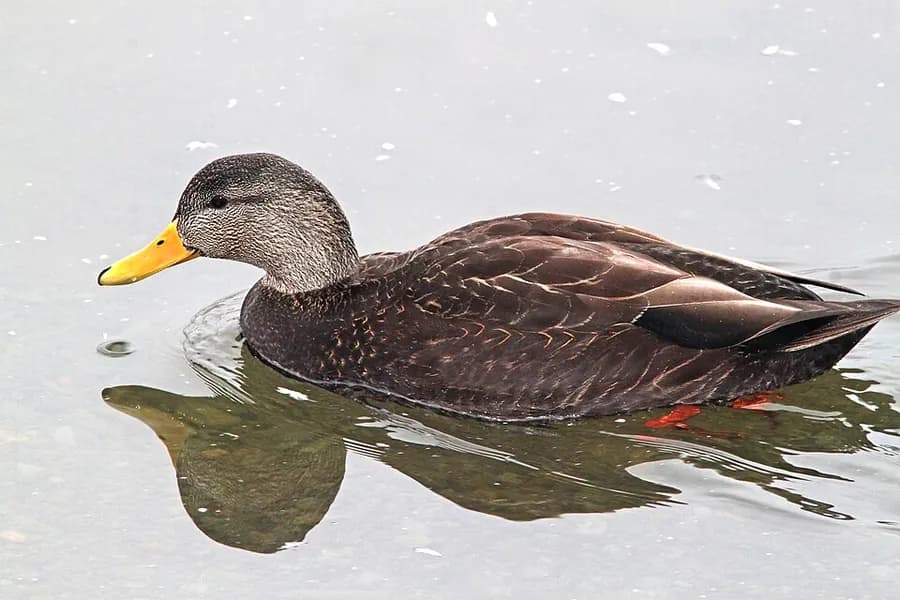
🦆American Black Duck
The American black duck is a large dabbling duck in the family Anatidae. It was described by William Brewster in 1902. It is the heaviest species in the genus Anas, weighing 720–1,640 g (1.6–3.6 lb) on average and measuring 54–59 cm (21–23 in) in length with an 88–95 cm (35–37 in) wingspan. It somewhat resembles the female and eclipse male mallard in coloration, but has a darker plumage. The male and female are generally similar in appearance, but the male's bill is yellow, while the female's is dull green with dark marks on the upper mandible. It is native to eastern North America. During the breeding season, it is usually found in coastal and freshwater wetlands from Saskatchewan to the Atlantic in Canada and the Great Lakes and the Adirondacks in the United States. It is a partially migratory species, mostly wintering in the east-central United States, especially in coastal areas.
Text: Wikipedia, CC BY-SA 4.0.
IUCN Red List assessment, 2021.
- Body mass
- 1.24 kg
- Body length
- not recorded
- Shoulder height
- not recorded
- Top speed
- not recorded
- Bite force
- not recorded
- Maximum lifespan
- 27 years
Everything we know about the American Black Duck
Typical adult figures. Where a value is an estimate rather than a measurement, it says so.
Body mass1.24 kgAVONETOther figures ↓Hide ↑
Source: AVONET · v1.1 (Tobias et al. 2022) · CC BY 4.0
By sex
- Male1.25 kgWikidataQ845292
- Female1.11 kgWikidataQ845292
Figures vary
- 1 kgAnAgeAnAge build 15, 2023-07-03 (HAGR)data quality: acceptable
Tail length0.07 mAVONETDetails ↓Hide ↑
Source: AVONET · v1.1 (Tobias et al. 2022) · CC BY 4.0
Wing length0.27 mAVONETDetails ↓Hide ↑
Source: AVONET · v1.1 (Tobias et al. 2022) · CC BY 4.0
Beak length0.06 mAVONETDetails ↓Hide ↑
Source: AVONET · v1.1 (Tobias et al. 2022) · CC BY 4.0
Tarsus length0.04 mAVONETDetails ↓Hide ↑
Source: AVONET · v1.1 (Tobias et al. 2022) · CC BY 4.0
Maximum lifespan27 yearsAnAgeDetails ↓Hide ↑
data quality: acceptable
Source: AnAge · AnAge build 15, 2023-07-03 (HAGR) · CC BY 3.0
Gestation28 daysAnAgeDetails ↓Hide ↑
data quality: acceptable
Source: AnAge · AnAge build 15, 2023-07-03 (HAGR) · CC BY 3.0
Litter sizeabout 9AnAgeDetails ↓Hide ↑
data quality: acceptable
Source: AnAge · AnAge build 15, 2023-07-03 (HAGR) · CC BY 3.0
Trophic levelOmnivoreAVONETDetails ↓Hide ↑
Source: AVONET · v1.1 (Tobias et al. 2022) · CC BY 4.0
HabitatWetlandAVONETDetails ↓Hide ↑
Source: AVONET · v1.1 (Tobias et al. 2022) · CC BY 4.0
LifestyleAquaticAVONETDetails ↓Hide ↑
Source: AVONET · v1.1 (Tobias et al. 2022) · CC BY 4.0
Volume l1.2 LaverageDetails ↓Hide ↑
Body mass at ~1.0 kg/L, the density of vertebrate tissue.
average = a mean across sexes or species in a group.
Not recorded for American Black Duck yet: body length, shoulder height, top speed, bite force.
Family tree
- kingdomAnimalia
- ›phylumChordata
- ›classAves
- ›orderAnseriformes
- ›familyAnatidae
- ›genusAnas
- ›speciesAnas rubripes
- classBirds · Aves
- superorderGalloanserae
- orderDucks, geese & swans · Anseriformes
- familyAnatidae
All 12 branches ↓Fewer branches ↑
- kingdomMetazoa
- phylumChordata
- subphylumCraniata
- subphylumVertebrata
- superclassGnathostomata
- superclassSarcopterygii
- superclassTetrapoda
- orderSauria
- classBirds · Aves
- superorderGalloanserae
- orderDucks, geese & swans · Anseriformes
- familyAnatidae
More about the American Black Duck


No videos of the American Black Duck yet.
We have 44,653 videos so far, and none of them features this animal yet.
All videos →Compare the American Black Duck
Pick a tool — the American Black Duck is already selected.
Compare every stat with any other animal.
Stand them on the same floor and see who's bigger.
How speed, brain and bite scale with body size. This animal isn't in the sample yet.
See where it sits in the tree of life.