
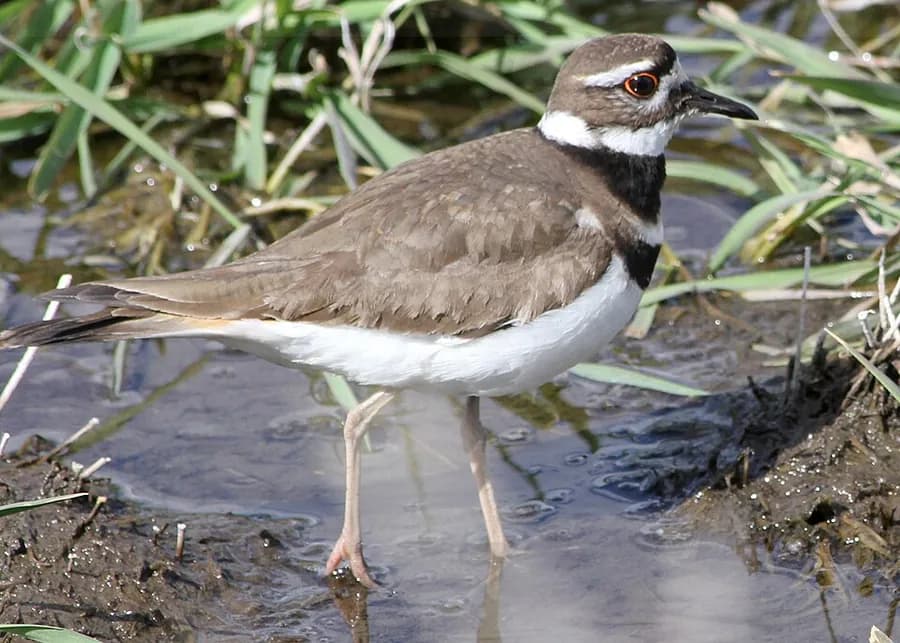
🐦Killdeer
The killdeer is a large plover found in the Americas. Its shrill, two-syllable call is often heard, sounding like "kill deer". It was described and given its current scientific name in 1758 by Carl Linnaeus in the 10th edition of his Systema Naturae. Three subspecies are described. Its upperparts are mostly brown with rufous fringes, the head has patches of white and black, and two black bands cross the breast. The belly and the rest of the breast are white. The nominate subspecies breeds from southeastern Alaska and southern Canada to Mexico. It is seen year-round in the southern half of its breeding range; the subspecies C. v. ternominatus is resident in the West Indies, and C. v. peruvianus inhabits Peru and surrounding South American countries throughout the year. North American breeders winter from their resident range south to Central America, the West Indies, and the northernmost portions of South America.
Text: Wikipedia, CC BY-SA 4.0.
IUCN Red List assessment, 2024.
- Body mass
- 0.1 kg
- Body length
- not recorded
- Shoulder height
- not recorded
- Top speed
- not recorded
- Bite force
- not recorded
- Maximum lifespan
- 11 years
Everything we know about the Killdeer
Typical adult figures. Where a value is an estimate rather than a measurement, it says so.
Body mass0.1 kgAVONETOther figures ↓Hide ↑
Source: AVONET · v1.1 (Tobias et al. 2022) · CC BY 4.0
Figures vary
- 0.09 kgAnAgeAnAge build 15, 2023-07-03 (HAGR)data quality: acceptable
Tail length0.09 mAVONETDetails ↓Hide ↑
Source: AVONET · v1.1 (Tobias et al. 2022) · CC BY 4.0
Wing length0.16 mAVONETDetails ↓Hide ↑
Source: AVONET · v1.1 (Tobias et al. 2022) · CC BY 4.0
Beak length0.02 mAVONETDetails ↓Hide ↑
Source: AVONET · v1.1 (Tobias et al. 2022) · CC BY 4.0
Tarsus length0.03 mAVONETDetails ↓Hide ↑
Source: AVONET · v1.1 (Tobias et al. 2022) · CC BY 4.0
Maximum lifespan11 yearsAnAgeDetails ↓Hide ↑
data quality: acceptable
Source: AnAge · AnAge build 15, 2023-07-03 (HAGR) · CC BY 3.0
Gestation24 daysAnAgeDetails ↓Hide ↑
data quality: acceptable
Source: AnAge · AnAge build 15, 2023-07-03 (HAGR) · CC BY 3.0
Litter sizeabout 4AnAgeDetails ↓Hide ↑
data quality: acceptable
Source: AnAge · AnAge build 15, 2023-07-03 (HAGR) · CC BY 3.0
Trophic levelCarnivoreAVONETDetails ↓Hide ↑
Source: AVONET · v1.1 (Tobias et al. 2022) · CC BY 4.0
HabitatWetlandAVONETDetails ↓Hide ↑
Source: AVONET · v1.1 (Tobias et al. 2022) · CC BY 4.0
LifestyleTerrestrialAVONETDetails ↓Hide ↑
Source: AVONET · v1.1 (Tobias et al. 2022) · CC BY 4.0
Danger to humansharmlessSeaLifeBaseDetails ↓Hide ↑
Source: SeaLifeBase · v25.04 · CC BY-NC 4.0
Volume l0.1 LaverageDetails ↓Hide ↑
Body mass at ~1.0 kg/L, the density of vertebrate tissue.
average = a mean across sexes or species in a group.
Not recorded for Killdeer yet: body length, shoulder height, top speed, bite force.
Family tree
- kingdomAnimalia
- ›phylumChordata
- ›classAves
- ›orderCharadriiformes
- ›familyCharadriidae
- ›genusCharadrius
- ›speciesCharadrius vociferus
- superclassSarcopterygii
- superclassTetrapoda
- orderSauria
- classBirds · Aves
All 9 branches ↓Fewer branches ↑
- kingdomMetazoa
- phylumChordata
- subphylumCraniata
- subphylumVertebrata
- superclassGnathostomata
- superclassSarcopterygii
- superclassTetrapoda
- orderSauria
- classBirds · Aves
More about the Killdeer


Animals caught on camera
Real footage of the animals on this site — hunting, fighting, and getting on with it.
Compare the Killdeer
Pick a tool — the Killdeer is already selected.
Compare every stat with any other animal.
Stand them on the same floor and see who's bigger.
How speed, brain and bite scale with body size. This animal isn't in the sample yet.
See where it sits in the tree of life.