
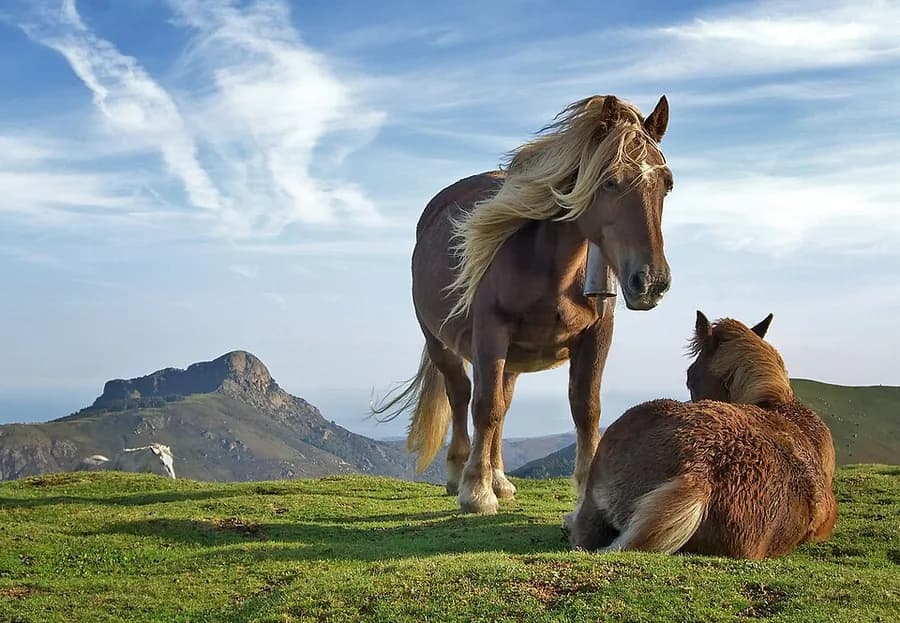
🐎Horse
The horse is a domesticated, one-toed, hoofed mammal. It belongs to the taxonomic family Equidae and is one of two extant subspecies of Equus ferus. The horse has evolved over the past 45 to 55 million years from a small multi-toed creature, Eohippus, into the large single-toed animal of today, originally in North America. Humans began domesticating horses around 4000 BCE in Central Asia, primarily associated with the Botai culture; and their domestication is believed to have been widespread by 3000 BCE. Horses in the subspecies caballus are domesticated, although some domesticated populations live in the wild as feral horses. These feral populations are not true wild horses, which are horses that have never been domesticated. There is an extensive, specialized vocabulary used to describe equine-related concepts, covering everything from anatomy to life stages, size, colors, markings, breeds, locomotion, and behavior.
Text: Wikipedia, CC BY-SA 4.0.
The IUCN Red List has not assessed Equus ferus caballus yet.
- Body mass
- 300 kg
- Body length
- not recorded
- Shoulder height
- 1.61 m
- Top speed
- 64 km/h
- Bite force
- not recorded
- Maximum lifespan
- 57 years
Everything we know about the Horse
Typical adult figures. Where a value is an estimate rather than a measurement, it says so.
Body mass300 kgAnAgeDetails ↓Hide ↑
data quality: high
Source: AnAge · AnAge build 15, 2023-07-03 (HAGR) · CC BY 3.0
Shoulder height1.61 m1.55–1.67 m · typical rangeDetails ↓Hide ↑
Height at the withers, riding horses. Overall domestic range spans 0.86-1.67+ m across breeds. NOTE: the Mammalian Species horse account's 120-146 cm is Przewalski's horse, not the domestic horse.
Source: Masko et al. 2022, Animals 12(7):931 · see citation
Top speed64 km/hDetails ↓Hide ↑
Sprint over a short distance, not a sustained pace. Compilations give 63.97 and 68.04 km/h. The fastest officially timed racehorse is 70.35 km/h over two furlongs (Winning Brew, Penn National, 2008) -- a record, not a typical animal. Hirt's 88 km/h is speedofanimals.com.
Source: Christiansen 2002, Zool J Linn Soc 136:685 and Bejan & Marden 2006, J Exp Biol 209:238; compiled in Hirt et al. 2017, Nat Ecol Evol 1:1116, Supplementary Data · see citation
Maximum lifespan57 yearsAnAgeDetails ↓Hide ↑
data quality: high
Source: AnAge · AnAge build 15, 2023-07-03 (HAGR) · CC BY 3.0
Gestation337 daysAnAgeDetails ↓Hide ↑
data quality: high
Source: AnAge · AnAge build 15, 2023-07-03 (HAGR) · CC BY 3.0
Litter size1AnAgeDetails ↓Hide ↑
data quality: high
Source: AnAge · AnAge build 15, 2023-07-03 (HAGR) · CC BY 3.0
Volume l300 LaverageDetails ↓Hide ↑
Body mass at ~1.0 kg/L, the density of vertebrate tissue.
average = a mean across sexes or species in a group.
Not recorded for Horse yet: body length, bite force.
Family tree
- kingdomAnimalia
- ›phylumChordata
- ›classMammalia
- ›orderPerissodactyla
- ›familyEquidae
- ›genusEquus
- ›speciesEquus caballus
- classMammals · Mammalia
- orderOdd-toed hoofed animals · Perissodactyla
- genusEquus
- subgenusEquus subgenus Equus
All 14 branches ↓Fewer branches ↑
- kingdomMetazoa
- phylumChordata
- subphylumCraniata
- subphylumVertebrata
- superclassGnathostomata
- superclassSarcopterygii
- superclassTetrapoda
- classMammals · Mammalia
- subclassTheria
- superorderLaurasiatheria
- orderOdd-toed hoofed animals · Perissodactyla
- familyEquidae
- genusEquus
- subgenusEquus subgenus Equus
More about the Horse


Animals caught on camera
Real footage of the animals on this site — hunting, fighting, and getting on with it.
Compare the Horse
Pick a tool — the Horse is already selected.
Compare every stat with any other animal.
Stand them on the same floor and see who's bigger.
How speed, brain and bite scale with body size. This animal isn't in the sample yet.
See where it sits in the tree of life.