
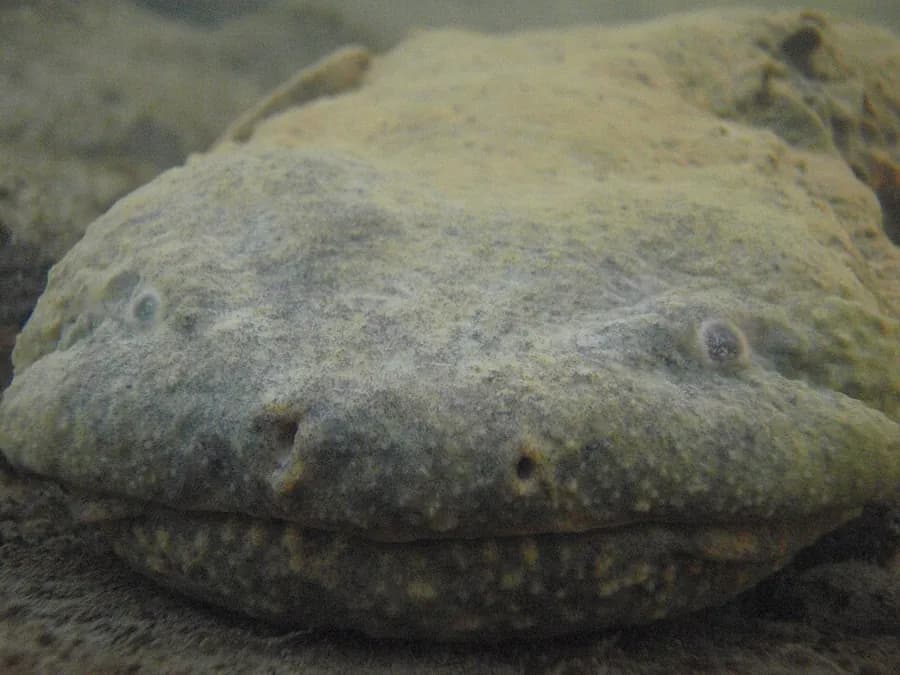
 🦎
Photo: U. S. Fish and Wildlife Service - Northeast Re… · Public domain
🦎Hellbender
The hellbender, also known as the hellbender salamander, is a species of aquatic giant salamander endemic to the eastern and central United States. It is the largest salamander in North America. A member of the family Cryptobranchidae, the hellbender is the only extant member of the genus Cryptobranchus. Other closely related salamanders in the same family are in the genus Andrias, which contains the Japanese and Chinese giant salamanders. The hellbender is much larger than any other salamander in its geographic range, and employs an unusual adaption for respiration through cutaneous gas exchange via capillaries found in its lateral skin folds. It fills a particular niche—both as a predator and prey—in its ecosystem, which either it or its ancestors have occupied for around 65 million years. The species is listed as Vulnerable on the IUCN Red List of Threatened Species due to the impacts of disease and widespread habitat loss and degradation throughout much of its range. Eastern hellbender populations are dropping quickly across most of their range, nearly 80% are declining or disappearing altogether. A reason for this is the loss of forest along streams, which they rely on to keep their habitats stable and clean. In many places, the populations are mostly older individuals, with few young hellbenders showing up to replace them.
Text: Wikipedia, CC BY-SA 4.0.
IUCN Red List assessment, 2022.
- Body mass
- 0.36 kg
- Body length
- 0.74 m
- Shoulder height
- not recorded
- Top speed
- not recorded
- Bite force
- not recorded
- Maximum lifespan
- 29 years
Everything we know about the Hellbender
Typical adult figures. Where a value is an estimate rather than a measurement, it says so.
Body mass0.36 kgAnAgeOther figures ↓Hide ↑
data quality: acceptable
Source: AnAge · AnAge build 15, 2023-07-03 (HAGR) · CC BY 3.0
Figures vary
- 0.36 kgAmphiBIOv1 (Oliveira et al. 2017)
Body length0.74 mAmphiBIODetails ↓Hide ↑
Source: AmphiBIO · v1 (Oliveira et al. 2017) · CC BY 4.0
Maximum lifespan29 yearsrecord 30 years · AmphiBIOAnAgeDetails ↓Hide ↑
data quality: acceptable
Record: largest individual on record
Source: AnAge · AnAge build 15, 2023-07-03 (HAGR) · CC BY 3.0
Gestation72 daysAnAgeDetails ↓Hide ↑
data quality: acceptable
Source: AnAge · AnAge build 15, 2023-07-03 (HAGR) · CC BY 3.0
Litter sizeabout 275AnAgeDetails ↓Hide ↑
data quality: acceptable
Source: AnAge · AnAge build 15, 2023-07-03 (HAGR) · CC BY 3.0
Dietarthropods, vertebratesAmphiBIODetails ↓Hide ↑
Source: AmphiBIO · v1 (Oliveira et al. 2017) · CC BY 4.0
Volume l0.4 LaverageDetails ↓Hide ↑
Body mass at ~1.0 kg/L, the density of vertebrate tissue.
average = a mean across sexes or species in a group.
Not recorded for Hellbender yet: shoulder height, top speed, bite force.
Family tree
- kingdomAnimalia
- ›phylumChordata
- ›classAmphibia
- ›orderCaudata
- ›familyCryptobranchidae
- ›genusCryptobranchus
- ›speciesCryptobranchus alleganiensis
- classAmphibians · Amphibia
- orderSalamanders & newts · Caudata
- familyCryptobranchidae
- genusCryptobranchus
All 13 branches ↓Fewer branches ↑
- kingdomMetazoa
- phylumChordata
- subphylumCraniata
- subphylumVertebrata
- superclassGnathostomata
- superclassSarcopterygii
- superclassTetrapoda
- classAmphibians · Amphibia
- superorderBatrachia
- orderSalamanders & newts · Caudata
- superfamilyCryptobranchoidea
- familyCryptobranchidae
- genusCryptobranchus
More about the Hellbender


Animals caught on camera
Real footage of the animals on this site — hunting, fighting, and getting on with it.
Compare the Hellbender
Pick a tool — the Hellbender is already selected.
Compare every stat with any other animal.
Stand them on the same floor and see who's bigger.
How speed, brain and bite scale with body size. This animal isn't in the sample yet.
See where it sits in the tree of life.