
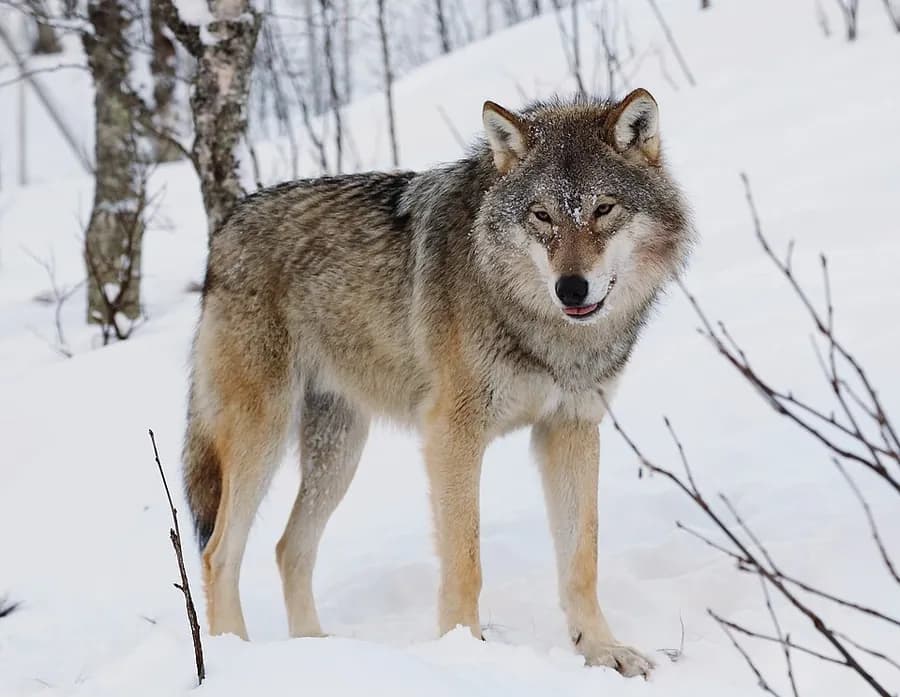
🐺Grey wolf
The wolf, also known as the grey wolf or gray wolf, is a canine native to Eurasia and North America. More than thirty subspecies of Canis lupus have been recognized, including the dog and dingo, though grey wolves, as popularly understood, include only naturally occurring wild subspecies. The wolf is the largest wild extant member of the family Canidae, and is further distinguished from other Canis species by its less pointed ears and muzzle, as well as a shorter torso and a longer tail. The wolf is nonetheless related closely enough to smaller Canis species, such as the coyote and the golden jackal, to produce fertile hybrids with them. The wolf's fur is usually mottled white, brown, grey, and black, although subspecies in the arctic region may be nearly all white.
Text: Wikipedia, CC BY-SA 4.0.
IUCN Red List assessment, 2026.
- Body mass
- 29 kg
- Body length
- 1.27 m
- Shoulder height
- 0.73 m
- Top speed
- 62 km/h
- Bite force
- 593 N
- Maximum lifespan
- 29 years
Everything we know about the Grey wolf
Typical adult figures. Where a value is an estimate rather than a measurement, it says so.
Body mass29 kgCOMBINEOther figures ↓Hide ↑
Source: COMBINE · v1 (Soria et al. 2021) · CC BY 4.0
Figures vary
- 27 kgAnAgeAnAge build 15, 2023-07-03 (HAGR)data quality: high
Body length1.27 mCOMBINEDetails ↓Hide ↑
Source: COMBINE · v1 (Soria et al. 2021) · CC BY 4.0
Shoulder height0.73 m0.66–0.81 m · typical rangecarcass, laid on sideDetails ↓Hide ↑
Global range, not sex-split. Young & Goldman 1944 (North America) give 0.66-0.97 m. The Heptner row in this file is USSR-centric and runs higher; prefer this one for a species-level figure.
Source: Hunter 2011, Carnivores of the World, Plate 43 · see citation
Top speed62 km/hDetails ↓Hide ↑
Sprint over a short distance, not a sustained pace. Compilations give 62.06 and 63.97 km/h.
Source: Iriarte-Diaz 2002, J Exp Biol 205:2897 and Christiansen 2002, Zool J Linn Soc 136:685; compiled in Hirt et al. 2017, Nat Ecol Evol 1:1116, Supplementary Data · see citation
Bite force593 NDetails ↓Hide ↑
Canine bite modelled by the dry-skull method (Thomason 1991) from a prepared skull; static bite at the canines, gape not stated. Not a live measurement. The skull's estimated body mass was 34.7 kg. A lever model of captive-animal skulls gives 1141 N for the same species (Rozycka et al. 2024, Animals 14:1367).
Source: Wroe, McHenry & Thomason 2005, Proc R Soc B 272:619, Table 1 · see citation
Bite force for its size136Details ↓Hide ↑
Bite force normalised for body mass: the residual of canine bite force regressed on body mass, average across the sample set to 100. Above 100 means the animal bites harder than its size predicts. Do not cross-check against Wikipedia's BFQ table, which silently mixes this paper with Christiansen & Wroe 2007 and cites a popular-science book.
Source: Wroe, McHenry & Thomason 2005, Proc R Soc B 272:619, Table 1 · see citation
Brain mass136 gCOMBINEDetails ↓Hide ↑
Source: COMBINE · v1 (Soria et al. 2021) · CC BY 4.0
Maximum lifespan29 yearsCOMBINEOther figures ↓Hide ↑
Source: COMBINE · v1 (Soria et al. 2021) · CC BY 4.0
Figures vary
- 21 yearsAnAgeAnAge build 15, 2023-07-03 (HAGR)data quality: high
Generation length7.89 yearsCOMBINEDetails ↓Hide ↑
Source: COMBINE · v1 (Soria et al. 2021) · CC BY 4.0
Age at maturity1.9 yearsCOMBINEDetails ↓Hide ↑
Source: COMBINE · v1 (Soria et al. 2021) · CC BY 4.0
Gestation62 daysCOMBINEOther figures ↓Hide ↑
Source: COMBINE · v1 (Soria et al. 2021) · CC BY 4.0
Figures vary
- 62 daysAnAgeAnAge build 15, 2023-07-03 (HAGR)data quality: high
Litter sizeabout 5COMBINEOther figures ↓Hide ↑
Source: COMBINE · v1 (Soria et al. 2021) · CC BY 4.0
Figures vary
- 6AnAgeAnAge build 15, 2023-07-03 (HAGR)data quality: high
Trophic levelCarnivoreCOMBINEDetails ↓Hide ↑
Source: COMBINE · v1 (Soria et al. 2021) · CC BY 4.0
Activity cycleCrepuscular / mixedCOMBINEDetails ↓Hide ↑
Source: COMBINE · v1 (Soria et al. 2021) · CC BY 4.0
Home range160 km²COMBINEDetails ↓Hide ↑
Source: COMBINE · v1 (Soria et al. 2021) · CC BY 4.0
Population density0.03 per km²COMBINEDetails ↓Hide ↑
Source: COMBINE · v1 (Soria et al. 2021) · CC BY 4.0
Volume l29 LaverageDetails ↓Hide ↑
Body mass at ~1.0 kg/L, the density of vertebrate tissue.
average = a mean across sexes or species in a group.
Family tree
- kingdomAnimalia
- ›phylumChordata
- ›classMammalia
- ›orderCarnivora
- ›familyCanidae
- ›genusCanis
- ›speciesCanis lupus
- classMammals · Mammalia
- orderCarnivorans · Carnivora
- suborderCaniformia
- familyCanidae
All 13 branches ↓Fewer branches ↑
- kingdomMetazoa
- phylumChordata
- subphylumCraniata
- subphylumVertebrata
- superclassGnathostomata
- superclassSarcopterygii
- superclassTetrapoda
- classMammals · Mammalia
- subclassTheria
- superorderLaurasiatheria
- orderCarnivorans · Carnivora
- suborderCaniformia
- familyCanidae
More about the Grey wolf


Animals caught on camera
Real footage of the animals on this site — hunting, fighting, and getting on with it.
Compare the Grey wolf
Pick a tool — the Grey wolf is already selected.
Compare every stat with any other animal.
Stand them on the same floor and see who's bigger.
Does it punch above its weight? Its stats against what body size predicts.
See where it sits in the tree of life.