
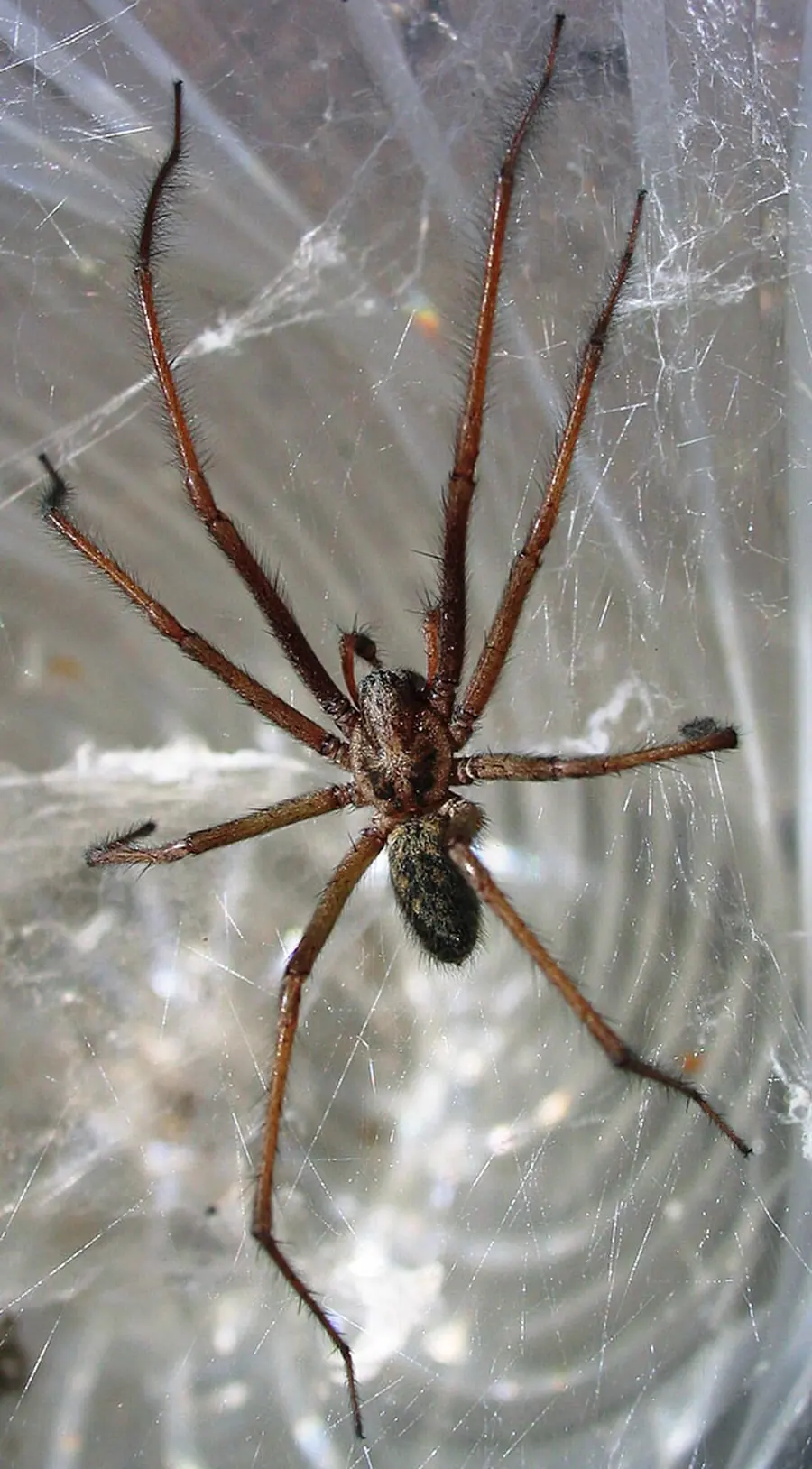
🕷️Giant house spider
The giant house spider has been treated as either one species, under the name Eratigena atrica, or as three species, E. atrica, E. duellica and E. saeva. As of April 2020, the three-species-view was accepted by the World Spider Catalog. They are among the largest spiders of Central and Northern Europe. They were previously placed in the genus Tegenaria. In 2013, they were moved to the new genus Eratigena as the single species Eratigena atrica. In 2018, the three separate species were restored. The bite of these species does not pose a threat to humans or pets, and they are generally reluctant to bite, preferring instead to hide or escape.
Text: Wikipedia, CC BY-SA 4.0.
The IUCN Red List has not assessed Eratigena atrica yet.
- Body mass
- 0 kg
- Body length
- 0.01 m
- Shoulder height
- not recorded
- Top speed
- not recorded
- Bite force
- not recorded
- Maximum lifespan
- not recorded
Everything we know about the Giant house spider
Typical adult figures. Where a value is an estimate rather than a measurement, it says so.
Body mass0 kgaverageOther figures ↓Hide ↑
Species-level value synthesised as the mean of: female.
By sex
- Female0 kgWorld Spider Trait DatabasePekar et al. 2021, Database 2021:baab064Adhesive foot pads and prey capture behaviour; Wolff et al. 2019
Body length0.01 mrecord 0.02 m · World Spider Trait Databasetypical adultWorld Spider Trait DatabaseOther figures ↓Hide ↑
Lyons et al 2025 trait data; Rayner, Vitkauskaite, Healy, Lyons, McShar
Record: largest individual on record
Source: World Spider Trait Database · Pekar et al. 2021, Database 2021:baab064 · CC BY
By sex
- Male0.01 mWorld Spider Trait DatabasePekar et al. 2021, Database 2021:baab064Body size of European spiders from Spiders of Europe; Nentwig et al. 2018
- Female0.01 mWorld Spider Trait DatabasePekar et al. 2021, Database 2021:baab064Body size of European spiders from Spiders of Europe; Nentwig et al. 2018
- Female0.01 mWorld Spider Trait DatabasePekar et al. 2021, Database 2021:baab064Spider morphometric and foraging traits; Bolzern et al. 2013
Figures vary
- 0.01 mWorld Spider Trait DatabasePekar et al. 2021, Database 2021:baab064Lyons et al 2025 trait data; Rayner, Vitkauskaite, Healy, Lyons, McShar
Volume l0 LaverageDetails ↓Hide ↑
Body mass at ~1.0 kg/L, the density of vertebrate tissue.
average = a mean across sexes or species in a group.
Not recorded for Giant house spider yet: shoulder height, top speed, bite force, maximum lifespan.
Family tree
- kingdomAnimalia
- ›phylumArthropoda
- ›classArachnida
- ›orderAraneae
- ›familyAgelenidae
- ›genusEratigena
- ›speciesEratigena atrica
- orderSpiders · Araneae
- suborderAraneomorphae
- familyAgelenidae
- genusEratigena
All 7 branches ↓Fewer branches ↑
- kingdomMetazoa
- phylumArthropoda
- subphylumChelicerata
- orderSpiders · Araneae
- suborderAraneomorphae
- familyAgelenidae
- genusEratigena
More about the Giant house spider
No videos of the Giant house spider yet.
We have 44,653 videos so far, and none of them features this animal yet.
All videos →Compare the Giant house spider
Pick a tool — the Giant house spider is already selected.
Compare every stat with any other animal.
Stand them on the same floor and see who's bigger.
How speed, brain and bite scale with body size. This animal isn't in the sample yet.
See where it sits in the tree of life.