
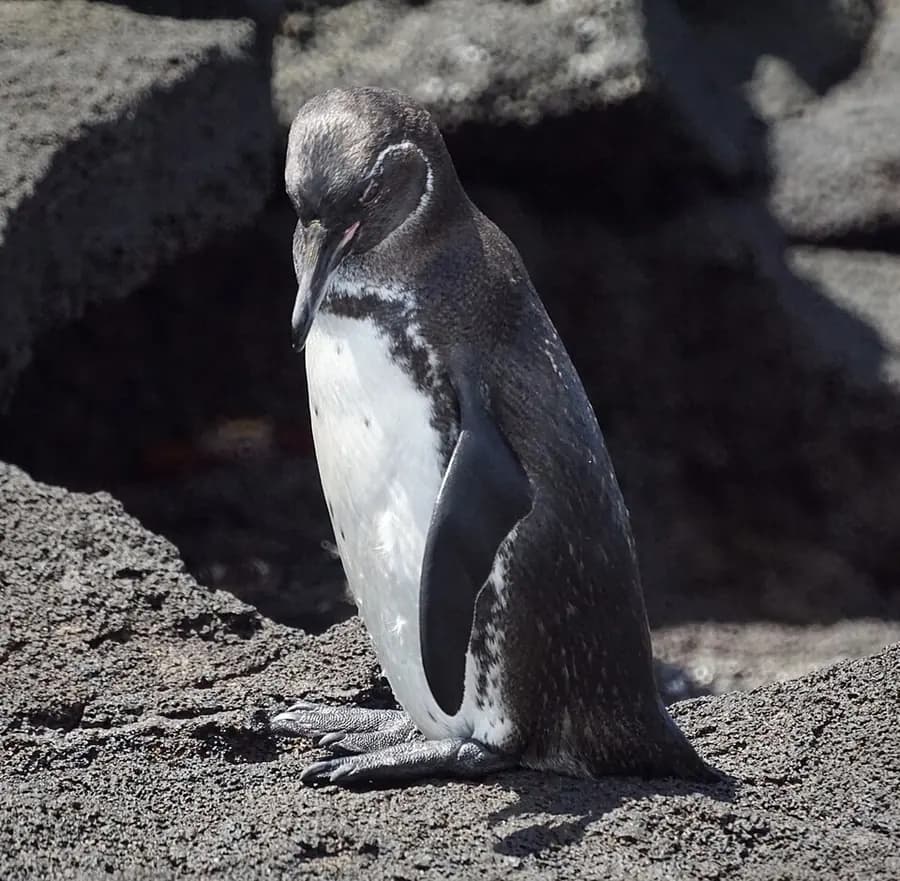
🐧Galápagos Penguin
The Galápagos penguin is a penguin endemic to the Galápagos Islands of Ecuador. It is the only penguin found north of the equator. Most inhabit Fernandina Island and the west coast of Isabela Island. The cool waters of the Humboldt and Cromwell Currents allow it to survive despite the tropical latitude. The Galápagos penguin is one of the banded penguins, the other species of which live mostly on the coasts of Africa and mainland South America. Due to their warm environment, Galápagos penguins have developed techniques to stay cool. The feathers on their back, flippers, and head are black, and they have a white belly and a stripe looping from their eyes down to their neck and chin. Each penguin keeps only one mate, and breeds year-round. Because there are no soft areas to nest, their nests are typically in caves and crevices which also provide protection against predators and the harsh environment. The Galápagos penguin has a lifespan of 20 years, but due to predation, life expectancy in the wild could be significantly reduced. They have been critically impacted to the point of endangerment by climate change and pollution caused by plastic waste due to tourism and urbanization.
Text: Wikipedia, CC BY-SA 4.0.
IUCN Red List assessment, 2020.
- Body mass
- 1.92 kg
- Body length
- 0.53 m
- Shoulder height
- not recorded
- Top speed
- not recorded
- Bite force
- not recorded
- Maximum lifespan
- 18 years
Everything we know about the Galápagos Penguin
Typical adult figures. Where a value is an estimate rather than a measurement, it says so.
Body mass1.92 kgrecord 2.5 kg · SeaLifeBaseAVONETOther figures ↓Hide ↑
Record: largest individual on record
Source: AVONET · v1.1 (Tobias et al. 2022) · CC BY 4.0
Figures vary
- 1.93 kgAnAgeAnAge build 15, 2023-07-03 (HAGR)data quality: acceptable
Body length0.53 mmaximum recorded, total lengthSeaLifeBaseDetails ↓Hide ↑
Source: SeaLifeBase · v25.04 · CC BY-NC 4.0
Tail length0.03 mAVONETDetails ↓Hide ↑
Source: AVONET · v1.1 (Tobias et al. 2022) · CC BY 4.0
Wing length0.08 mAVONETDetails ↓Hide ↑
Source: AVONET · v1.1 (Tobias et al. 2022) · CC BY 4.0
Beak length0.06 mAVONETDetails ↓Hide ↑
Source: AVONET · v1.1 (Tobias et al. 2022) · CC BY 4.0
Tarsus length0.03 mAVONETDetails ↓Hide ↑
Source: AVONET · v1.1 (Tobias et al. 2022) · CC BY 4.0
Maximum lifespan18 yearsAnAgeDetails ↓Hide ↑
data quality: acceptable
Source: AnAge · AnAge build 15, 2023-07-03 (HAGR) · CC BY 3.0
Trophic levelCarnivoreAVONETDetails ↓Hide ↑
Source: AVONET · v1.1 (Tobias et al. 2022) · CC BY 4.0
HabitatMarineAVONETDetails ↓Hide ↑
Source: AVONET · v1.1 (Tobias et al. 2022) · CC BY 4.0
LifestyleAquaticAVONETDetails ↓Hide ↑
Source: AVONET · v1.1 (Tobias et al. 2022) · CC BY 4.0
Volume l1.9 LaverageDetails ↓Hide ↑
Body mass at ~1.0 kg/L, the density of vertebrate tissue.
average = a mean across sexes or species in a group.
Not recorded for Galápagos Penguin yet: shoulder height, top speed, bite force.
Family tree
- kingdomAnimalia
- ›phylumChordata
- ›classAves
- ›orderSphenisciformes
- ›familySpheniscidae
- ›genusSpheniscus
- ›speciesSpheniscus mendiculus
- classBirds · Aves
- orderPenguins · Sphenisciformes
- familySpheniscidae
- genusSpheniscus
All 12 branches ↓Fewer branches ↑
- kingdomMetazoa
- phylumChordata
- subphylumCraniata
- subphylumVertebrata
- superclassGnathostomata
- superclassSarcopterygii
- superclassTetrapoda
- orderSauria
- classBirds · Aves
- orderPenguins · Sphenisciformes
- familySpheniscidae
- genusSpheniscus
More about the Galápagos Penguin


No videos of the Galápagos Penguin yet.
We have 44,653 videos so far, and none of them features this animal yet.
All videos →Compare the Galápagos Penguin
Pick a tool — the Galápagos Penguin is already selected.
Compare every stat with any other animal.
Stand them on the same floor and see who's bigger.
How speed, brain and bite scale with body size. This animal isn't in the sample yet.
See where it sits in the tree of life.