
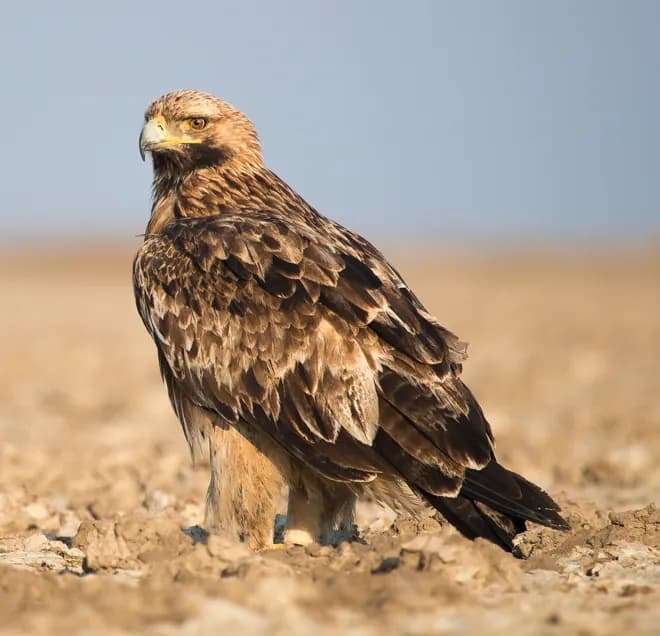
🦅Eastern Imperial Eagle
The eastern imperial eagle is a large bird of prey that breeds in southeastern Europe and extensively through West and Central Asia. Most populations are migratory and winter in northeastern Africa, the Middle East and South and East Asia. Like all eagles, the eastern imperial eagle is a member of the family Accipitridae. Furthermore, its feathered legs mark it as a member of the subfamily Aquilinae. It is a large, dark-colored eagle, with a resemblance to other members of the genus Aquila, but it is usually the darkest species in its range. It is an opportunistic predator that mostly selects smallish mammals as prey but also a fairly large proportion of birds, reptile and other prey types, including carrion. Compared to other Aquila eagles, it has a strong preference for the interface of tall woods with plains and other open, relatively flat habitats, including the wooded mosaics of the steppe. Normally, nests are located in large, mature trees and the parents raise around one or two fledglings. The global population is small and declining due to persecution, loss of habitat and prey. It has therefore been IUCN Red Listed as Vulnerable since 1994.
Text: Wikipedia, CC BY-SA 4.0.
IUCN Red List assessment, 2025.
- Body mass
- 3.13 kg
- Body length
- not recorded
- Shoulder height
- not recorded
- Top speed
- not recorded
- Bite force
- not recorded
- Maximum lifespan
- 56 years
Everything we know about the Eastern Imperial Eagle
Typical adult figures. Where a value is an estimate rather than a measurement, it says so.
Body mass3.13 kgAVONETOther figures ↓Hide ↑
Source: AVONET · v1.1 (Tobias et al. 2022) · CC BY 4.0
By sex
- Male2.58 kgWikidataQ168976
- Female3.85 kgWikidataQ168976
Figures vary
- 3.26 kgAnAgeAnAge build 15, 2023-07-03 (HAGR)data quality: acceptable
Tail length0.32 mAVONETDetails ↓Hide ↑
Source: AVONET · v1.1 (Tobias et al. 2022) · CC BY 4.0
Wing length0.58 mAVONETDetails ↓Hide ↑
Source: AVONET · v1.1 (Tobias et al. 2022) · CC BY 4.0
Beak length0.06 mAVONETDetails ↓Hide ↑
Source: AVONET · v1.1 (Tobias et al. 2022) · CC BY 4.0
Tarsus length0.09 mAVONETDetails ↓Hide ↑
Source: AVONET · v1.1 (Tobias et al. 2022) · CC BY 4.0
Maximum lifespan56 yearsAnAgeDetails ↓Hide ↑
data quality: acceptable
Source: AnAge · AnAge build 15, 2023-07-03 (HAGR) · CC BY 3.0
Trophic levelCarnivoreAVONETDetails ↓Hide ↑
Source: AVONET · v1.1 (Tobias et al. 2022) · CC BY 4.0
HabitatWoodlandAVONETDetails ↓Hide ↑
Source: AVONET · v1.1 (Tobias et al. 2022) · CC BY 4.0
LifestyleGeneralistAVONETDetails ↓Hide ↑
Source: AVONET · v1.1 (Tobias et al. 2022) · CC BY 4.0
Volume l3.1 LaverageDetails ↓Hide ↑
Body mass at ~1.0 kg/L, the density of vertebrate tissue.
average = a mean across sexes or species in a group.
Not recorded for Eastern Imperial Eagle yet: body length, shoulder height, top speed, bite force.
Family tree
- kingdomAnimalia
- ›phylumChordata
- ›classAves
- ›orderAccipitriformes
- ›familyAccipitridae
- ›genusAquila
- ›speciesAquila heliaca
- orderSauria
- classBirds · Aves
- orderHawks & eagles · Accipitriformes
- familyAccipitridae
All 11 branches ↓Fewer branches ↑
- kingdomMetazoa
- phylumChordata
- subphylumCraniata
- subphylumVertebrata
- superclassGnathostomata
- superclassSarcopterygii
- superclassTetrapoda
- orderSauria
- classBirds · Aves
- orderHawks & eagles · Accipitriformes
- familyAccipitridae
More about the Eastern Imperial Eagle
No videos of the Eastern Imperial Eagle yet.
We have 44,653 videos so far, and none of them features this animal yet.
All videos →Compare the Eastern Imperial Eagle
Pick a tool — the Eastern Imperial Eagle is already selected.
Compare every stat with any other animal.
Stand them on the same floor and see who's bigger.
How speed, brain and bite scale with body size. This animal isn't in the sample yet.
See where it sits in the tree of life.