
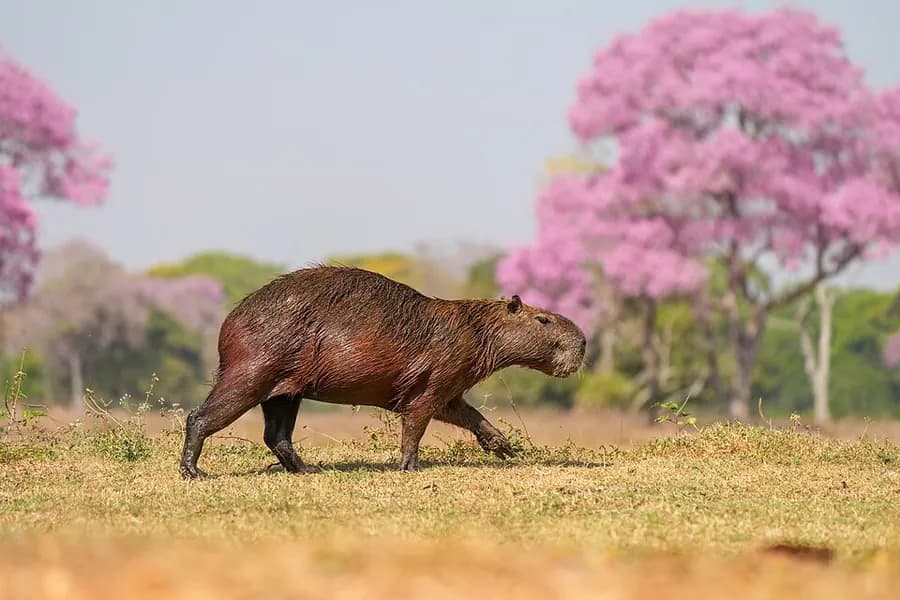
🐹Capybara
The capybara or greater capybara is the largest living rodent, native to all countries in South America except Chile. It is a semiaquatic herbivore that inhabits savannas and dense forests, living near and in bodies of freshwater and feeding mainly on grasses and aquatic plants.
Text: Wikipedia, CC BY-SA 4.0.
IUCN Red List assessment, 2016.
- Body mass
- 52 kg
- Body length
- 1.25 m
- Shoulder height
- 0.57 m
- Top speed
- not recorded
- Bite force
- not recorded
- Maximum lifespan
- 15 years
Everything we know about the Capybara
Typical adult figures. Where a value is an estimate rather than a measurement, it says so.
Body mass52 kgCOMBINEOther figures ↓Hide ↑
Source: COMBINE · v1 (Soria et al. 2021) · CC BY 4.0
Figures vary
- 55 kgAnAgeAnAge build 15, 2023-07-03 (HAGR)data quality: high
Body length1.25 mCOMBINEDetails ↓Hide ↑
Source: COMBINE · v1 (Soria et al. 2021) · CC BY 4.0
Shoulder height0.57 m0.5–0.62 m · typical rangeat withersDetails ↓Hide ↑
"height at withers, 566 (500 to 620, n = 92)" (mm) - mean and extremes for 92 Llanos animals; sex not stated. ADW gives a consistent "standing up to 0.6 meters at the shoulder".
Source: Mones & Ojasti 1986, Mammalian Species 264:1-7 (data of Ojasti 1973, Llanos population), https://doi.org/10.2307/3503784 · see citation
Brain mass67 gCOMBINEDetails ↓Hide ↑
Source: COMBINE · v1 (Soria et al. 2021) · CC BY 4.0
Maximum lifespan15 yearsCOMBINEOther figures ↓Hide ↑
Source: COMBINE · v1 (Soria et al. 2021) · CC BY 4.0
Figures vary
- 15 yearsAnAgeAnAge build 15, 2023-07-03 (HAGR)data quality: high
Generation length5.56 yearsCOMBINEDetails ↓Hide ↑
Source: COMBINE · v1 (Soria et al. 2021) · CC BY 4.0
Age at maturity1.6 yearsCOMBINEDetails ↓Hide ↑
Source: COMBINE · v1 (Soria et al. 2021) · CC BY 4.0
Gestation151 daysCOMBINEOther figures ↓Hide ↑
Source: COMBINE · v1 (Soria et al. 2021) · CC BY 4.0
Figures vary
- 150 daysAnAgeAnAge build 15, 2023-07-03 (HAGR)data quality: high
Litter sizeabout 3COMBINEOther figures ↓Hide ↑
Source: COMBINE · v1 (Soria et al. 2021) · CC BY 4.0
Figures vary
- 4.8AnAgeAnAge build 15, 2023-07-03 (HAGR)data quality: high
Trophic levelHerbivoreCOMBINEDetails ↓Hide ↑
Source: COMBINE · v1 (Soria et al. 2021) · CC BY 4.0
Activity cycleDiurnalCOMBINEDetails ↓Hide ↑
Source: COMBINE · v1 (Soria et al. 2021) · CC BY 4.0
Home range0.07 km²COMBINEDetails ↓Hide ↑
Source: COMBINE · v1 (Soria et al. 2021) · CC BY 4.0
Population density7.01 per km²COMBINEDetails ↓Hide ↑
Source: COMBINE · v1 (Soria et al. 2021) · CC BY 4.0
Volume l52 LaverageDetails ↓Hide ↑
Body mass at ~1.0 kg/L, the density of vertebrate tissue.
average = a mean across sexes or species in a group.
Not recorded for Capybara yet: top speed, bite force.
Family tree
- kingdomAnimalia
- ›phylumChordata
- ›classMammalia
- ›orderRodentia
- ›familyCaviidae
- ›genusHydrochoerus
- ›speciesHydrochoerus hydrochaeris
- classMammals · Mammalia
- orderRodents · Rodentia
- familyHydrochaeridae
- genusHydrochoerus
All 14 branches ↓Fewer branches ↑
- kingdomMetazoa
- phylumChordata
- subphylumCraniata
- subphylumVertebrata
- superclassGnathostomata
- superclassSarcopterygii
- superclassTetrapoda
- classMammals · Mammalia
- subclassTheria
- superorderEuarchontoglires
- orderRodents · Rodentia
- suborderHystricomorpha
- familyHydrochaeridae
- genusHydrochoerus
More about the Capybara


Animals caught on camera
Real footage of the animals on this site — hunting, fighting, and getting on with it.
Compare the Capybara
Pick a tool — the Capybara is already selected.
Compare every stat with any other animal.
Stand them on the same floor and see who's bigger.
Does it punch above its weight? Its stats against what body size predicts.
See where it sits in the tree of life.