
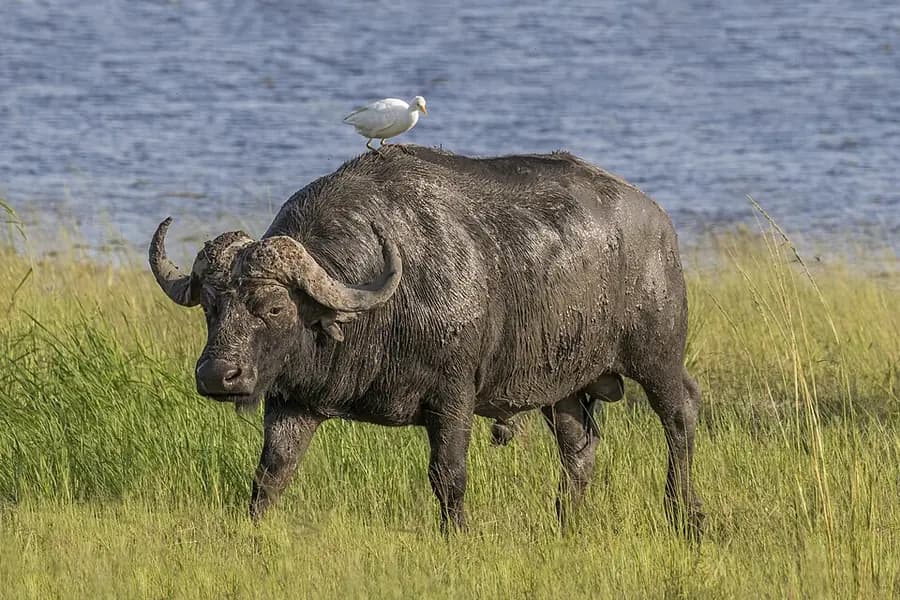
🐃Cape buffalo
The African buffalo is a large species of true buffalo native to Sub-Saharan Africa, where it is found in a number of disconnected ranges stretching from south-eastern Senegal through West and Central Africa to South Africa. The adult African buffalo's horns are its characteristic feature: they have fused bases that form a continuous bone shield, referred to as a "boss", across the top of the head. The African buffalo is more closely related to Asian buffalo (Bubalus) species than it is to other bovids such as American bison or domestic cattle. Its unpredictable temperament may be part of the reason that the African buffalo has never been domesticated and has no domesticated descendants, unlike the wild yak and wild water buffalo, which are the ancestors of the domestic yak and water buffalo, respectively. Natural predators of adult African buffaloes include lions, African wild dogs, spotted hyenas, and Nile crocodiles. As one of the Big Five game animals, the Cape buffalo, the largest subspecies native to eastern and southern Africa, is a sought-after trophy in hunting.
Text: Wikipedia, CC BY-SA 4.0.
IUCN Red List assessment, 2019.
- Body mass
- 646 kg
- Body length
- 2.96 m
- Shoulder height
- 1.35 m
- Top speed
- 55 km/h
- Bite force
- not recorded
- Maximum lifespan
- 30 years
Everything we know about the Cape buffalo
Typical adult figures. Where a value is an estimate rather than a measurement, it says so.
Body mass646 kgCOMBINEOther figures ↓Hide ↑
Source: COMBINE · v1 (Soria et al. 2021) · CC BY 4.0
Figures vary
- 700 kgAnAgeAnAge build 15, 2023-07-03 (HAGR)data quality: acceptable
Body length2.96 mCOMBINEDetails ↓Hide ↑
Source: COMBINE · v1 (Soria et al. 2021) · CC BY 4.0
Shoulder height1.35 m1–1.7 m · typical rangeDetails ↓Hide ↑
Range spans all subspecies, so it is wide; not specific to S. c. caffer.
Source: Kingdon 2015, The Kingdon Field Guide to African Mammals · see citation
Top speed55 km/hDetails ↓Hide ↑
Sprint over a short distance, not a sustained pace. Compilations give 55.44 and 57.02 km/h.
Source: Bejan & Marden 2006, J Exp Biol 209:238 and Christiansen 2002, Zool J Linn Soc 136:685; compiled in Hirt et al. 2017, Nat Ecol Evol 1:1116, Supplementary Data · see citation
Brain mass583 gCOMBINEDetails ↓Hide ↑
Source: COMBINE · v1 (Soria et al. 2021) · CC BY 4.0
Maximum lifespan30 yearsCOMBINEOther figures ↓Hide ↑
Source: COMBINE · v1 (Soria et al. 2021) · CC BY 4.0
Figures vary
- 33 yearsAnAgeAnAge build 15, 2023-07-03 (HAGR)data quality: acceptable
Generation length11 yearsCOMBINEDetails ↓Hide ↑
Source: COMBINE · v1 (Soria et al. 2021) · CC BY 4.0
Age at maturity4.6 yearsCOMBINEDetails ↓Hide ↑
Source: COMBINE · v1 (Soria et al. 2021) · CC BY 4.0
Gestation333 daysCOMBINEOther figures ↓Hide ↑
Source: COMBINE · v1 (Soria et al. 2021) · CC BY 4.0
Figures vary
- 331 daysAnAgeAnAge build 15, 2023-07-03 (HAGR)data quality: acceptable
Litter size1COMBINEOther figures ↓Hide ↑
Source: COMBINE · v1 (Soria et al. 2021) · CC BY 4.0
Figures vary
- 1AnAgeAnAge build 15, 2023-07-03 (HAGR)data quality: acceptable
Trophic levelHerbivoreCOMBINEDetails ↓Hide ↑
Source: COMBINE · v1 (Soria et al. 2021) · CC BY 4.0
Activity cycleCrepuscular / mixedCOMBINEDetails ↓Hide ↑
Source: COMBINE · v1 (Soria et al. 2021) · CC BY 4.0
Home range64 km²COMBINEDetails ↓Hide ↑
Source: COMBINE · v1 (Soria et al. 2021) · CC BY 4.0
Population density2.99 per km²COMBINEDetails ↓Hide ↑
Source: COMBINE · v1 (Soria et al. 2021) · CC BY 4.0
Volume l646 LaverageDetails ↓Hide ↑
Body mass at ~1.0 kg/L, the density of vertebrate tissue.
average = a mean across sexes or species in a group.
Not recorded for Cape buffalo yet: bite force.
Family tree
- kingdomAnimalia
- ›phylumChordata
- ›classMammalia
- ›orderArtiodactyla
- ›familyBovidae
- ›genusSyncerus
- ›speciesSyncerus caffer
- classMammals · Mammalia
- orderEven-toed hoofed animals · Artiodactyla
- subfamilyBovinae
- genusSyncerus
All 16 branches ↓Fewer branches ↑
- kingdomMetazoa
- phylumChordata
- subphylumCraniata
- subphylumVertebrata
- superclassGnathostomata
- superclassSarcopterygii
- superclassTetrapoda
- classMammals · Mammalia
- subclassTheria
- superorderLaurasiatheria
- orderEven-toed hoofed animals · Artiodactyla
- suborderRuminantia
- infraorderPecora
- familyBovidae
- subfamilyBovinae
- genusSyncerus
More about the Cape buffalo


Animals caught on camera
Real footage of the animals on this site — hunting, fighting, and getting on with it.
Compare the Cape buffalo
Pick a tool — the Cape buffalo is already selected.
Compare every stat with any other animal.
Stand them on the same floor and see who's bigger.
Does it punch above its weight? Its stats against what body size predicts.
See where it sits in the tree of life.