
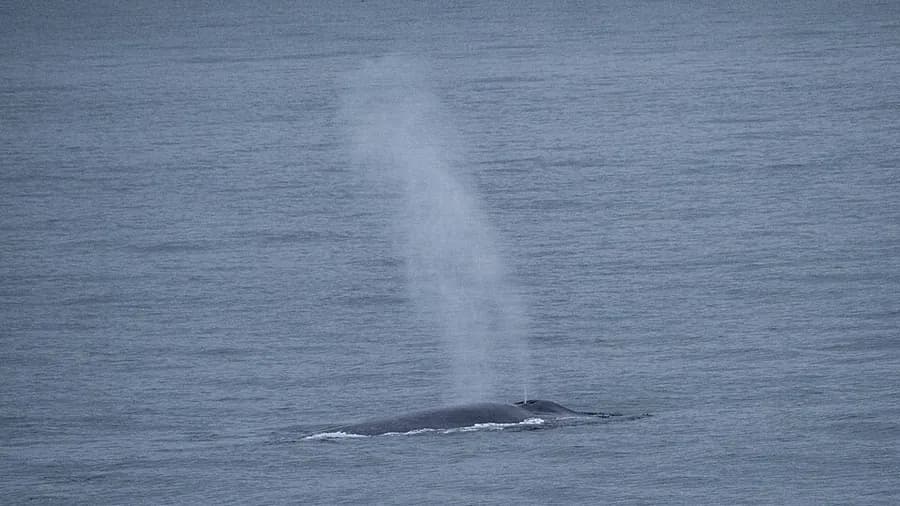
🐋Blue whale
The blue whale is a species of baleen whale and the largest marine mammal in the rorqual family Balaenopteridae. Reaching a maximum confirmed length of 29.9–30.5 m (98–100 ft) and weighing up to 190–200 t, it is the largest animal known to have ever existed. The blue whale's long and slender body can be of various shades of greyish-blue on its upper surface and somewhat lighter underneath. Four subspecies are recognized: B. m. musculus in the North Atlantic and North Pacific, B. m. intermedia in the Southern Ocean, B. m. brevicauda in the Indian Ocean and South Pacific Ocean, and B. m. indica in the Northern Indian Ocean. There is a population in the waters off Chile that may constitute a fifth subspecies.
Text: Wikipedia, CC BY-SA 4.0.
IUCN Red List assessment, 2018.
- Body mass
- 149,000 kg
- Body length
- 30 m
- Shoulder height
- not recorded
- Top speed
- not recorded
- Bite force
- not recorded
- Maximum lifespan
- 110 years
Everything we know about the Blue whale
Typical adult figures. Where a value is an estimate rather than a measurement, it says so.
Body mass149,000 kgrecord 160,000 kg · SeaLifeBaseCOMBINEOther figures ↓Hide ↑
Record: largest individual on record
Source: COMBINE · v1 (Soria et al. 2021) · CC BY 4.0
Figures vary
- 136,000 kgAnAgeAnAge build 15, 2023-07-03 (HAGR)data quality: acceptable
Body length30 mCOMBINEOther figures ↓Hide ↑
Source: COMBINE · v1 (Soria et al. 2021) · CC BY 4.0
By sex
- Female27 mWikidataQ42196
Figures vary
- 33 mSeaLifeBasev25.04
Brain mass6,729 gCOMBINEDetails ↓Hide ↑
Source: COMBINE · v1 (Soria et al. 2021) · CC BY 4.0
Maximum lifespan110 yearsCOMBINEOther figures ↓Hide ↑
Source: COMBINE · v1 (Soria et al. 2021) · CC BY 4.0
Figures vary
- 110 yearsAnAgeAnAge build 15, 2023-07-03 (HAGR)data quality: acceptable
Generation length31 yearsCOMBINEDetails ↓Hide ↑
Source: COMBINE · v1 (Soria et al. 2021) · CC BY 4.0
Age at maturity5.4 yearsCOMBINEDetails ↓Hide ↑
Source: COMBINE · v1 (Soria et al. 2021) · CC BY 4.0
Gestation327 daysCOMBINEOther figures ↓Hide ↑
Source: COMBINE · v1 (Soria et al. 2021) · CC BY 4.0
Figures vary
- 350 daysAnAgeAnAge build 15, 2023-07-03 (HAGR)data quality: acceptable
Litter size1COMBINEOther figures ↓Hide ↑
Source: COMBINE · v1 (Soria et al. 2021) · CC BY 4.0
Figures vary
- 1AnAgeAnAge build 15, 2023-07-03 (HAGR)data quality: acceptable
Trophic levelCarnivoreCOMBINEDetails ↓Hide ↑
Source: COMBINE · v1 (Soria et al. 2021) · CC BY 4.0
Activity cycleDiurnalCOMBINEDetails ↓Hide ↑
Source: COMBINE · v1 (Soria et al. 2021) · CC BY 4.0
Volume l149,000 LaverageDetails ↓Hide ↑
Body mass at ~1.0 kg/L, the density of vertebrate tissue.
average = a mean across sexes or species in a group.
Not recorded for Blue whale yet: shoulder height, top speed, bite force.
Family tree
- kingdomAnimalia
- ›phylumChordata
- ›classMammalia
- ›orderCetacea
- ›familyBalaenopteridae
- ›genusBalaenoptera
- ›speciesBalaenoptera musculus
- classMammals · Mammalia
- orderEven-toed hoofed animals · Artiodactyla
- suborderWhippomorpha
- infraorderWhales & dolphins · Cetacea
All 13 branches ↓Fewer branches ↑
- kingdomMetazoa
- phylumChordata
- subphylumCraniata
- subphylumVertebrata
- superclassGnathostomata
- superclassSarcopterygii
- superclassTetrapoda
- classMammals · Mammalia
- subclassTheria
- superorderLaurasiatheria
- orderEven-toed hoofed animals · Artiodactyla
- suborderWhippomorpha
- infraorderWhales & dolphins · Cetacea
More about the Blue whale


Animals caught on camera
Real footage of the animals on this site — hunting, fighting, and getting on with it.
Compare the Blue whale
Pick a tool — the Blue whale is already selected.
Compare every stat with any other animal.
Stand them on the same floor and see who's bigger.
Does it punch above its weight? Its stats against what body size predicts.
See where it sits in the tree of life.