
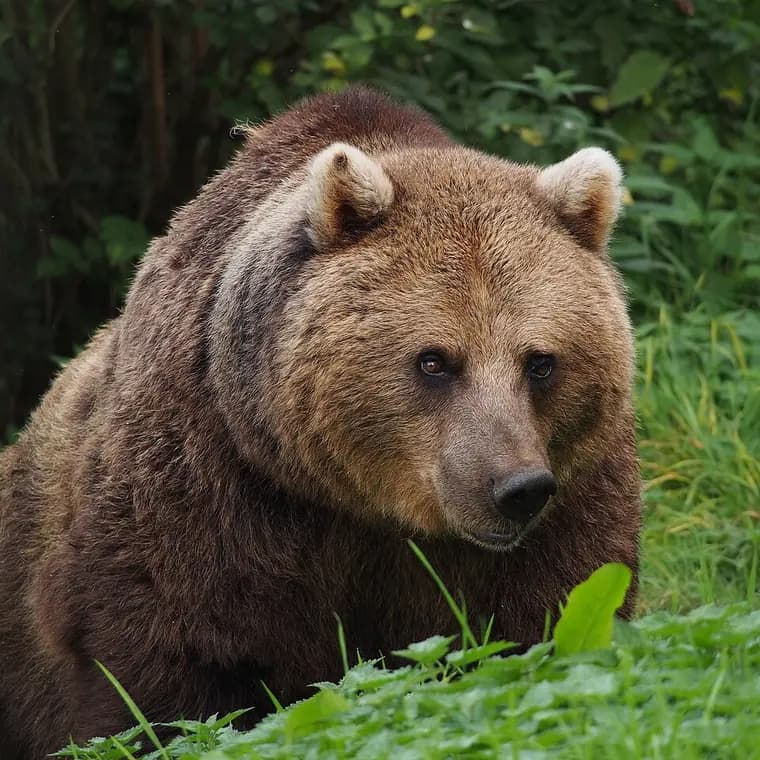
🐻Bears
Bears are carnivoran mammals of the family Ursidae. They are classified as caniforms within the suborder Caniformia. Although only eight species of bears are extant, they are widespread, appearing in a wide variety of habitats throughout most of the Northern Hemisphere and partially in the Southern Hemisphere. Bears are found on the continents of North America, South America, and Eurasia. Common characteristics of modern bears include large bodies with stocky legs, long snouts, small rounded ears, shaggy hair, plantigrade paws with five nonretractile claws, and short tails.
Text: Wikipedia, CC BY-SA 4.0.
The Red List assesses individual species. Each animal in this group has its own status.
- Body mass
- 152 kg
- Body length
- 1.75 m
- Shoulder height
- 0.92 m
- Top speed
- 43 km/h
- Bite force
- 1,436 N
- Maximum lifespan
- 40 years
Everything we know about Bears
Typical adult figures. Where a value is an estimate rather than a measurement, it says so.
Body mass152 kgaverage46–372 kg · range across the groupaggregated across membersDetails ↓Hide ↑
range across 8 member species
Body length1.75 maverage1.31–2.29 m · range across the groupaggregated across membersDetails ↓Hide ↑
range across 8 member species
Shoulder height0.92 maverage0.68–1.45 m · range across the groupaggregated across membersDetails ↓Hide ↑
range across 7 member species
Top speed43 km/haverage39–47 km/h · range across the groupaggregated across membersDetails ↓Hide ↑
range across 2 member species
Bite force1,436 Naverage751–2,121 N · range across the groupaggregated across membersDetails ↓Hide ↑
range across 2 member species
Brain mass333 gaverage243–476 g · range across the groupaggregated across membersDetails ↓Hide ↑
range across 8 member species
Maximum lifespan40 yearsaverage34–50 years · range across the groupaggregated across membersDetails ↓Hide ↑
range across 8 member species
Generation length12 yearsaverage9.99–16 years · range across the groupaggregated across membersDetails ↓Hide ↑
range across 8 member species
Age at maturity4.5 yearsaverage1,015–2,413 days · range across the groupaggregated across membersDetails ↓Hide ↑
range across 8 member species
Gestation151 daysaverage91–226 days · range across the groupaggregated across membersDetails ↓Hide ↑
range across 8 member species
Litter sizeabout 2average1.1–2.46 · range across the groupaggregated across membersDetails ↓Hide ↑
range across 8 member species
Home range12,937 km²average0.7–77,270 km² · range across the groupaggregated across membersDetails ↓Hide ↑
range across 6 member species
Population density0.32 per km²average0.01–1.21 per km² · range across the groupaggregated across membersDetails ↓Hide ↑
range across 6 member species
average = a mean across sexes or species in a group.
Family tree
- classMammals · Mammalia
- superorderLaurasiatheria
- orderCarnivorans · Carnivora
- suborderCaniformia
All 12 branches ↓Fewer branches ↑
- kingdomMetazoa
- phylumChordata
- subphylumCraniata
- subphylumVertebrata
- superclassGnathostomata
- superclassSarcopterygii
- superclassTetrapoda
- classMammals · Mammalia
- subclassTheria
- superorderLaurasiatheria
- orderCarnivorans · Carnivora
- suborderCaniformia
More about Bears


Animals caught on camera
Real footage of the animals on this site — hunting, fighting, and getting on with it.
Compare Bears
Pick a tool — Bears are already selected.
Compare every stat with any other animal.
Stand them on the same floor and see who's bigger.
How speed, brain and bite scale with body size. This group isn't in the sample yet.
See where it sits in the tree of life.