
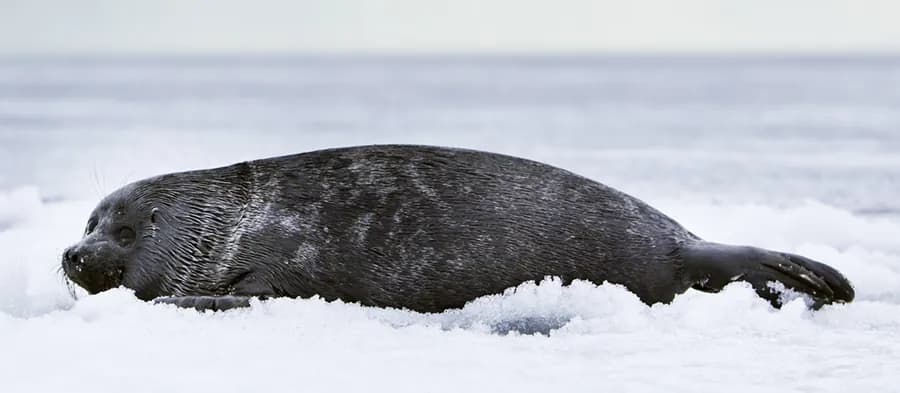
🦭Baikal Seal
The Baikal seal, also known as Lake Baikal seal or nerpa, is a species of earless seal endemic to Lake Baikal in Siberia, Russia. The Baikal seal is one of the smallest earless/true seals, and one of the few exclusively freshwater pinniped species. The related Caspian seal inhabits another lake, albeit being saltwater, the Caspian Sea. Both species are closely related to the ringed seal, which inhabits the Arctic Ocean.
Text: Wikipedia, CC BY-SA 4.0.
IUCN Red List assessment, 2016.
- Body mass
- 90 kg
- Body length
- 1.35 m
- Shoulder height
- not recorded
- Top speed
- not recorded
- Bite force
- not recorded
- Maximum lifespan
- 56 years
Everything we know about the Baikal Seal
Typical adult figures. Where a value is an estimate rather than a measurement, it says so.
Body mass90 kgrecord 90 kg · SeaLifeBaseCOMBINEOther figures ↓Hide ↑
Record: largest individual on record
Source: COMBINE · v1 (Soria et al. 2021) · CC BY 4.0
Figures vary
- 90 kgAnAgeAnAge build 15, 2023-07-03 (HAGR)data quality: acceptable
Body length1.35 mCOMBINEOther figures ↓Hide ↑
Source: COMBINE · v1 (Soria et al. 2021) · CC BY 4.0
Figures vary
- 1.4 mSeaLifeBasev25.04
Brain mass194 gCOMBINEDetails ↓Hide ↑
Source: COMBINE · v1 (Soria et al. 2021) · CC BY 4.0
Maximum lifespan56 yearsCOMBINEOther figures ↓Hide ↑
Source: COMBINE · v1 (Soria et al. 2021) · CC BY 4.0
Figures vary
- 56 yearsAnAgeAnAge build 15, 2023-07-03 (HAGR)data quality: acceptable
Generation length22 yearsCOMBINEDetails ↓Hide ↑
Source: COMBINE · v1 (Soria et al. 2021) · CC BY 4.0
Age at maturity6.2 yearsCOMBINEDetails ↓Hide ↑
Source: COMBINE · v1 (Soria et al. 2021) · CC BY 4.0
Gestation276 daysCOMBINEOther figures ↓Hide ↑
Source: COMBINE · v1 (Soria et al. 2021) · CC BY 4.0
Figures vary
- 273 daysAnAgeAnAge build 15, 2023-07-03 (HAGR)data quality: acceptable
Litter size1COMBINEOther figures ↓Hide ↑
Source: COMBINE · v1 (Soria et al. 2021) · CC BY 4.0
Figures vary
- 1.02AnAgeAnAge build 15, 2023-07-03 (HAGR)data quality: acceptable
Trophic levelCarnivoreCOMBINEDetails ↓Hide ↑
Source: COMBINE · v1 (Soria et al. 2021) · CC BY 4.0
Activity cycleCrepuscular / mixedCOMBINEDetails ↓Hide ↑
Source: COMBINE · v1 (Soria et al. 2021) · CC BY 4.0
Population density1.58 per km²COMBINEDetails ↓Hide ↑
Source: COMBINE · v1 (Soria et al. 2021) · CC BY 4.0
Volume l90 LaverageDetails ↓Hide ↑
Body mass at ~1.0 kg/L, the density of vertebrate tissue.
average = a mean across sexes or species in a group.
Not recorded for Baikal Seal yet: shoulder height, top speed, bite force.
Family tree
- kingdomAnimalia
- ›phylumChordata
- ›classMammalia
- ›orderCarnivora
- ›familyPhocidae
- ›genusPusa
- ›speciesPusa sibirica
- classMammals · Mammalia
- orderCarnivorans · Carnivora
- familyPhocidae
- genusPusa
All 14 branches ↓Fewer branches ↑
- kingdomMetazoa
- phylumChordata
- subphylumCraniata
- subphylumVertebrata
- superclassGnathostomata
- superclassSarcopterygii
- superclassTetrapoda
- classMammals · Mammalia
- subclassTheria
- superorderLaurasiatheria
- orderCarnivorans · Carnivora
- suborderCaniformia
- familyPhocidae
- genusPusa
More about the Baikal Seal


Animals caught on camera
Real footage of the animals on this site — hunting, fighting, and getting on with it.
Compare the Baikal Seal
Pick a tool — the Baikal Seal is already selected.
Compare every stat with any other animal.
Stand them on the same floor and see who's bigger.
How speed, brain and bite scale with body size. This animal isn't in the sample yet.
See where it sits in the tree of life.