
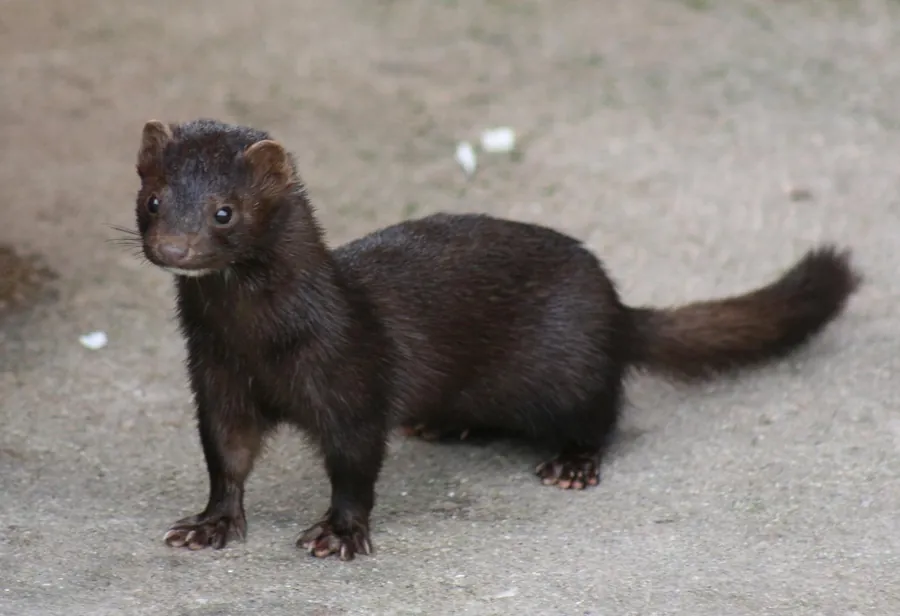
🦡American mink
The American mink is a semiaquatic species of mustelid native to North America, though human introduction has expanded its range to many parts of Europe, Asia, and South America. Because of range expansion, the American mink is classed as a least-concern species by the IUCN. The American mink was formerly thought to be the only extant member of the genus Neovison following the extinction of the sea mink (N. macrodon), but recent studies, followed by taxonomic authorities, have reclassified it and the sea mink within the genus Neogale, which also contains a few New World weasel species. The American mink is a carnivore that feeds on rodents, fish, crustaceans, frogs, and birds. In its introduced range in Europe it has been classified as an invasive species linked to declines in European mink, Pyrenean desman, and water vole populations. It is the animal most frequently farmed for its fur, exceeding the silver fox, sable, marten, and skunk in economic importance.
Text: Wikipedia, CC BY-SA 4.0.
IUCN Red List assessment, 2016.
- Body mass
- not recorded
- Body length
- not recorded
- Shoulder height
- not recorded
- Top speed
- not recorded
- Bite force
- not recorded
- Maximum lifespan
- not recorded
Everything we know about the American mink
Typical adult figures. Where a value is an estimate rather than a measurement, it says so.
No measurements for American mink yet.
Family tree
Lineage not available yet.
More about the American mink
Animals caught on camera
Real footage of the animals on this site — hunting, fighting, and getting on with it.
Compare the American mink
Pick a tool — the American mink is already selected.
Compare every stat with any other animal.
Stand them on the same floor and see who's bigger.
How speed, brain and bite scale with body size. This animal isn't in the sample yet.
See where it sits in the tree of life.