
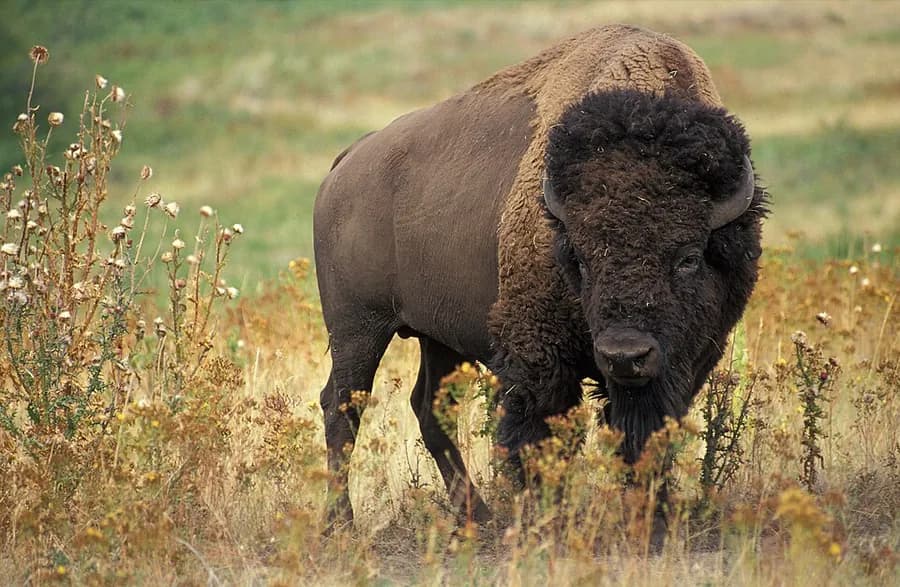
 🦬
Photo: Jack Dykinga · Public domain
🦬American bison
The American bison, commonly known as the American buffalo, or simply buffalo, is a species of bison that is endemic to North America. It is one of two extant species of bison, along with the European bison. Its historical range circa 9000 BC is referred to as the great bison belt, a tract of rich grassland spanning from Alaska south to the Gulf of Mexico, and east to the Atlantic Seaboard, as far north as New York, south to Georgia, and according to some sources, further south to northern Florida, with sightings in North Carolina near Buffalo Ford on the Catawba River as late as 1750.
Text: Wikipedia, CC BY-SA 4.0.
IUCN Red List assessment, 2017.
- Body mass
- 625 kg
- Body length
- 2.9 m
- Shoulder height
- 1.66 m
- Top speed
- 52 km/h
- Bite force
- not recorded
- Maximum lifespan
- 33 years
Everything we know about the American bison
Typical adult figures. Where a value is an estimate rather than a measurement, it says so.
Body mass625 kgCOMBINEOther figures ↓Hide ↑
Source: COMBINE · v1 (Soria et al. 2021) · CC BY 4.0
Figures vary
- 630 kgAnAgeAnAge build 15, 2023-07-03 (HAGR)data quality: high
Body length2.9 mCOMBINEDetails ↓Hide ↑
Source: COMBINE · v1 (Soria et al. 2021) · CC BY 4.0
Shoulder height1.66 maverage1.54–1.76 m · range across sexesOther figures ↓Hide ↑
Species-level value synthesised as the mean of: female, male.
By sex
- Male1.76 mMeagher 1986, Mammalian Species 266, p.1Value is the midpoint of the published range.
- Female1.54 mMeagher 1986, Mammalian Species 266, p.1Value is the midpoint of the published range.
Top speed52 km/hDetails ↓Hide ↑
Sprint over a short distance, not a sustained pace. Compilations give 52.0 and 54.43 km/h.
Source: Christiansen 2002, Zool J Linn Soc 136:685 and Bejan & Marden 2006, J Exp Biol 209:238; compiled in Hirt et al. 2017, Nat Ecol Evol 1:1116, Supplementary Data · see citation
Brain mass334 gCOMBINEDetails ↓Hide ↑
Source: COMBINE · v1 (Soria et al. 2021) · CC BY 4.0
Maximum lifespan33 yearsCOMBINEOther figures ↓Hide ↑
Source: COMBINE · v1 (Soria et al. 2021) · CC BY 4.0
Figures vary
- 34 yearsAnAgeAnAge build 15, 2023-07-03 (HAGR)data quality: high
Generation length12 yearsCOMBINEDetails ↓Hide ↑
Source: COMBINE · v1 (Soria et al. 2021) · CC BY 4.0
Age at maturity2.5 yearsCOMBINEDetails ↓Hide ↑
Source: COMBINE · v1 (Soria et al. 2021) · CC BY 4.0
Gestation274 daysCOMBINEOther figures ↓Hide ↑
Source: COMBINE · v1 (Soria et al. 2021) · CC BY 4.0
Figures vary
- 274 daysAnAgeAnAge build 15, 2023-07-03 (HAGR)data quality: high
Litter size1COMBINEOther figures ↓Hide ↑
Source: COMBINE · v1 (Soria et al. 2021) · CC BY 4.0
Figures vary
- 1AnAgeAnAge build 15, 2023-07-03 (HAGR)data quality: high
Trophic levelHerbivoreCOMBINEDetails ↓Hide ↑
Source: COMBINE · v1 (Soria et al. 2021) · CC BY 4.0
Activity cycleCrepuscular / mixedCOMBINEDetails ↓Hide ↑
Source: COMBINE · v1 (Soria et al. 2021) · CC BY 4.0
Home range47 km²COMBINEDetails ↓Hide ↑
Source: COMBINE · v1 (Soria et al. 2021) · CC BY 4.0
Population density0.15 per km²COMBINEDetails ↓Hide ↑
Source: COMBINE · v1 (Soria et al. 2021) · CC BY 4.0
Volume l625 LaverageDetails ↓Hide ↑
Body mass at ~1.0 kg/L, the density of vertebrate tissue.
average = a mean across sexes or species in a group.
Not recorded for American bison yet: bite force.
Family tree
- kingdomAnimalia
- ›phylumChordata
- ›classMammalia
- ›orderArtiodactyla
- ›familyBovidae
- ›genusBison
- ›speciesBison bison
- classMammals · Mammalia
- orderEven-toed hoofed animals · Artiodactyla
- familyBovidae
- subfamilyBovinae
All 15 branches ↓Fewer branches ↑
- kingdomMetazoa
- phylumChordata
- subphylumCraniata
- subphylumVertebrata
- superclassGnathostomata
- superclassSarcopterygii
- superclassTetrapoda
- classMammals · Mammalia
- subclassTheria
- superorderLaurasiatheria
- orderEven-toed hoofed animals · Artiodactyla
- suborderRuminantia
- infraorderPecora
- familyBovidae
- subfamilyBovinae
More about the American bison


Animals caught on camera
Real footage of the animals on this site — hunting, fighting, and getting on with it.
Compare the American bison
Pick a tool — the American bison is already selected.
Compare every stat with any other animal.
Stand them on the same floor and see who's bigger.
Does it punch above its weight? Its stats against what body size predicts.
See where it sits in the tree of life.